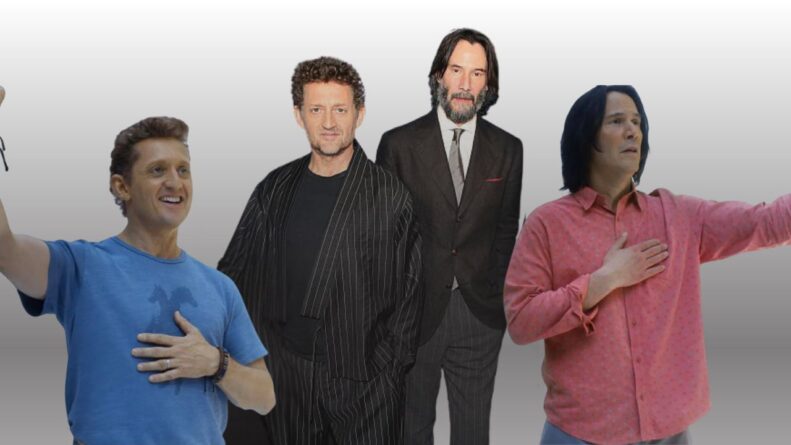
Keanu Reeves & Alex Winter Reunite on Broadway — and Tease Bill & Ted 4
Keanu Reeves and Alex Winter reunite on Broadway, sparking excitement as they tease the long-awaited Bill & Ted 4. Fans can’t wait for this iconic return!
The surprise pairing of Keanu Reeves and Alex Winter on the hallowed stage of Broadway — not as Bill S. Preston, Esq. and Ted “Theodore” Logan, but as the philosophical hoboes Vladimir and Estragon — has come into focus with the future of their beloved time-traveling franchise. Their joint venture into Samuel Beckett’s absurdist classic, Waiting for Godot, has not only reinforced their decades-long friendship, but has also served as the perfect, lofty-art soapbox to announce that a fourth movie venture is in the works: Bill & Ted 4.
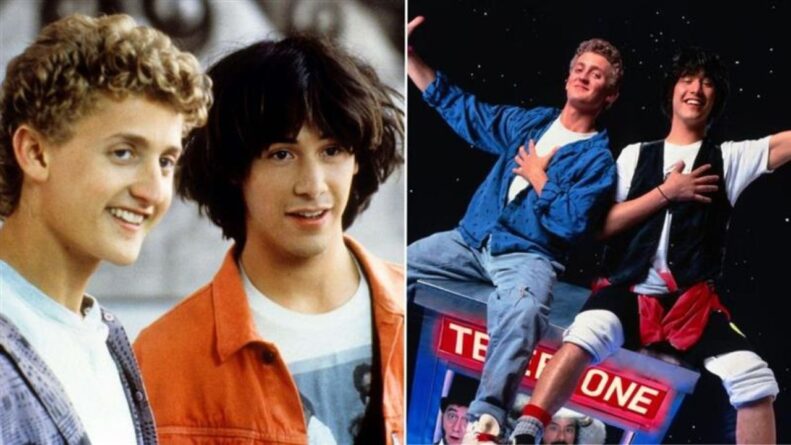
Thirty-five years since they first prompted the world to “Be excellent to each other and party on, dudes,” Keanu Reeves and Alex Winter return as our spotlighted guides through space and time, swapping their time traveling phone booth for the desolate stage of the Hudson Theatre in New York. The impetus for the latest resurgence of affection for the Bill & Ted franchise is their critically lauded Broadway revival of Waiting for Godot.
The reunion itself is a “crazy, inspired idea” dreamed up by Reeves, marking his Broadway debut and Winter’s first time back on stage in 40 years. Playing Vladimir (Winter) and Estragon (Reeves), the pair represents yet another set of lifelong friends desperately waiting for a fate that may we see ahead, a thematic resonance observers characterized as feeling “like ‘Bill and Ted’ on steroids”. Variety Shared, Winter recognized that the association was inescapable, saying, “We are inextricably Bill and Ted. So there’s going to be an element of that in there, because that’s who we are.”
While the Broadway reunion is a cultural landmark event, the real adjustment fans need to know about is around the back. Alex Winter has now delivered the most definitive confirmation to date on the possibility of a future film in the series, indicating that a fourth film is “slowly but surely happening”. More importantly, Winter confirmed that original screenwriters Chris Matheson and Ed Solomon have written a pitch for the sequel.
People catch longtime friends, Winter has confirmed the concept is indeed “really good, obvious really good.” while still keeping the plot under wraps. This caginess sets the creative tone of actors In The Room Clearly They Know What They Are Doing. Winter has stated that the films “have never been cash grab movies,” and they make them ” sincerely from a place of love and interest,” that is a bar they expect to clear for any further entries.
The lifelong friendship and professional partnership that Keanu Reeves and Alex Winter cultivated is essential to the continued viability of the Bill & Ted IP. The two actors reunited for the TV movie Bogus Journey in 1991 and then for a third time in 2020’s Face the Music. The lasting quality of their relationship, which has spanned over 30 years now, is the real emotional heart that grounds the often-absurd science fiction conceit of the movies.
The current project, the Broadway revival of Samuel Beckett’s Waiting for Godot, has been a conscious decision for the actors to reunite, this time outside of the well-formed characters of Bill and Ted. Previews began September 13th for the, production was led by Reeves, who came to Winter with the “crazy, inspired idea” of doing the monumental play, leading one’s debut on Broadway and here for Winter after four decades.
Read More :- Elizabeth Olsen’s MCU Return: The Truth Behind the Headlines
Using Godot as the reunion mechanism operates as a sly, brainy hook to a potential sequel. The overarching fear in Bill & Ted Face the Music was failure: the now-middle-aged pair still hadn’t written the world-saving song foretold in the first films. Their constant nervous, procrastinated fate-perversion — waiting for inspiration, waiting for success — is a direct reflection of Vladimir and Estragon’s long, agonizing wait in Godot.
In staging a play about which the whole point is to wait for salvation, Reeves and Winter are making a conscious, profound statement about their characters’ mythology, and laying the psychological foundation for a fourth film about whether Bill and Ted ever really fulfilled their destiny.
The reunion of Keanu Reeves and Alex Winter on Broadway is the cultural and psychic engine powering the next chapter of the Bill & Ted saga. The friendship, boosted up by Waiting for Godot’s gravitas, not only reaffirms their unique connection, but reveals a mutual willingness to risk going further creatively.
The participation of Bill & Ted series stars Reeves and Winter as well as original writers Matheson & Solomon means that Bill & Ted 4 will be a strong, idea-led concept, and that it will live up to the high standards the fans expect and demand.
There is plenty of “real” friendship and proven digital profitability plus renewed artistic collaboration of the three leads to suggest that a third film is a matter of when, not if. The upcoming episode is set to capitalize on the digital market and offer the very particular cocktail of hopefulness and the absurd that people seem to keep wanting more of from Bill and Ted.
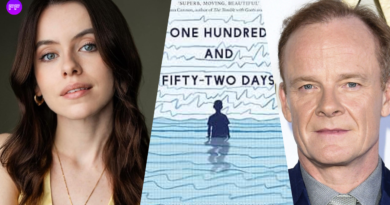
Outlander star Rosie Day makes her powerful directorial debut in One Hundred and Fifty-Two Days with Alistair Petrie and Roman Griffin-Davis. Full details here.
Outlander Star Rosie Day is making her directorial debut with One Hundred and Fifty-Two Days, a powerful British cinema project. There’s a particular kind of enchantment that takes place when an actor who has been poked and prodded and told what to do for most of their life steps behind the camera. They don’t just make a movie, they curate a performance. British cinema, 2026 appears to be staking out the title of year of the actor-auteur. First up was Outlander Star Rosie Day. If you don’t know her by that name, then you will know her as the tough Mary Hawkins in Outlander or the quietly brutal lead in The Seasoning House.
But now, Outlander Star Rosie Day is swapping the corset for the director’s monitor to make her feature directorial debut with One Hundred and Fifty-Two Days – it seems less a debut and more a manifesto. Starring powerhouse talent such as Alistair Petrie (The Night Manager), Roman Griffin-Davis (Jojo Rabbit), and Alice Lowe (Timestalker) this isn’t just another indie drama — it’s a “a sucker punch to the heart.”
Outlander Star Rosie Day career has been shaped by parts that require her to be emotionally and physically tough. Mary Hawkins in Starz’s Outlander Star Rosie Day, which made her deal with complex trauma, sexual assault and historical repression. Likewise, The Seasoning House (her starring role) allowed Gara to express deep emotions with very little verbal exchange.
Outlander Star Rosie Day has never been afraid to explore the darker corners of human life. Acting, writing her hit book Instructions for a Teenage Armageddon – her goal has always been to “give the microphone back” to young people.
Statement on the production Day described the visceral impact of the script:
“One Hundred and Fifty Two Days is a deeply moving and powerful piece, with its hilarious moments perfectly balanced by tears. There’s a rarely seen screenplay that makes you experience so many feelings and turns that I can tell you this is a very moving experience.”
That quote is indicative of the film’s tone. This is not to imply that Day is turning out a grim melodrama. “Laughing” could indicate she’s embracing the absurdity of grief—strange encounters along the way, the dark comedy of hospitals and, yes, the grandmother figure. She added further about her excitement to ensemble:
“It’s going to be an amazing ride to watch, and I can’t wait to see where it goes!”
An otherwise undisclosed member of the writing duo, Giles Paley-Phillips (involved from the outset) has co-written the screenplay. He has spoken of the journey as being:
“I’m so grateful to be on this amazing journey working with such an incredible team and creative minds to tell this story. This is really rewarding on a personal level, and I’m very lucky to be doing it.”
The “personal” nature of this may be that it is autobiographical to some extent: Paley-Phillips has openly talked about losing his mother and how grief has influenced his life and his work. When a writer films their own story, especially one involving personal trauma, there is usually greater truth to the emotional story.
The pairing with Elizabeth Morris is a strategic one, Morris presumably grounds Paley-Phillips’s poetic tendencies with the requisite structural discipline of screenwriting.
The narrative of One Hundred and Fifty-Two Days is almost sadly poetic.
He must mourn from afar, stuck in medical limbo. It’s a story about the 152 days that define a life — a “blank” moment during which everything stops, yet everything changes.
The casting of One Hundred and Fifty-Two Days demonstrates a conscious effort to mix star appeal with proven character-actor skill.
| Actor | Known For | Narrative Archetype | Key Plot |
| Roman Griffin | Jojo Rabbit, Silent Night | The Boy (Protagonist) | After Jojo Rabbit, we know he can hold the weight of a film’s soul on his shoulders. |
| Alistair Petrie | The Night Manager, Sex Education | The Father (Likely) | Specializes in repressed authority figures. Perfect for a father who uses silence and rigidity (or alcohol) as a shield against grief. |
| Alice Lowe | Timestalker, Prevenge | Physiotherapist / Relative | Known for dark comedy. Will likely inject the “laugh” element Rosie Day mentioned, preventing the film from becoming maudlin. |
| Annette Badland | Ted Lasso, Outlander | The Grandmother (Likely) | A veteran character actress capable of great warmth and steel. A former colleague of Day from Outlander. |
| Paterson Joseph | Wonka, Peep Show | Doctor / Mentor | brings a charismatic gravitas. Can play the “institutional face” of the hospital or a supportive family friend. |
Both the book and its later film version are profoundly resonant with our collective experience of the COVID-19 pandemic, though they were imagined well before its arrival. Its portrayal of a respiratory disease that causes isolation and separation is uncannily reminiscent of what people around the world are experiencing. This link lets viewers infuse their own recollections of lockdown, loss, and resilience into the story.
Under Outlander Star Rosie Day direction, the film turns into a bittersweet portrayal of shared trauma, affirming the anguish of separation and the emotional impact of medical crises on people and families as a whole.
The film is about grief and the male frailty and it subverts all the expected ones. By introducing the character of the “whimsical grandmother” as a vehicle for the grieving process being non-linear, it suggests the presence of life and death simultaneously and encourages the main character to live while losing. This say-turning laughter and tears up the complexity of loss. And the fact that they’re allowed to be vulnerable men and that is important in itself.
The Boy’s vulnerability and need for guidance stand in stark contrast to the Father’s repressed emotions, represented by his struggle with alcoholism. These aspects serve to demonstrate that mental health care, and particularly that of teenage boys and men, can be treated with compassion and realism — before our very eyes, in true Day fashion.
Outlander Star Rosie Day and Alistair Petrie, in fairness, aren’t just colleagues, they have a professional shorthand. Previously seen together at industry functions such as The Uninvited screening last year, it’s probably a safe assumption that their relationship brings a sense of trust on set that you can’t just make up.
When a director and their lead actor “speak the same language”, the performance is usually ten times stronger.
Read More 👉 ‘A Knight of the Seven Kingdoms’ Episode 5 Hailed as a Masterpiece in the Game of Thrones Universe
Don’t expect your typical “hospital movie.” Since the original book was written in free verse, expect the film to rely on silence and visual metaphors rather than heavy dialogue.
Rosie Day’s previous short films, like Tracks, have told us she’s a filmmaker who can make the most of every moment on screen. In One Hundred and Fifty-Two Days, she is transposing poetry’s “white space” to the “quiet space” of cinema.
Verdict: This is a film about male vulnerability, the absurdity of grief, and the odd people (an “erratic” grandmother or a no-nonsense physiotherapist) who reel us back into the living world.
One Hundred and Fifty-Two Days would undoubtedly be a milestone in British film making when it is completed in 2027. This film elevates the basic tenets of the best-seller adaptation formula with an organic synthesis of art and commerce.
Outlander Star Rosie Day, making the leap from in front of the camera, applies her “teenage armageddon” concept to a sensitivity study of male frailty. Alistair Petrie assumes a role that questions his hardline authoritarian identity, with the pandemic shadowing, highlighting themes of solitude and reflection.
What makes the project unique, however, is its subtle narrative — about a boy fighting for breath — told by a director who is dedicated to telling the stories of young people. Should Day get her wish and meld emotional grit with comic relief, she’ll be further established as a sensitive auteur reflecting on the mess of being.
Production is underway on Britain’s craggy northern shoreline for what could be another classic of modern British social realism.
Get all the details from the latest upgradation and evolution in FandomFans is a digital publication to share, engage, and inspire from movies, TV shows, webseries, and celebrities. Get reliable, accurate, and insightful updates, reviews, and details crafted for the entertainment enthusiast
Juliette Binoche steps behind the camera with her feature film debut In-Eye in Motion and reveals a powerful and emotional creative transformation. Read more!
When you think of Juliette Binoche, the Oscar-winning French actress known for some of the film industry’s most iconic roles immediately comes to mind. But the iconic actress told Sisters in Cinema at the Red Sea Film Festival in Jeddah récemment that transforming an already extraordinary career in a surprising new direction – she’s not just acting anymore. She is going behind the lens and the tales she is telling are very personal, emotionally raw and fascinating.
In-I In Motion is also Binoche’s first film as director, and it’s nothing like the standard debut film you’d expect. The French actress Charlotte Gainsbourg decided to film something almost too personal, her own story of learning dances. The film chronicles her tempestuous and terrifying 18 months of creating and performing a daring dance show with British dance legend Akram Khan in 2007.
The origin of this piece of work together is wonderfully serendipitous. Binoche remembers being rubbed down by Su-Man Hsu in London when In a completely spontaneous moment she said “yes” in response to a simple question:
“Do you want to dance?”
That took us to Akram Khan’s stunning show, and finally, for just two or three days, to jam as improvisers. But that brief meeting ignited a magical chemistry that would lead them on a mutually transforming creative journey.
What is extraordinary about “In-I In Motion” is not just that Binoche chose to dance professionally at an age when most people would consider such a leap foolhardy. It is that she had the guts to shoot the whole thing— all 170 hours of raw, occasionally chaotic footage and then cut it into a film that is intellectually provocative, politically aware and genuinely tearful. The film doesn’t hide from vulnerability. Binoche speaks candidly about her fears and even relives past traumas, revealing the physical and emotional cost of making art at such a high degree.
The road to finishing this movie was nearly as difficult as bringing the dance show to life. Converting old tapes, obtaining music licensing for each song run in rehearsals, and trying to manage the massive amounts of footage pushed Binoche to her breaking point. During the editing process, she cycled between bouts of intense happiness and hopelessness, at times believing that the whole thing was going nowhere. But she persisted, ultimately adding several editors and formulating a visual strategy, shooting each scene as a photograph to help conceptualize the abstract material that enabled her to pare down a nine-hour first cut into the final film.
“Every night I thought I wasn’t going to make it through this show – it was so exhausting physically and emotionally,”
—she recalls.
That was the feeling every night. Yet this openness is exactly what makes her work so powerful.
Though “In-I In Motion” establishes Binoche as a director, she has not given up acting by any means. At the Red Sea Festival she spoke about “Queen at Sea,” the next movie from director Lance Hammer (the Sundance darling “Ballast”).The film features an outstanding ensemble cast including Oscar-nominated Tom Courtenay, Emmy-winning Anna Calder-Marshall, and “Bridgerton” breakout Florence Hunt.
The story alone is enough to make you emotional. Binoche is a woman who moves to London with her adolescent daughter to look after her aging mother. But this is no mere family drama. Deftly handling one of the most challenging and deeply human topics — Alzheimer’s disease — the movie examines the profoundly emotional and ethical dilemmas of facing the boundaries of what we can (and whether we should) do for someone we love.
“It’s about Alzheimer’s, and about what you can and what you cannot do for a person who has that disease,” says Binoche cautiously,
As she does want to keep the emotional punch of the movie intact. So, the audience could feel deep during the moments. It’s one of the qualities which makes her an incredible performer.
“It asks important questions, especially when it comes to three different generations.”
This emphasis on multiple generations is said to provide a nuanced look at the obligations family members owe each other, love and harsh truths about growing old.
She also is working on an ultimate journey project, “Merci Charlotte,” a collaboration with a Turkish filmmaker that delves in similarly engaging human terrain.
The story focuses on the bond between Binoche and a young boy (under 10 years old) from Turkey.
What is especially extraordinary about Binoche’s first-time director and these continuing projects is how they show the path of her growth as an artist. She has never backed away from testing her limits,whether studying under demanding directors such as Kieslowski or Kiarostami or by challenging her body and emotions on the dance floor. Now, with real directing credits under her belt, she is ready to take that same fearless eye to the story telling form itself.
She received a special tribute at the Red Sea Festival and even met with celebrated director Sean Baker, director of “Anora.” The pair of Oscar winners have “exchanged numbers,” Binoche gushed about working with him. But if that team-up comes to fruition or not, one thing’s for certain: Juliette Binoche is not yet done surprising us.She’s become a full-fledged filmmaker — as a vulnerable person on screen and one who can make the camera tremble from behind it.
Read More 👉 James Gunn Confirms: The Long-Awaited Supergirl Teaser Is Coming This Week!
The turn to directing for Juliette Binoche represents a daring and intimate new phase in her professional life. With In-I In Motion, she transposes her vulnerabilities into art and shows that she is as intrepid behind the camera as she is before it. Her upcoming projects, including Queen at Sea and Merci Charlotte, continue to reflect her dedication to truthful, emotionally driven narratives. If anything is clear, Binoche isn’t simply stretching out her talents; she’s reimagining them, and she has only just gotten started.
Fandomfans is focusing on celebrities’ journey from a simple acting role to a legendary directorial debut which makes them unstoppable, catching up with us on your favorite celebrity’s outlook.