

Richard Linklater is known for his temporal distortions, which he often varies over the course of decades, as in the Before trilogy or Boyhood. But in his 2025 magnum opus, Blue Moon, he does something radically different. He condenses the crushing burden of an entire career going down the tubes into a single confining night in the bowels of Sardi’s restaurant.
This movie is not simply a biopic, it’s a chamber piece on the brutal architecture of artistic mourning. It is March 31, 1943, and with these words the film memorializes the end of the Jazz Age, which was immediately supplanted by the “golden age” of the musical theater.
Larry Hart’s Emotional Unraveling Inside the Walls of Sardi’s
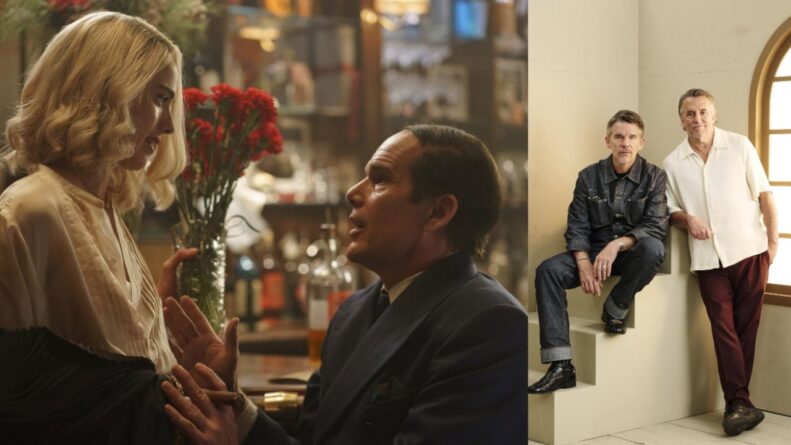
The setup is ruinously straightforward. Lorenz “Larry” Hart (an electric Ethan Hawke), the brilliant, jaded lyricist half of the legendary Rodgers and Hart team, is holding up the bar at Sardi’s.

Just across the street, his one-time soul mate and partner, Richard Rodgers, is debuting Oklahoma! with another partner, Oscar Hammerstein II. Hart must wait in the limbo of the restaurant, the muted applause he can hear is the sound of him being made redundant.
Linklater has said the film “Deals with a trauma that is, in a way, two-fold.”
This is not just a business split, it’s an artistic divorce between two men who defined an era together. Rodgers, the practical puppet master, had to change in order to live, to detach himself from Hart’s chaotic alcoholism and revue-style wit to something more formal and honest. Hart, the poetic soul of the roaring twenties, was just abandoned.
Read More 👉 Martin Gero and Amazon MGM Studios is looking for a New Cast for The Military Sci-Fi Series
Ethan Hawke’s Career-Defining Transformation as Lorenz Hart
The brilliance of Blue Moon is that it knows how to wait. According to The Guardian, Linklater and Hawke had been thinking about this film for more than ten years. Linklater famously told Hawke years ago,
“I’ll wait 10 years,”
Knowing the actor had to age into the role. To play the battered, gnome-like figure of the 47-year-old Hart, a guy worn down by drink and depression, he had to lose his youthful boyishness.

That prolonged timeline gives the film a deep, lived-in sadness. We see Hart desperately go through the motions of his old self — flirting, quipping, drinking trying to drown out the scary fact that the society he helped shape has no use for him anymore. He derides the “corny” nostalgia of Oklahoma! and cannot understand why the audience’s preference has moved away from his urbane sophistication to simple country sweetness.
Blue Moon Feels Like a Love Letter to Forgotten Artists
“We all think we’re gonna run the table forever but tastes can change,” Linklater says in the production notes.
That is the film’s haunting thesis. Blue Moon is a monument to the “loser” of historical change. It’s a beautiful, sad recognition that sometimes even the most brilliant cultural architects find themselves trapped in the past, watching the future being built just down the street without them.
Conclusion
Blue Moon isn’t merely a movie — it’s an elegy. Linklater creates a haunting reflection on change, mourning and the slow brutality of time. The film, anchored by Ethan Hawke’s brilliant performance, reminds us that even the most brilliant creative minds can quickly become relics. It’s a masterwork of stillness, sorrow and storytelling: a paean to those who made the past even as they watched the future speed by.
Our daily coverage brings you the key takeaways, storytelling and pop-culture shifts from cinema. The Fandomfan’s mission is to assist you understand films not just as entertainment, but as cultural events that influence in the world of what we think.