Michael B. Jordan and Ryan Coogler’s ‘Sinners’ Lands Historic Grammy Nods
Michael B. Jordan and Ryan Coogler’s latest project is making headlines with major cultural and cinematic impact.
Published: November 8, 2025, 10:48 am

Michael B. Jordan and Ryan Coogler’s latest project is making headlines with major cultural and cinematic impact.
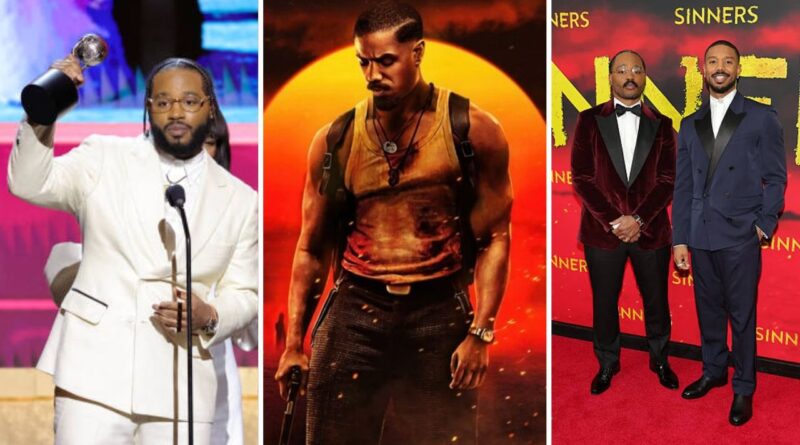
The narrative of ‘Sinners,’ a supernatural Southern Gothic tale from Michael B. Jordan and Ryan Coogler, is evolving further, and now, the hype is surrounding the music. The movie, which has already broken box office records and received high praise for its fearless delving into Black horror and spirituality, just managed to snag a historic five nominations at the 68th Annual Grammy Awards, solidifying its position as one of the most-nominated films in Grammy history.
This isn’t just about counting awards; it is a strong statement about the film’s sound ambition and how the music is integrated in the story telling of the film. The Grammy nods celebrate ‘Sinners’ in key visual media categories, showing that its influence goes well beyond the silver screen.
“Ryan and I, from the very beginning, wanted Sinners to sound like the South remembers — the pain, the hope, the hymns in the dark. These Grammy nods aren’t just for us; they’re for the generations whose voices built that sound. ”
— Michael B. Jordan, in an interview with Variety.
Behind this achievement is the film’s music department, spearheaded by composer Ludwig Göransson. Göransson (who has worked with Coogler previously on Black Panther and Creed) also scored an individual nomination for Best Score Soundtrack for Film/TV. His work on Sinners has been called “haunting” (featuring a desperate gospel sound in the background connecting you into the 1930s Mississippi environment and channeling faith, sin, and survival with every note)The background music isn’t listening noise — it’s emotional, music character that defines the film.
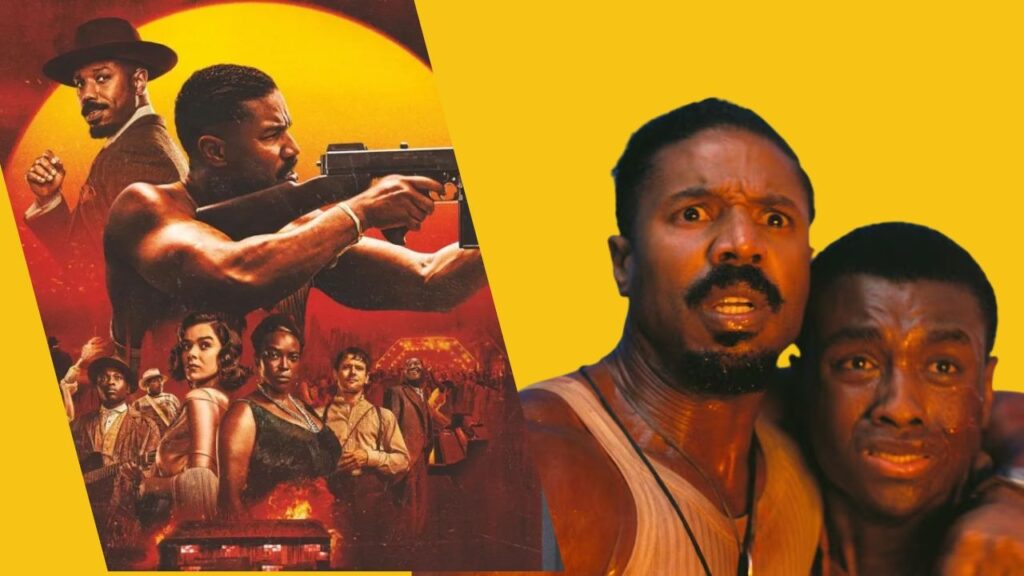
Impact the film had on music is underscored further with three nominations for Best Song Written for Film/TV. The nominations highlight the extraordinary range of the soundtrack, which transitions seamlessly from raw, confessional spiritual blues to cinematic anthems and even poignantly emotional ballads such as I Lied to You.
This hat-trick of awards is a strong indication that the individual songs are connecting with audiences and critics both, and that they capture both the heart and feel of the film.
Read More:- Death by Lightning Review: A Brilliant Yet Hollow Historical Drama That Ends Too Soon
Also on the list is a nod for Best Compilation Soundtrack for Film/TV. This album is a powerful, generational statement that fuses traditional Southern music, gospel, blues, and contemporary voices.It’s a musical extension of the film’s world, providing a unique, culturally definitive sound rooted in the Black southern experience.
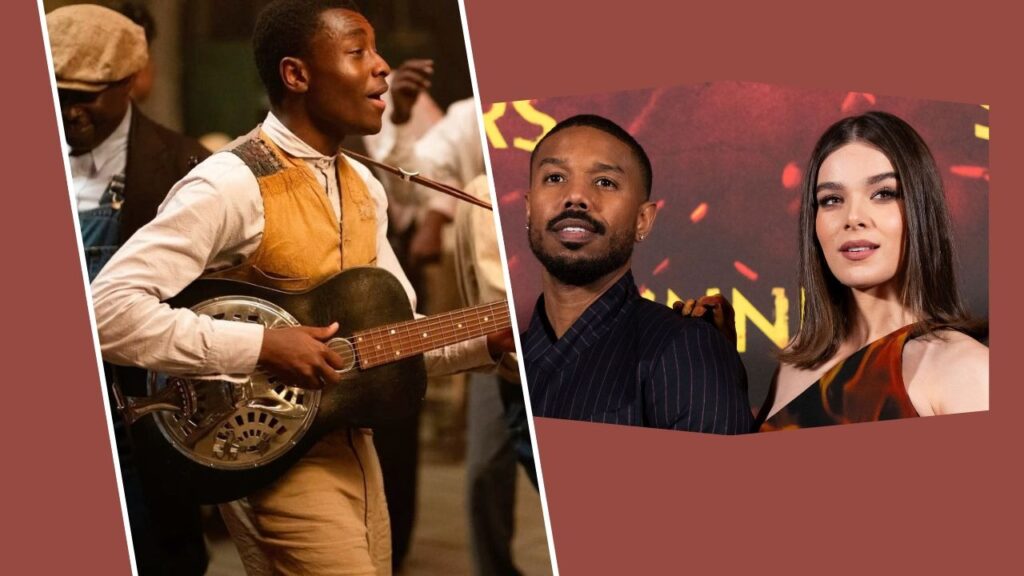
The blockbuster Grammy acknowledgement rounds out an amazing run for Sinners, which has effectively reimagined contemporary Black horror space and showcased where music, identity, and storytelling converge. It joins the ranks of legendary movies such as The Bodyguard and Purple Rain whose music outgrew their medium to become cultural landmarks.

With the 68th annual Grammy Awards coming up on 2/1/26, the pressure is all on Coogler and Jordan’s searing drama. No matter how many golden gramophone trophies it gathers, the film has already established itself as one of the sonically most ambitious and culturally significant works of its era.
At FandomFans, we believe ‘Sinners’ has done more than redefine horror and spirituality on screen — it’s transformed the way we hear them. With Ludwig Göransson’s hauntingly soulful score and a soundtrack that dares to blend genres, the film resonates with emotion and cultural depth far beyond the cinema. Its five Grammy nominations aren’t just recognition; they mark a shift in how Black narratives and music intertwine to express identity, struggle, and faith. Win or lose, ‘Sinners’ has already earned its place among culture-shaping films — one whose sound will echo long after the lights fade.

Explore the Best Sci-Fi fantasy movies in 20th century, such as The Matrix and Blade Runner, that combine philosophy, originality and timeless storytelling.
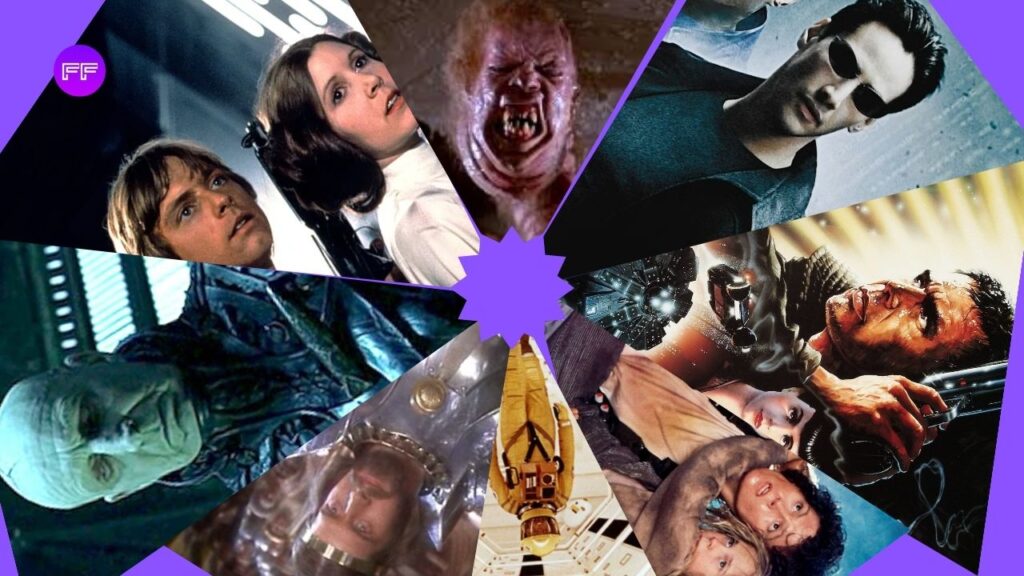
The best sci-fi fantasy movies grain late in the 20th century is wonderful, there’s no denying it. It was a time for practical effects combined with high-concept philosophy, and when “Science Fiction” and “Fantasy” weren’t just about spaceships or swords—they were about what it means to be human.
When we look at some of the absolute giants in the genre, these not only are movies – they are our collective cultural dreams. Take a stroll down a curated list of masterpieces that defined generations.
Before smartphones and everyday online availability existed, The Matrix was an audience mind-melter: What if none of this is real? The film was memorable not just because of its iconic leather trench coats, or pioneering “bullet time” sequences.
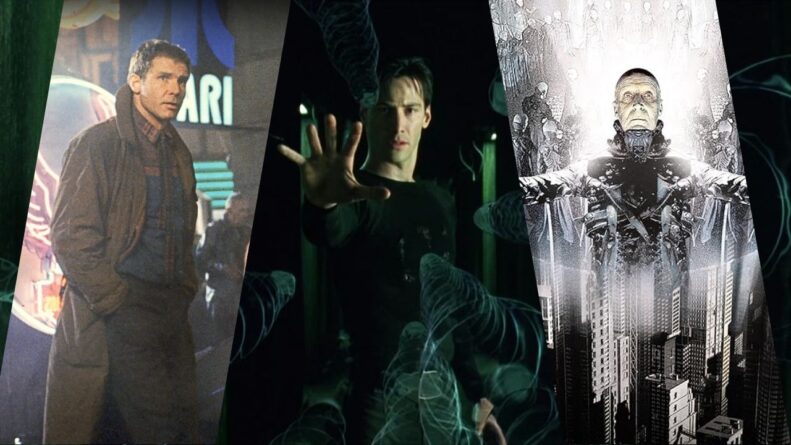
Its real power was in the concept of waking up to a secret truth. Neo’s choice of the Red Pill has become a potent symbol that continues to hold sway. The film was a perfect distillation of the changing of the guard from the gritty, analog 90s “street” culture to the unknown, but pique-inducing digital culture.
| Aspect | Details |
| Directors | Alex Proyas |
| Release Date | 27/February/1998 |
| Runtime | 100 minutes |
| Genre | Science fiction, Mystery, Neo-noir |
| John Murdoch | Amnesiac protagonist discovering his psychic powers to fight the Strangers; played by Rufus Sewell |
| Emma/Anna | Murdoch’s wife, central to his identity quest and emotional arc; played by Jennifer Connelly |
Frequently overlooked in comparison to The Matrix, this noir-infused jewel ought to have a place under the sun (or, more suitably, the perpetual darkness). It’s a visually beautiful mystery about memory and who you are. If The Matrix is about escaping a digital prison, Dark City is about the human spirit surviving an existence where the world is constantly rearranged by extraterrestrials. It’s dark, moody, and off the wall unique, to say the least.
Read More 👉 Andrew Stanton’s ‘In the Blink of an Eye’ Might Be the Most Important Sci-Fi Film of the Decade
| Aspect | Details |
| Directors | Ridley Scott |
| Release Date | 25/June/1982 |
| Runtime | 117 minutes |
| Genre | Science fiction |
| Rick Deckard | Blade Runner hunting rogue replicants, questions his own humanity; played by Harrison Ford |
| Rachael | Advanced replicant with implanted memories, love interest; played by Sean Young |
Ridley Scott’s Los Angeles was a rainy, neon-lit cauldron that defined the cyberpunk look. It’s just that if you peel away the flying cars you’ve got a deeply tragic, beautiful poem about death. Roy Batty’s “Tears in Rain” speech is more than just a well-written piece of sci-fi, it is a cry for life. It just goes to show you, even artificial life can long for meaning as much as we do.
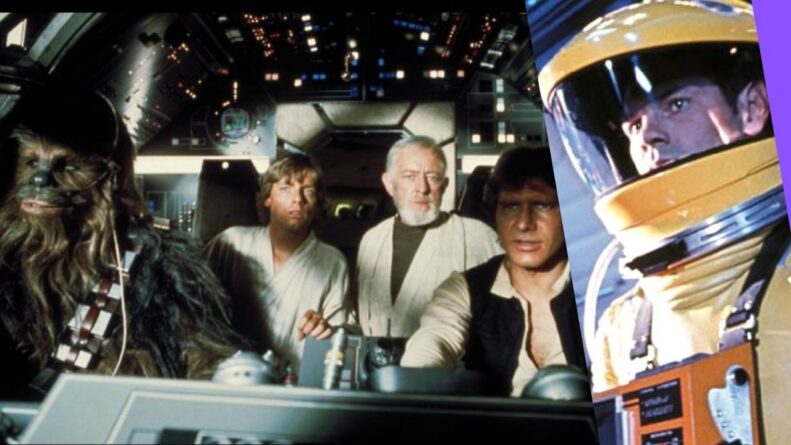
Nothing about the original movie is overrated. George Lucas wasn’t just one of the Best sci-fi fantasy movies, he brought timeless myth into the modern world, the stars. There are mystical warriors like the Jedi, shining swords called lightsabers and a memorable dark knight in Darth Vader. At its core, it’s a film that tells a tale of hope and is a classic hero’s journey – one for everyone who’s ever gazed at the night sky in awe.
| Aspect | Details |
| Directors | Stanley Kubrick |
| Release Date | 6/April/1968, wide release May 1968 |
| Runtime | 149 minutes |
| Genre | Science fiction |
| Dave Bowman | Astronaut leader on Discovery One mission; confronts HAL and transcends via monolith; played by Keir Dullea |
| Frank Poole | Bowman’s fellow astronaut killed by HAL during the Jupiter voyage; played by Gary Lockwood |
Star Wars is the fantasy of space in Best sci-fi fantasy movies, 2001 is the wonder and fear of it. Stanley Kubrick made a film which is more a religious experience than a movie. From the dawn of man to the chilling calm of HAL 9000, it dares the audience to just watch and think. It’s still the gold standard for “hard” sci-fi.
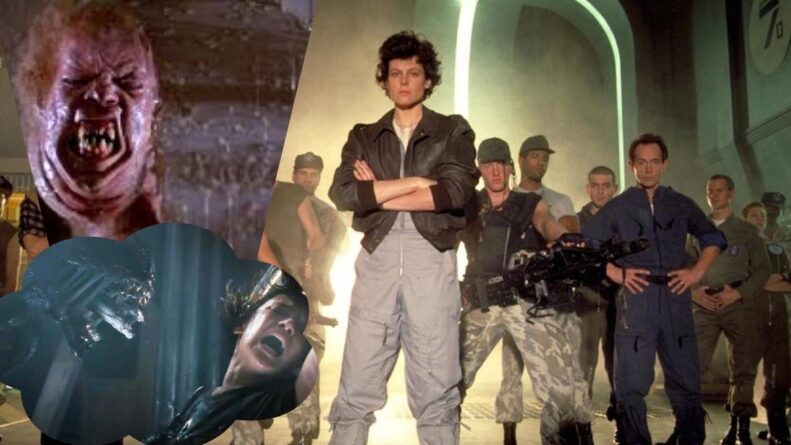
| Aspect | Details |
| Directors | James Cameron |
| Release Date | 18/July/1986 |
| Runtime | 137 minutes |
| Genre | Science fiction, Action, Horror |
| Ellen Ripley | Survivor turned leader guiding marines against alien hive; played by Sigourney Weaver |
| Newt | Lone child survivor of the colony massacre, bonds with Ripley; played by Carrie Henn |
It is one of the best film in Best sci-fi fantasy movies. James Cameron made a haunted house film in space (Alien) and turned that sequel into the ultimate war movie. But among the pulse rifles and xenomorphs, the heart of the movie is the connection between Ripley and Newt. It roots the blast-a-minute action in a maternal, ferocious, protective instinct. It shows us that sci-fi action can have a big heart.
| Aspect | Details |
| Directors | John Carpenter |
| Release Date | 25/June/1982 |
| Runtime | 109 minutes |
| Genre | Science fiction, Horror |
| R.J. MacReady | Helicopter pilot turned leader testing for the alien infiltrator; played by Kurt Russell |
| Childs | Station mechanic, key survivor in final standoff against the Thing; played by Keith David |
Paranoia has never been so brilliantly captured. John Carpenter’s classic is tension incarnate. How do you know who to trust when the enemy could be your best friend? The practical effects — fleshy, nauseating hold up better than most modern CGI because they are real. It’s a harsh, drab and dazzling study in how fear erodes trust.
| Aspect | Details |
| Directors | John Boorman |
| Release Date | 10/April/1981 |
| Runtime | 140 minutes |
| Genre | Fantasy/Adventure |
| King Arthur | Nigel Terry portrait as a bastard son who pulls Excalibur from the stone, but faced many struggles |
| Guinevere | The queen of arthurian legend played by Cherie Lunghi. |
Unlike contemporary clean fantasy, Excalibur is the stuff of nightmare dark age fever dreams. It conveys the tragedy of Camelot and the disappearing magic of the world in a way very few films have been able to.
Read More 👉 Bridgerton Season 4 Take a Top Place on Streaming Charts
We revisit Best sci-fi fantasy movies not only for nostalgia’s sake but because they dared to take chances. They used the impossible settings of outer space or magical kingdoms to tell very grounded stories about love, fear, identity and hope.
They show us that no matter how much our technology evolves, the human story remains constant.
Fandomfans give you a well-crafted list of old legendary movies that’s worth watching.

Explore all James Bond movies in order, iconic fight scenes, unforgettable villains, and how 007 evolved across six decades of cinema.
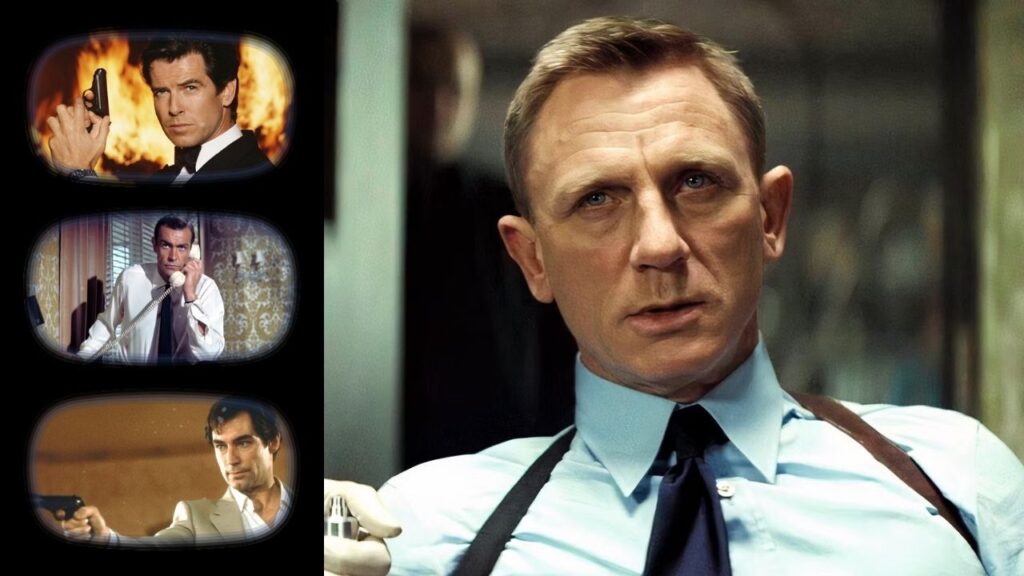
James Bond fighting is so much more than flashy action sequences. It is a six-decade journey through the evolution of fight choreography on film, changing global attitudes toward violence and the increasing complexity and artifice of stunt choreography in the movies. Ian Fleming once described Bond as a “blunt instrument” of the state—a man made to achieve results, not to be elegant while doing so.
It prefers its action to be muscled, aggressive, and violently blunt rather than graceful or theatrical. While Bond in Fleming’s novels was taught boxing and judo to mirror commando skills of the Second World War, cinematic 007 has evolved into more of a living painting, adapting to the martial philosophies, political climates and cultural sensibilities of the era.
The best fight scene in No Time to Die is the punishing stairwell brawl in Safin’s lair, where Bond is up against three armed adversaries in a narrow slab of concrete. Filmed in long, fluid shots, the scene is relentless and tiring, highlighting Craig’s older, injured Bond relying on instinct on the battlefield.
There’s a weight behind each punch, every gunshot is earned, and being in a tight space doesn’t bring with it any glitz. It’s Bond the hardened survivor, not the dazzling hero—pragmatic, efficient, and potently human. This moment perfectly embodies the movie’s themes of sacrifice, perseverance and the physical toll of being 007.
Spectre contains a loving nod to the From Russia With Love train fight, with Bond facing off against Mr. Hinx (Dave Bautista). It’s destructive, shattering several train cars. Bautista was starting to be “gentle,” but Craig told him to be more brutal.
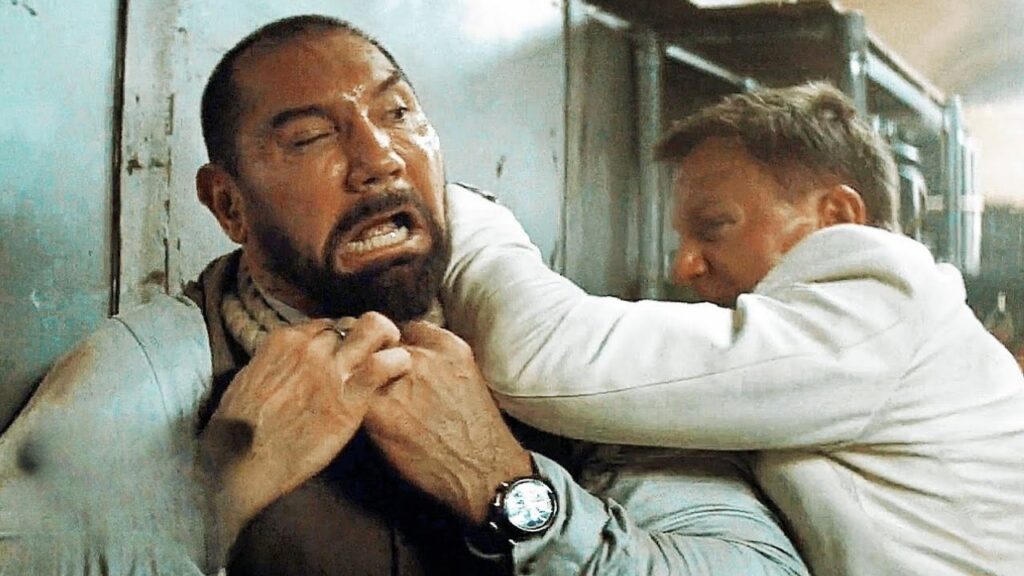
Bautista complied, hurling Craig so violently that he left the actor with a serious knee injury (meniscus tear), forcing him to wear a brace for the rest of the shoot and ultimately having surgery. This fight, then, features real pain and injury from both players.
“Casino Royale” jolted the audience with its unsentimental brutality right from the start of the film. Shot in high-contrast grainy black & white the fight isn’t clean, it is chaotic and crude and Bond ends the fight bleeding. Bond attempts to drown his quarry, Fisher, in a sink, the quarry fights back. There is no elegance here.
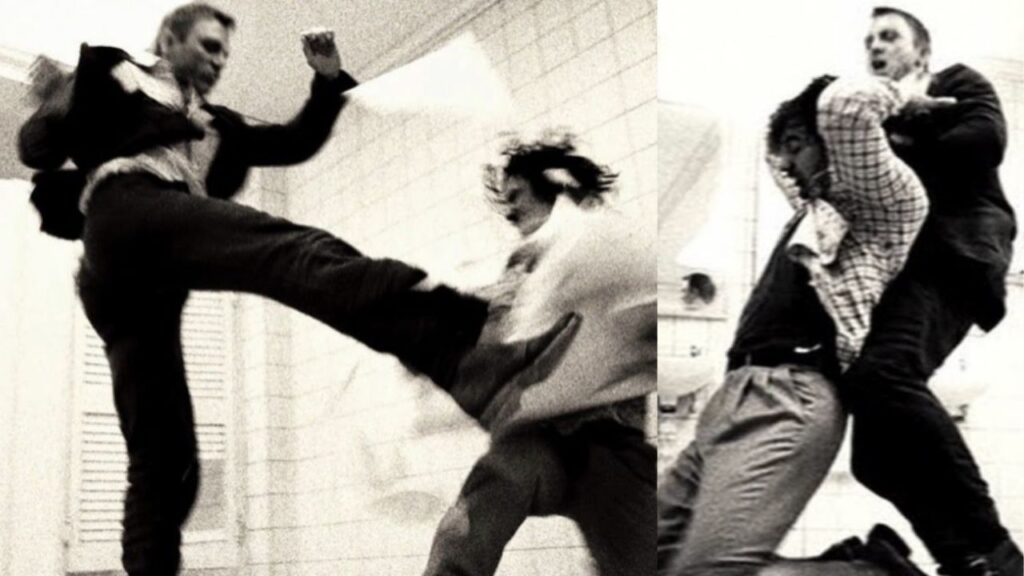
The cinematography is in keeping with Cold War noir and spy fare such as The Ipcress File while confirming that this Bond is a “blunt instrument” and implying that he’s still coming to terms with the emotional cost of killing. The scene was intentionally to feel unchoreographed, to ball the struggle and the fatigue of taking a life.
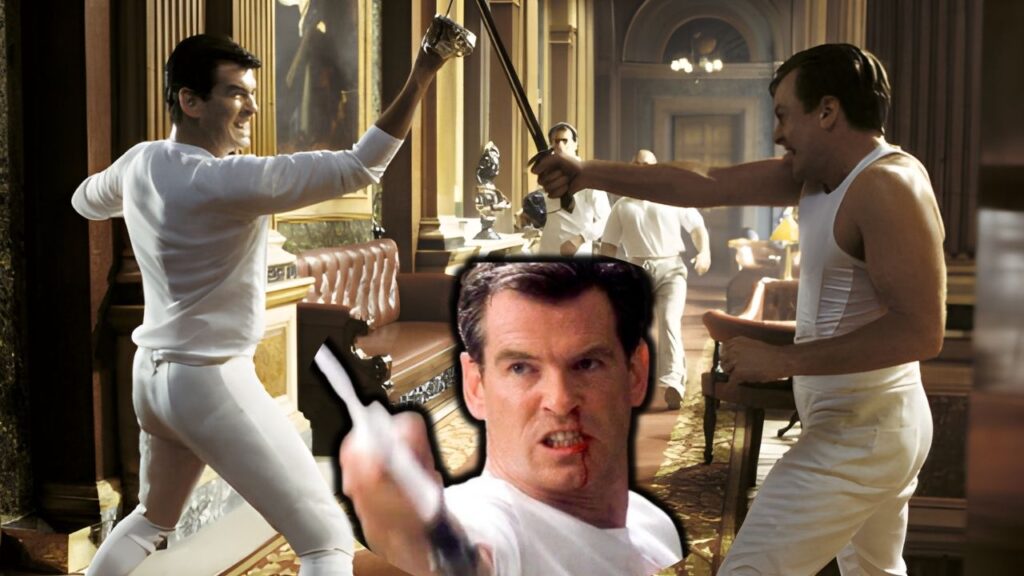
Die Another Day is widely derided for its use of terrible CGI (the invisible car, the tsunami surfing, etc.), but the fencing match between Bond and Gustav Graves (Toby Stephens) at the Blades Club is a rare moment of hands-on stunt work. It begins as a civilized fencing bout and ends with a full-on broadsword brawl, wrecking the club set.
Trevelyan is Bond’s equal—a fellow “00” agent with the same training. The battle is a mirror match. Most importantly, the sequence mutes out the bombastic score and all we can hear is the metallic thuds, the heavy breaths and the wind. This sound design decision highlights the brutal intimacy of two friends attempting to kill each other.
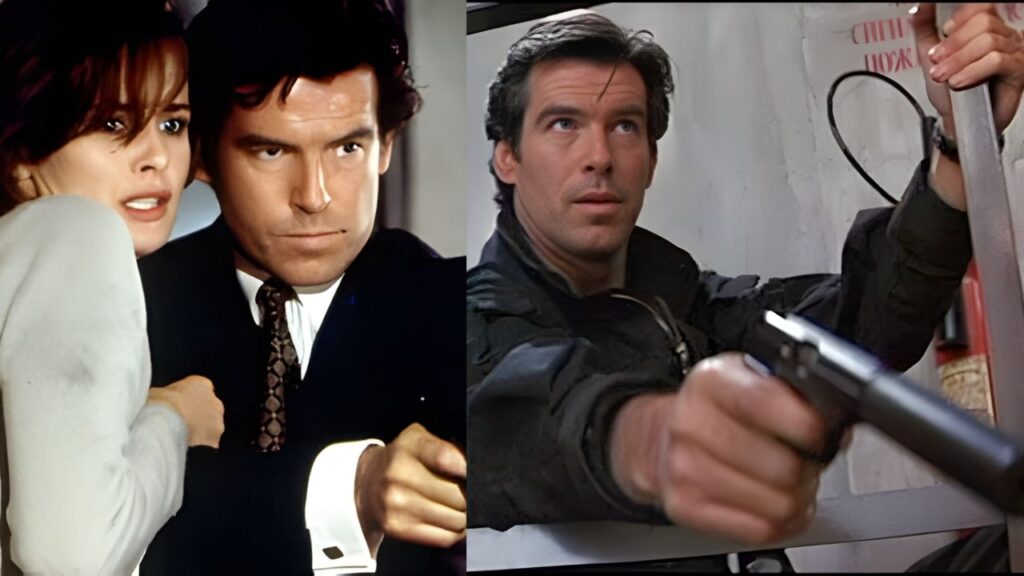
The fight is a combination of technical grappling and dirty fighting (headbutts, biting), Bond finally throwing Trevelyan to his death. The classic line “For me” in response to Bond’s “For England, James?” that he answers shortly after meeting Trevelyan, signals a personal change in Bond’s motivation.
In The Living Daylights, the tussle between Bond and Necros clinging to the outside of a cargo plane is a marvel of aerial stunt work. Withstood the strain Unlike the green-screen-laden sequences of later times, this was shot with stuntmen (BJ Worth and others) actually hanging from a plane over the Mojave Desert.
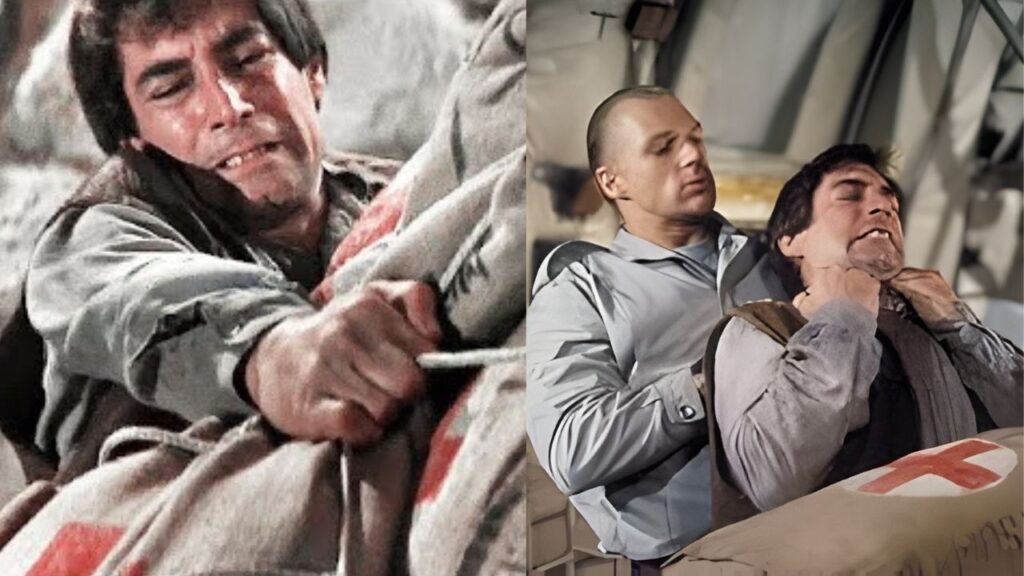
The physical struggle, as well as the roaring wind (sound design has a significant role in that), make it all very disorienting and high-risk. It’s a battle dominated by gravity, not martial arts moves.
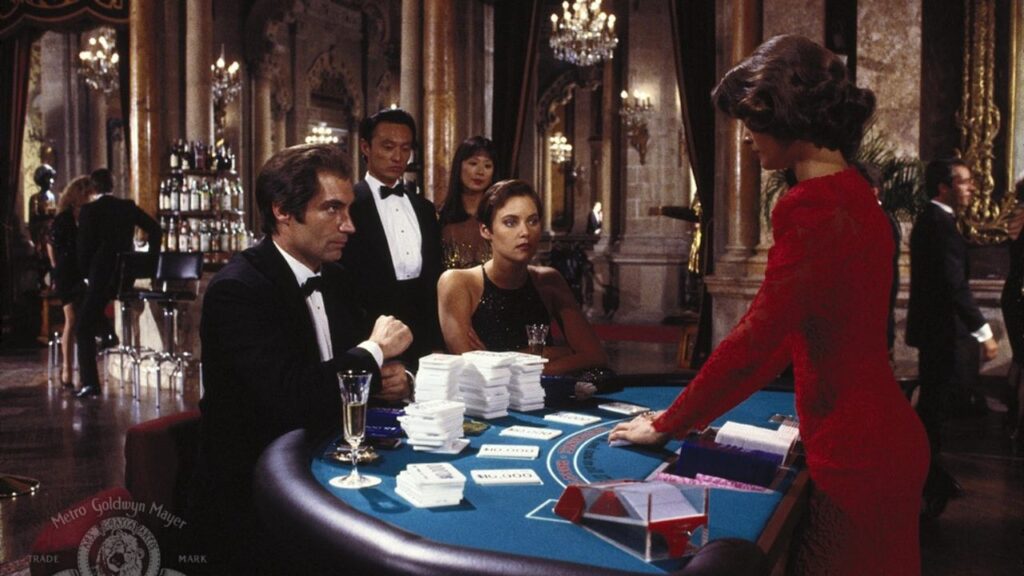
Licence to Kill is the bloodiest of the pre-Craig Bond films, and was the first to be given a 15 rating in the United Kingdom. The Bimini barrelhouse brawl is a highlight for its raw brutality. Bond isn’t trying to get away as he fights; He’s trying to do as much damage as possible. They refer to pool cues, broken bottles and a brawl that seems more at home in a western saloon than a spy movie.
The scene is staged and lit to highlight the fearsome Jaws, playing with shadows (the train closet) and jump scares. Bond is completely physically impotent; he punches Jaws in the jaw and breaks his hand — a world away from Connery’s crushing blows to Grant’s neckline. This makes Jaws a supernatural entity.
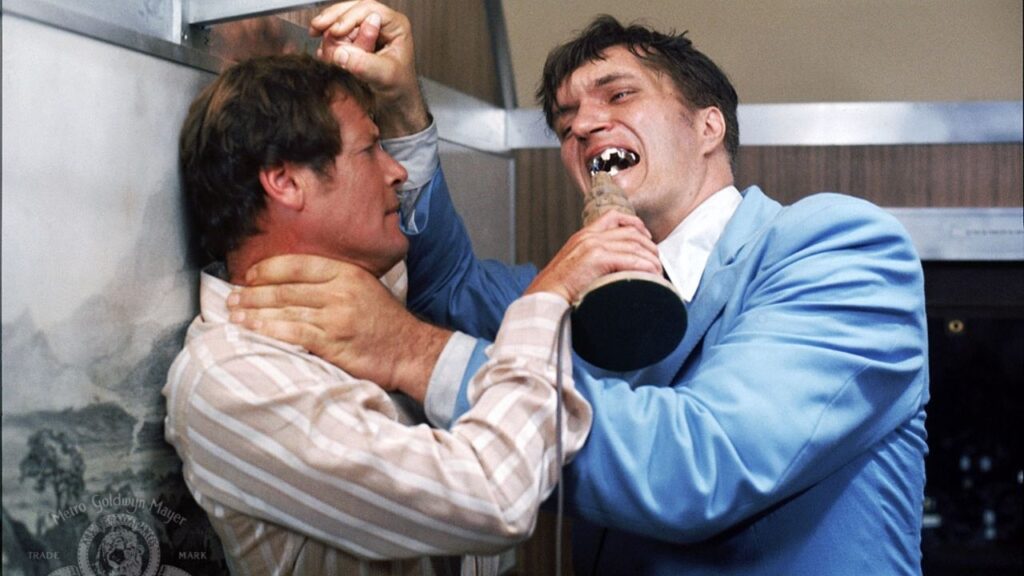
The resolution Bond stabs Jaws with a jagged lamp, delivering an electric shock is a variation on the Oddjob demise that includes a comic bounce, as Jaws endures and then departs. The sequence was choreographed by Bob Simmons, maintaining the trilogy of train fight masterpieces.
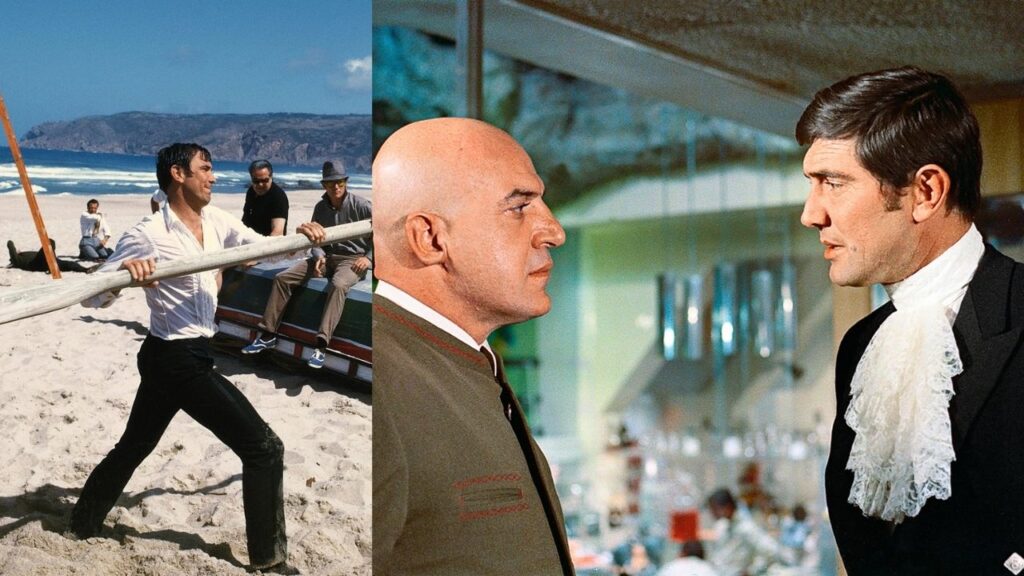
The beach fight and the hotel room brawl with Draco’s men reveal a new editing philosophy employed by director Peter Hunt. Hunt used quick cuts, jump cuts and a little bit of speeded up footage to make the fights more energetic. This gave the film a visceral, almost frenzied feel that anticipated the “shaky cam” mode of the Jason Bourne series by several decades.
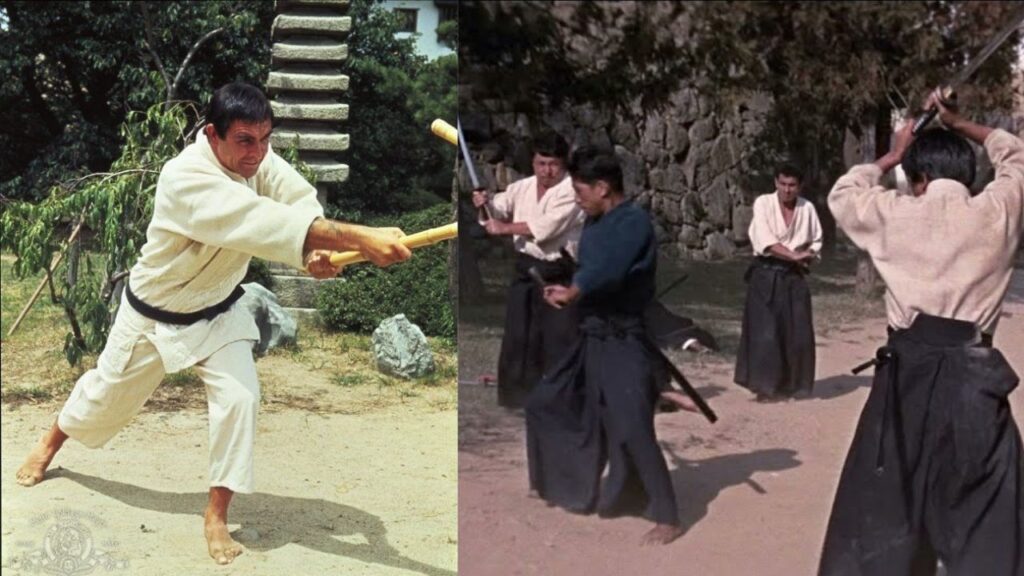
The brawling judo fight is a demonstration of this transition from the chaotic to the slightly more stylized fighting in Dr. No. Bond uses the environment, a sofa, and a large statue to fend off the sumo’s size, continuing the message that Bond has to change his fighting style to whatever culture he’s invading.
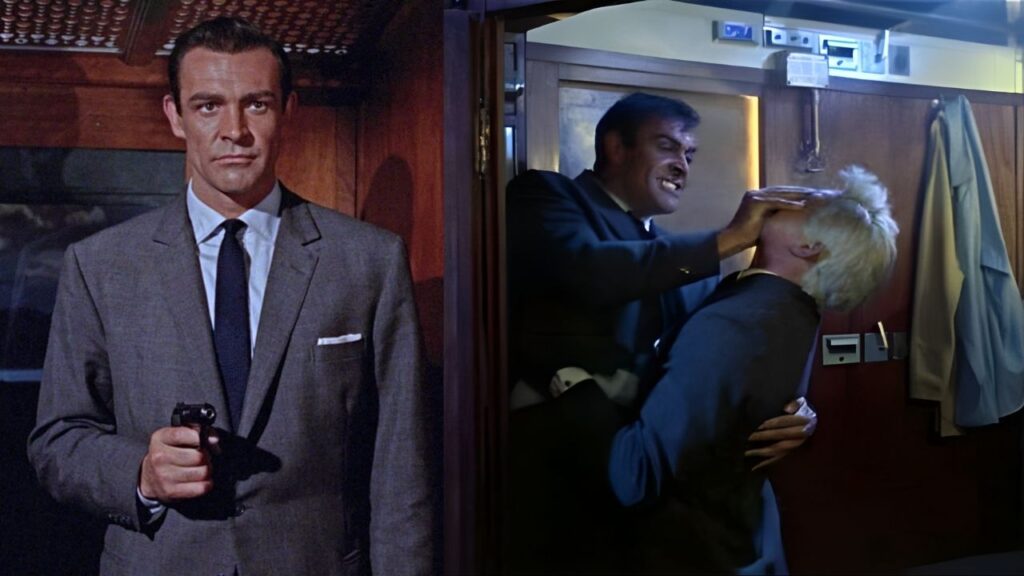
When you ask people who know what they are talking about when it comes to the Bond movie library what the best is, it’s almost always From Russia With Love that is named, the duel between Bond and Donald “Red” Grant (Robert Shaw) on the Orient Express stands as a cornerstone moment in action movie history. It took the genre away from the bloodless fisticuffs that defined 1950s action films to a more visceral, claustrophobic reality.
The development of James Bond’s style of fighting is indicative of a narrative that’s about more than just choreography or spectacle. Every punch, wrestle, and fight for life is a product of the time it was made, informed by global politics, shifting definitions of masculinity and what audiences want to see in it. From Connery’s primal, rough-and-tumble fights to Craig’s brutal, Krav Maga–inflected efficiency, Bond’s battles have always stripped away the suave disguise of the gentleman spy to expose the lethal truth beneath.
Fandomfans is focusing on delivering movie details from old to new, stay connected for more updates.