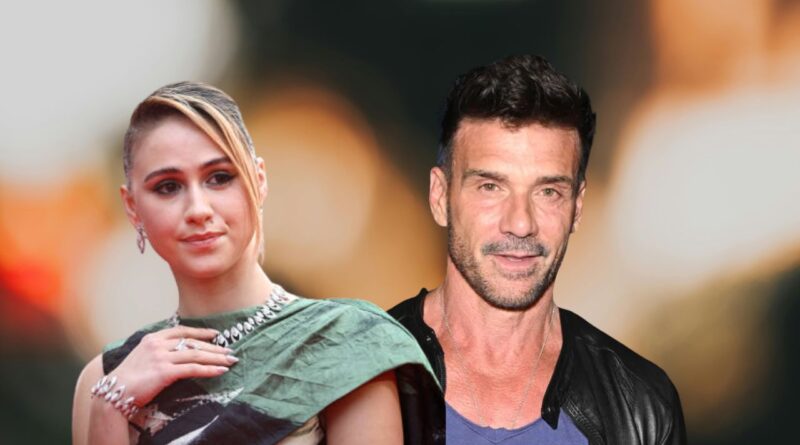
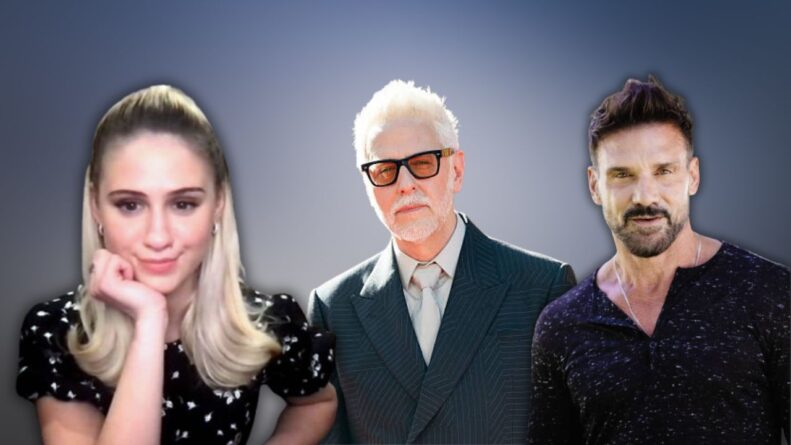
Well, get ready to set your countdown clocks, because two powerful forces (Frank Grillo and Maria Bakalova) in cinema collide on screen. The gritty and intense action veteran Frank Grillo is now set to star alongside Academy Award nominee Maria Bakalova in the high-octane sci-fi survival thriller Override. And the best part? This isn’t a random team-up, it’s a live-action reunion for two foundational players of James Gunn’s new DC Universe.
Just the official synopsis would be enough to terrify you. Override centers on a futuristic soldier (Bakalova) who is betrayed and left for dead. With a fatal wound that could end her mission and her life — she’s forced to race against time. Her last best chance, an experimental synthetic angel (Grillo), the most advanced battlefield A.I. Now that is a premise that practically screams high-stakes survival.
Casting: Frank Grillo Steps Into a Bold New Role
Image credit: Getty Image
Frank Grillo has carved out a niche as a hard, take-no-prisoners type of character exactly the type of guy who would survive in a dark, futuristic world. In the cage, behind the mask or chasing bad guys in one of his numerous action franchises, Grillo infuses each role with a visceral, authentic edge. Watching him play something as nuanced as a synthetic angel on a battlefield A.I. probably running in a human host is a nifty swerve that may meld his physicality with a colder, more technical turn.
Then there is Maria Bakalova. She’s a genuine chameleon of an actress. She made a splash with a phenomenal, Oscar-nominated turn in Borat Subsequent Moviefilm, displaying stunning comedic and dramatic chops. She established her action and sci-fi bonafides with her voice work as Cosmo the Spacedog in Guardians of the Galaxy Vol. 3. Her casting as a futuristic soldier abandoned to die is a perfect match, giving her a chance to go full tilt in an emotionally charged, physically grueling part.
A DCU Connection That Makes This Team-Up Even Bigger
What makes this matchup so appealing for comic book movie fans is their shared DCU history. Both Grillo and Bakalova are a part of the new James Gunn-led slate, voicing characters in the upcoming animated series, Creature Commandos Grillo as the gruff Rick Flag Sr., and Bakalova as Princess Ilana Rostovic. To have their professional collaboration go straight from the sound booth of an animated series to an intense, original live-action thriller is really affirming of their chemistry.
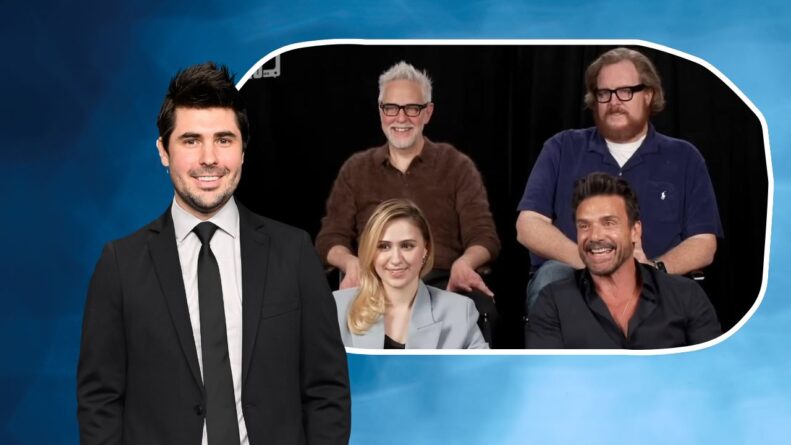
Jordan Downey’s Visionary Touch
Image credit: Facebook (S U P E R V E R S E)
Behind the lens, the movie is in capable hands. Override is directed by Jordan Downey, who charmed critics with his 2018 fantasy-horror film, The Head Hunter. His background indicates that this isn’t going to be just a plain action movie, expect strong visual aesthetics, sharp and focused narrating that will bring the project above the run-of-the-mill sci-fi thriller.
What to Expect From Override
The most thrilling news is that this film is not only in development—it’s being made as we speak. Production is underway in Belfast, so updates, first look images and a trailer are definitely coming sooner rather than later. Amid the relentless churn of reboots and sequels, Override feels like a fresh blast of futuristic wind. It brings together two amazing talent with very different skill sets – Grillo’s action credentials and Bakalova’s dynamic versatility – in a high-concept, pulse-pounding scenario.
Override looks like it will be one of the most thrilling sci-fi thrillers coming out in the near future. Embodying her trademark hard-edged and ferocious presence alongside grittiness of Frank Grillo and versatility of Maria Bakalova lending emotional depth, heat and high-tech chaos is a recipe for heart, heat and high-tech chaos. Their reunion outside the DCU is a crossover fans never knew they wanted a mash-up of action-star firepower and nuanced acting. In control Jordan Downey’s direction, Override is more than just a futuristic survival flick, it’s a cinematic declaration of resilience, trust, and the narrow divide between humanity and machine. To sum up, everything is indicating that this will be the next big genre hit to “override” the competition.
About Us
Welcome to Fandomfans— your source for the latest buzz from Hollywood’s creative underworld. Here, we explore the art of filmmaking, knowing about how visionary directors, designers, and actors shape the worlds we escape into. Today we will know everything about Frank Grillo and Maria Bakalova Reunion in Jordan Downey’s direction, Override.
Alpana
Articles Published :
164
Alpana is Fandomfans Senior Editor across all genres of entertainment. She evolved in the media industry since a very long time, she manages the content strategy and editing of all the blogs. Her focus on story development, review analysis, and research is well-equipped that ensures every article meets the standards of accuracy and depth.
You Shouldn’t Miss To Rewatch ‘Kill Bill’ Because of These Legendary Moments
Rewatch 'Kill Bill' to rediscover the iconic fights, hidden details and cinematic homages that shaped Tarantino's masterpiece. Explore the moments. Learn more!
Among the records of 21st-century film, very few works can claim the unparalleled position held by Kill Bill Vol. Ostensibly a revenge thriller, the film functions less as a story and more as a spirited look back at film history: a “curated museum” whose high art and exploitation cinema boundaries dissolve.
Seeing a film like Kill Bill is to see a dervish at work—homing in on a “roaring rampage of revenge” to examine how genre works, the aesthetics of violence, and the lasting power of the screen image. If volume 1 is a blistering tribute to Eastern cinema (wuxia, samurai chanbara, and anime), volume 2 makes a sudden shift to the West, adopting the dry tempos of the Spaghetti Western.
This article unpacks the minuscule details — from cereal brands to philosophical monologues which elevate Kill Bill from a film to a masterpiece.
The Genesis: From “Q & U” to the Silver Screen
Image Credit: IMDb
Tarantino and Thurman conceived “The Bride” in casual conversations while life mimicked art in the six years it took to write. When Thurman got pregnant before shooting, Tarantino delayed production instead of recasting, saying,
“If Josef Von Sternberg is planning to make Morocco and Marlene Dietrich gets pregnant, he waits for Dietrich!”
It indicates the character Bride is not just a simple role but a specifically designed around Thurman’s physicality.
Casting Counterfactuals
The movie might have been very different. The part of Bill was first written for Warren Beatty, as a suave, Bond-villain kind of guy. When David Carradine was cast, the character shifted to a tough martial arts icon, drawing on Carradine’s background as the lead of Kung Fu, which originally aired in the early 1970s.
Character
Actor Cast
Original Choice
Impact of Change
Bill
David Carradine
Warren Beatty / Bruce Willis
Shifted Bill from a suave suit to a rugged, flute-playing martial arts legend.
O-Ren
Lucy Liu
Generic Japanese Actress
Rewritten as Chinese-Japanese-American to accommodate Liu, adding racial tension to her Yakuza rise.
Budd
Michael Madsen
Robert Patrick
Madsen’s weary persona perfectly suited the “loser” brother living in a trailer.
Johnny Mo
Gordon Liu
Michael Madsen
Gordon Liu (he is a Shaw Brothers legend) was given the opportunity to take on two roles (Johnny Mo and Pai Mei), connecting the two volumes.
Revenge is a Dish Best Served Cold
Bloodied, terrified, and immobilized, The Bride has a stark black-and-white close-up of her face. This decision to film the slaughter aftermath in black and white has several reasons. While this is mostly justified as an homage to 70s TV censorship of kung fu movies, it is also an aesthetic choice. It creates a detachment, and the violence is transformed into nightmarish and abstract rather than realistic.
Image Credit: IMDb
The needle drop of Nancy Sinatra’s “Bang Bang (My Baby Shot Me Down)” is among the most iconic musical cues in cinema history. The song is also used as a literal narration:
“Bang bang, he shot me down… bang bang, that awful sound.”
The sad tremolo guitar establishes a mood of tragic inexorability. Instead of a regular action flick beginning with high-octane stunts, Kill Bill begins with failure and grief, laying out the emotional deficit The Bride needs to replenish with vengeance.
The Bride is creating her own future nemesis
The battle concludes at the death of Vernita Boreas, observed by her four-year-old daughter, Nikki. The Bride’s line here is an important one:
“It was not intentional and for that I am sorry. But you can take my word for it, your momma had it comin.”
Then she provides the child with a future means for vendetta: “When you get a little older, if you still feel raw about it, I’ll be waiting”.This is at least an acknowledgement that revenge is cyclical.
The “sniper shot,” as O-Ren kills a politician, is a highlight in visual storytelling. The space, the quiet, the abrupt violence all serve to define O-Ren as an emotionally cold, remote character. The return to live action O-Ren’s single tear, bridges the stylized animated trauma and the real life villain The Bride will take on.
The Brides Blue Leaves Disguise
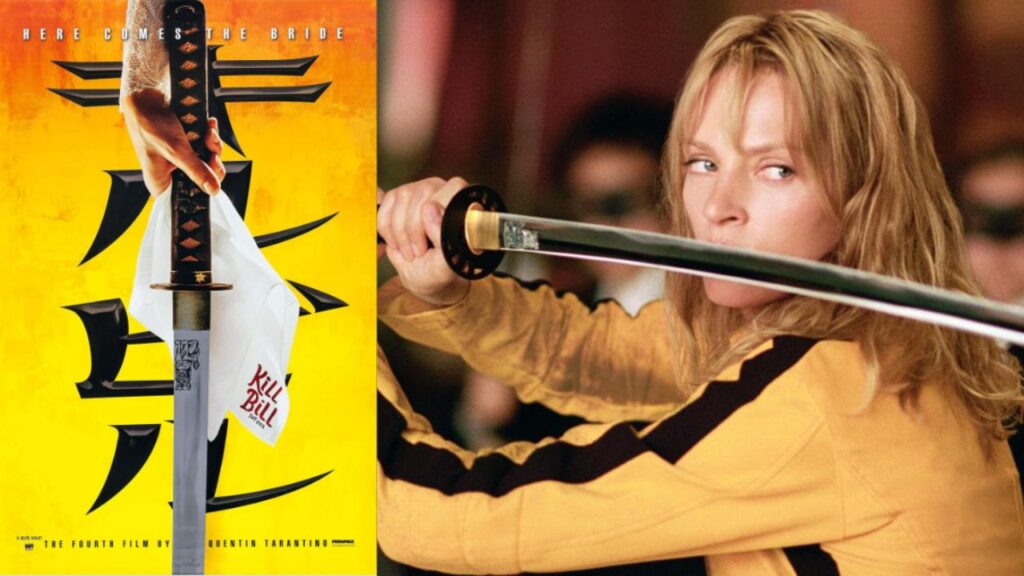
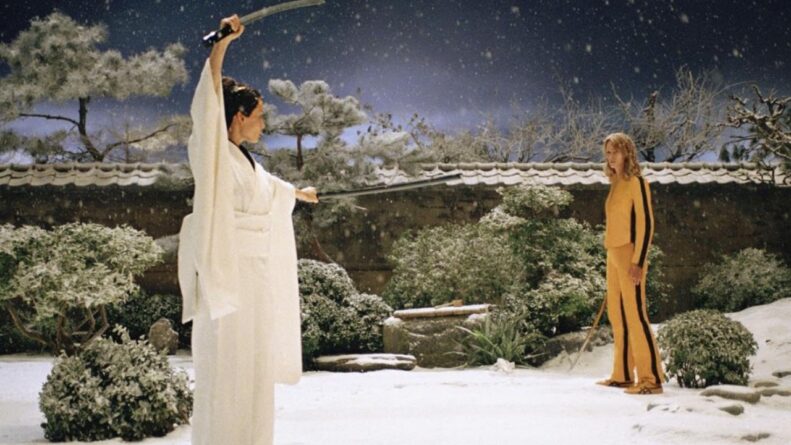
The Bride’s yellow tracksuit with black stripes is the film’s most obvious visual nod, an homage to Bruce Lee’s outfit in Game of Death (1978). This wardrobe choice places The Bride among the martial arts greats. But she is armed with a katana, so that visually she blends the Chinese kung fu tradition with the Japanese samurai tradition.
Gogo Yubari and the Meteor Hammer
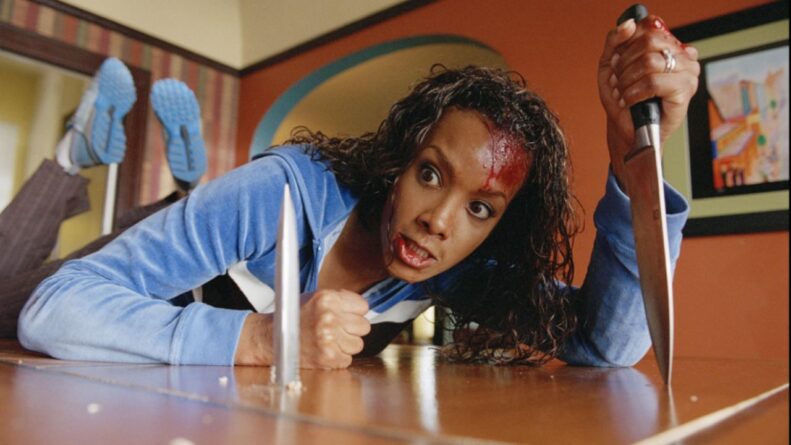
The battle with Gogo Yubari (Chiaki Kuriyama) alters the “schoolgirl” cliché. Gogo is a cruel murderer who uses a ”meteor hammer” (a form of the flying guillotine weapon).
Image Credit: IMDb
The sound here is fastidious; When Gogo, is defeated and lands on a table, the crash has the sound of bowling pins being knocked over quietly layered in – a sonic joke to the violent absurdity.
Lady Snowblood is the spiritual mother of Kill Bill
The fight ends with a moment of grisly precision — The Bride cuts off the top of O-Ren’s head. Inversion of a usual decapitation. It exposes O-Ren’s brain, making her vulnerable both literally and figuratively.
“I sincerely apologize for my haste in judgment and for trivializing the circumstances in not knowing the full case.”
Are O-Ren’s final words and a return to the samurai code of honor. It elevates the action from a simple kill to a shared moment of warrior respect.
The death of Budd at the hands of Elle Driver is ironic
Elle brings a Black Mamba snake, The Bride’s codename in Kill Bill vol to kill him. The scene in which she reads trivia about the snake from a notepad
“The amount of venom… can be gargantuan”
Is a moment of dark humor. Elle makes the link between the reptile and the woman, essentially informing Budd that “The Bride” has already killed him, even if she wasn’t physically there.
The Cruel Tutelage of Pai Mei
Gordon Liu, who portrayed Johnny Mo in Volume 1, reprises his role as Pai Mei. This double casting is an homage to Liu’s stature as a martial arts legend, Screenrant mentioned. The lesson is on the “Three-Inch Punch,” a variant of Bruce Lee’s “One-Inch Punch.”
Image Credit: IMDb
This method is the narrative key to The Bride’s escape from the casket. In having so much of the film be taken up with the repeating of this movement. The bloody knuckles and fatigue of The Bride — Tarantino “earns” the improbable act of punching through a coffin lid two-thirds of the way through.
Conclusion
Kill Bill is a celebration of how cinema can consume itself and regenerate. It’s the film about two lovers of movies telling the story with the language of movies. The “legendary moments” discussed here, reveal a level of precision and attention that makes the movie more than just a pastiche.
Watching Kill Bill again is like reading a text that is constantly opening up. It is also a tale of identity, The Bride’s view that identity is mutable (she moves from killer to mother). It is a tale about the “forest” of revenge — A place that has been known to disorient travelers.
Alpana
Articles Published :
164
Alpana is Fandomfans Senior Editor across all genres of entertainment. She evolved in the media industry since a very long time, she manages the content strategy and editing of all the blogs. Her focus on story development, review analysis, and research is well-equipped that ensures every article meets the standards of accuracy and depth.
Eddie Munson Won’t Return in Stranger Things Season 5: Matt Duffer Confirms
Stranger Things creator Matt Duffer confirms Season 5 won’t bring back Eddie Munson. Find out why his story ended in Season 4. Read more visit website...!
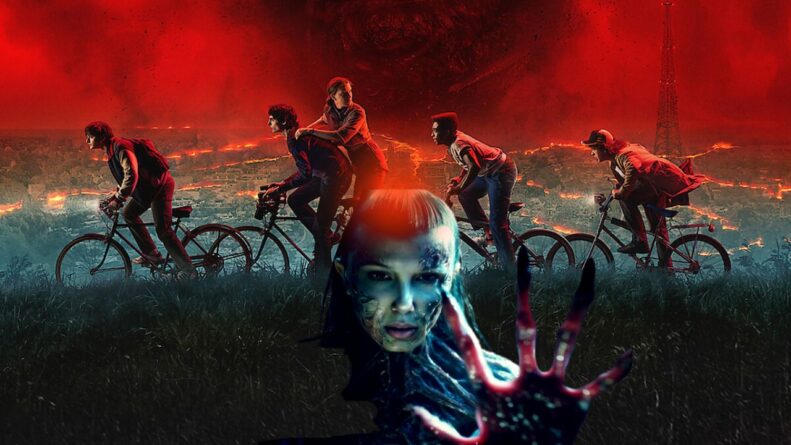
Eddie Munson (played by Joseph Quinn) is not returning for season 5, which is the final season of the series. People confirmed that, In a recent chat with Empire magazine, co-creator Matt Duffer squashed once and for all rumors that beloved character could return.
The creators (Duffer Brothers) of Stranger Things have officially confirmed, “I love that Joe Quinn is just playing with fans! But he’s dead,” he described Eddie’s fate in the interview. “Joe is so busy anyway, the world should know he’s not coming back,” he added. He’s been shot like five movies since! When the hell does he get the time to come and shoot Stranger Things? No, unfortunately, RIP. “He’s fully under that ground.”
The statement follows months of speculation stoked by Quinn himself, who at times teased fans at events about returning. At a fan con in Belgium and asked if he would reprise his role, Quinn enigmatically replied, “I do know, but I’m not telling,” fueling even more hype. After a while, Duffer brothers have publicly shared that the story of Eddie Munson was finished in Season 4.
Fans Will Remember Eddie Munson’s Heroic Sacrifice
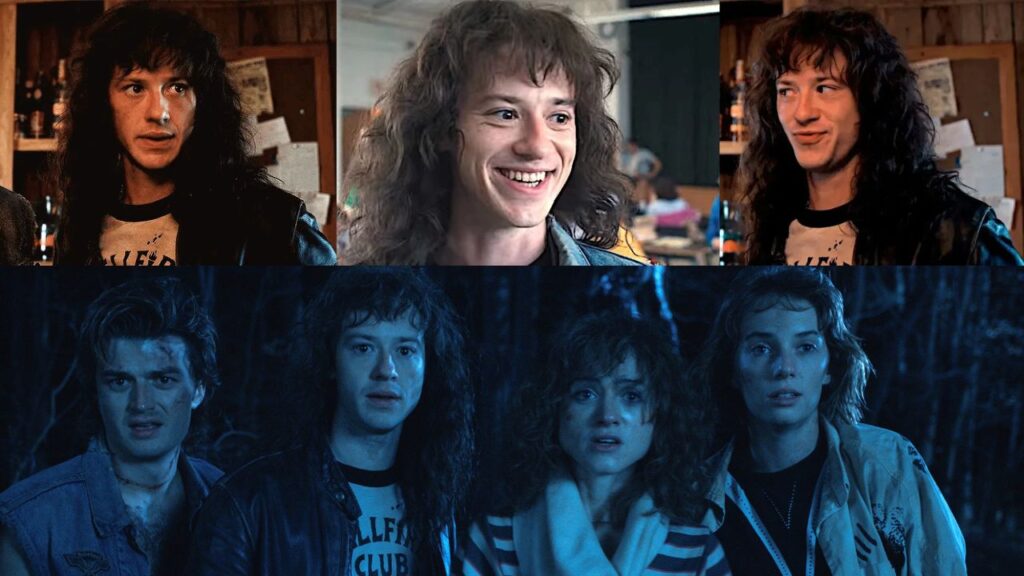
Eddie Munson debuted in Stranger Things season 4, projecting the charm of an outcast metalhead leader at the same time as he was ruggedly told that the Dungeons & Dragons game was Just Not Cool. His arc was all the more emotional when he died in the Upside Down to protect his friends Dustin, Steve, Nancy, and Robin.
In a standout Season 4 moment, Eddie delivered a triumphant performance of Metallica’s “Master of Puppets” on guitar, drawing the demobats away from Vecna’s lair. Sadly, he didn’t make it out alive, sacrificing himself in a blaze of glory to save Hawkins – the same town that had turned its back on him.
Since leaving Stranger Things, Joseph Quinn’s star has risen exponentially. The 31-year-old British actor has joined a number of major film franchises, so a return to the Netflix series now seems all but impossible from a scheduling standpoint.
Quinn has appeared in several blockbuster projects including, A Quiet Place: Day One, Gladiator II, Warfare, The Fantastic Four: First Steps, and his upcoming project Beatles biopic where he plays a role of George Harrison.
This packed schedule, coupled with the fact that his character is dead, means Eddie’s comeback is out of the question.
Stranger Things Season 5 Release
The final season of the Stranger Things will be split into three parts during the holiday season: Volume 1 contains 4 episodes which will release on November 26, 2025, Volume 2 of 3 episodes: December 25, 2025, and Final Episode is going to air on December 31, 2025.
Who Will Return in Season 5?
Eddie may not be coming back, but at least everyone’s favorite characters will be making their appearances for the latest look at the end-of-the-world finale. The cast is filled with familiar faces such as Millie Bobby Brown as Eleven, Finn Wolfhard as Mike, Noah Schnapp as Will, Gaten Matarazzo as Dustin, and Caleb McLaughlin as Lucas. Sadie Sink returns as Max, as does Winona Ryder as Joyce, and David Harbour as Hopper. Natalia Dyer, Charlie Heaton, Joe Keery also return as Nancy, Jonathan and Steve respectively. Maya Hawke returns as Robin, Priah Ferguson returns as Erica.. Brett Gelman returns as Murray, Jamie Campbell Bower as Vecna, Cara Buono as Karen, and Amybeth McNulty as Vickie. It’s shaping up to be an intense reunion with plenty of drama and action. There will be a void certainly for Eddie, but this cast of stars is sure to give us an ending to the story that we’ve all been addicted to. One last ride in Hawkins!
Conclusion
While it’s disappointing that Eddie Munson but his amazing character is firmly cemented in Stranger Things history. His heroic sacrifice at the end of Season 4 provided a great send off for his character. With the end of the series in sight, viewers can now turn their attention to that big showdown — and the return of characters they have loved for almost 10 years. A fight with Vecna and the secret of the Upside Down are set to come to a thrilling end, bringing the Hawkins saga to a close this holiday season.
Alpana
Articles Published :
164
Alpana is Fandomfans Senior Editor across all genres of entertainment. She evolved in the media industry since a very long time, she manages the content strategy and editing of all the blogs. Her focus on story development, review analysis, and research is well-equipped that ensures every article meets the standards of accuracy and depth.