Home > Movies > ‘Wake Up Dead Man’ Review: A Bold Mystery..
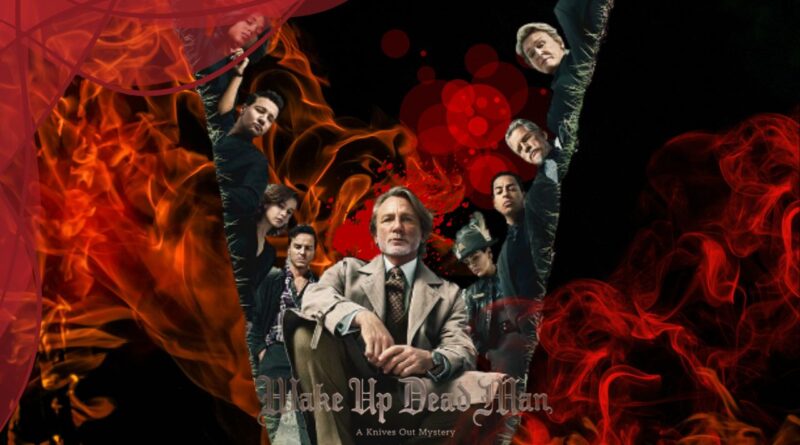
‘Wake Up Dead Man’ Review: A Bold Mystery but Missing the Knives Out Spark
"Wake Up Dead Man review: Superb performances and a bold storyline, but this Knives Out follow-up lacks the complex twists of the originals." Learn more..!
The late 2025 launch of Wake Up Dead Man: A Knives Out Mystery is a high-stakes moment for one of the greatest IPs in modern moviemaking. Taking its place as the crown jewel amongst writer-director Rian Johnson’s body of work, the Knives Out franchise hasn’t simply breathed new life into the “whodunit” genre, it has transformed it into a tool for sharp social commentary, adapting the warm tropes of Agatha Christie to unpack the unsettling realities of 21st-century American class relations.
Coming off the sleeper theatrical success of Knives Out (2019) and the opulent, streaming-centered cultural moment of Glass Onion (2022), this third entry arrives with the weight of an inherently high-stakes legacy and the burdensome $450 million payday by Netflix.
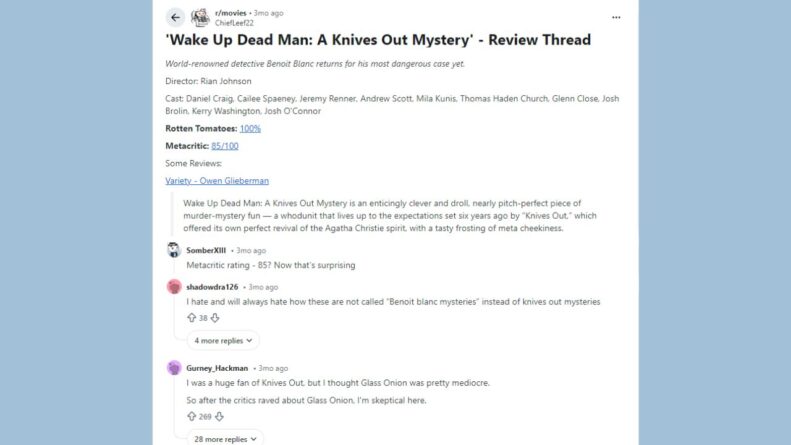
Although the film has received overwhelmingly positive ratings—for example, it currently has a Rotten Tomatoes rating of 96% to 100% in the wake of its premiere at the Toronto International Film Festival—a close read of the reviews reveals a series struggling to find new energy in its satirical bite and its narrative mechanics.
The biggest departure in Wake Up Dead Man and the cause of most critical dissent is its bold structure. Johnson seeks to destabilize the standard whodunit paradigm not in the question of who did it, but in the mode of storytelling.
Bold Structural Shift: Blanc Arrives Too Late
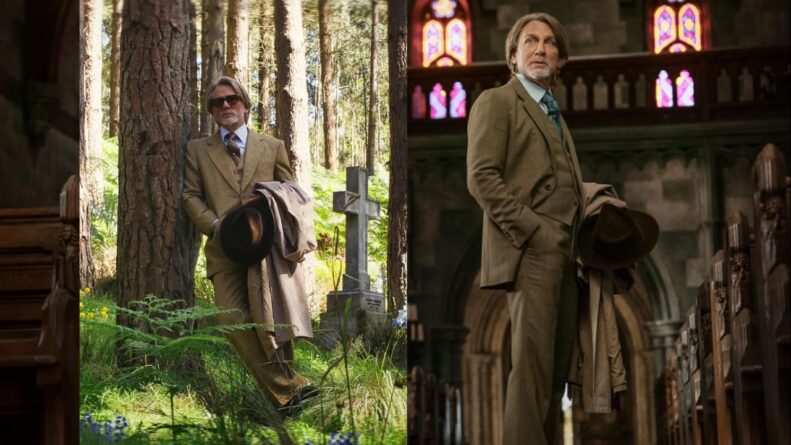
Everything has been turned on its head in what is being called a “subversive” and “harmful” marketing move: The franchise centerpiece, Benoit Blanc (Daniel Craig), does not show up until the 45-minute mark. This decision in narrative style changes the whole DNA of the whodunit.
Image credit: IMDb
The movie devotes its whole first act to introducing the “victim,” Monsignor Jefferson Wicks (Josh Brolin), and the main protagonist/suspect, Father Jud Duplenticy (Josh O’Connor). The viewer is so deeply ensconced in the personalities of the Chimney Rock group, the history of the church and even the philosophical divide between Jud and Wicks that the arrival of law enforcement feels intrusive. The point of this construction is to give the mystery an emotional charge — the murder is not simply a brainteaser, but a tragedy involving characters the audience has come to know.
Reviewers said the first two reels of the film are slow. By the time the detective, Blanc, finally makes his appearance, most of the puzzles are already set on the table, so he’s not quite as active and important as he was in previous entries. He’s more like a “buddy cop” partner to Father Jud than the main engine of the narrative.
Image credit: IMDb
With Blanc arriving so late, the first act becomes a drama — nicely acted, but lacking the strong mystery “hook” that normally pulls audience in. That’s why they thought it was “far too long” to get truly started.
Classic Locked-Room Mystery With Predictable Twists
The movie borrows from a classic play, “the locked room” mystery, in which a murder takes place inside a church during a service and only the congregants could be suspects. The premise is entertaining — a seemingly impossible murder with no weapon or assailant in sight, inspired by old-school authors like John Dickson Carr.
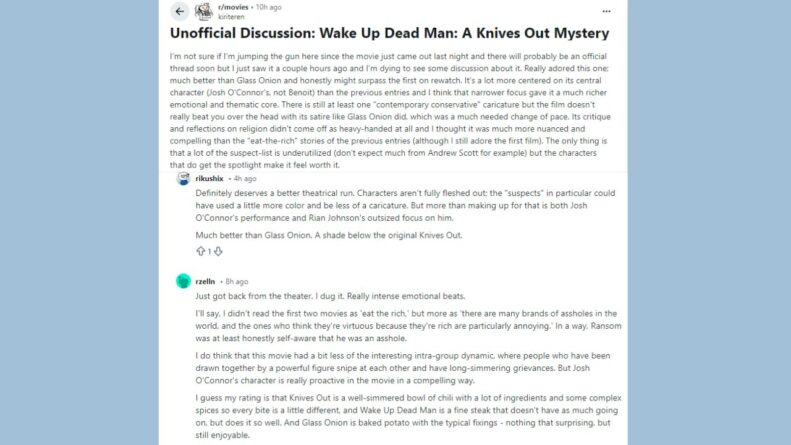
Reviewers enjoyed the classic Christie-style tone, but many thought the answer was both a little too complex and still too easy to guess. Since the killer could be identified by the audience rather early on, the mystery was not very surprising and some considered the film to have lost the unpredictable energy that made the previous Knives Out films so exciting.
The film’s primary antagonist Monsignor Wicks is a gaunt, terrorized priest who wields religion as a tool of oppression, placing him among the more blatant political extremism and faith abuse in the stacked deck of the film. The movie even sets him up against the gentler Father Jud to illustrate the difference between poisonous institutions and real spirituality. But manyreviewers found the satire too on the nose and “safe.”
The portrayal of Wicks is made so blatantly villainous that the satire feels toothless and uninspired, especially when compared to the cutting, dangerous satire of the earlier Knives Out films. It makes the criticism feel routine and less hard-hitting.
Reviews say the movie is bigger than Knives Out but not as sharp as Glass Onion, and many feel it doesn’t have the tight, focused writing of the first film. It also plays it safe, leaning on well-worn mystery tropes rather than attempting to surprise or outsmartits audience.
Although the storyline can appear to be baffling at the beginning, the twists are quite predictable, which causes the mystery to be foreseeable and less emotional. Without a clever, mind blowing reveal, the ending just feels mundane.
Conclusion
Wake Up Dead Man is a “safe” triumph—a film that refines the form but loses the anarchic, punk-rock energy that made Knives Out a sensation. It’s a mystery that insists on being watched for its craft, if not one that will be viewed again and again as its antecedents have been.
Moving forward with the franchise, Johnson has a choice— he can continue his journey toward introspection and “cinema,” or he can come back to the tight, aggressive storytelling that made the original a searing experience. The “Knives” may still be out, but this time, they seem a little less sharp.
Fandomfans is an entertainment source which delivers consistently every movie reviews analysis and audience reception for a Wake Up Dead Man movie.
Mariyam
Articles Published :
50
Mariyam Khan is Fandomfans Content Writer and providing reports and reviews on Movie Celebrities, and Superheroes particularly Marvel & DC. She is covering across multiple genres from more than 4+ years, experience in delivering the timely updates.
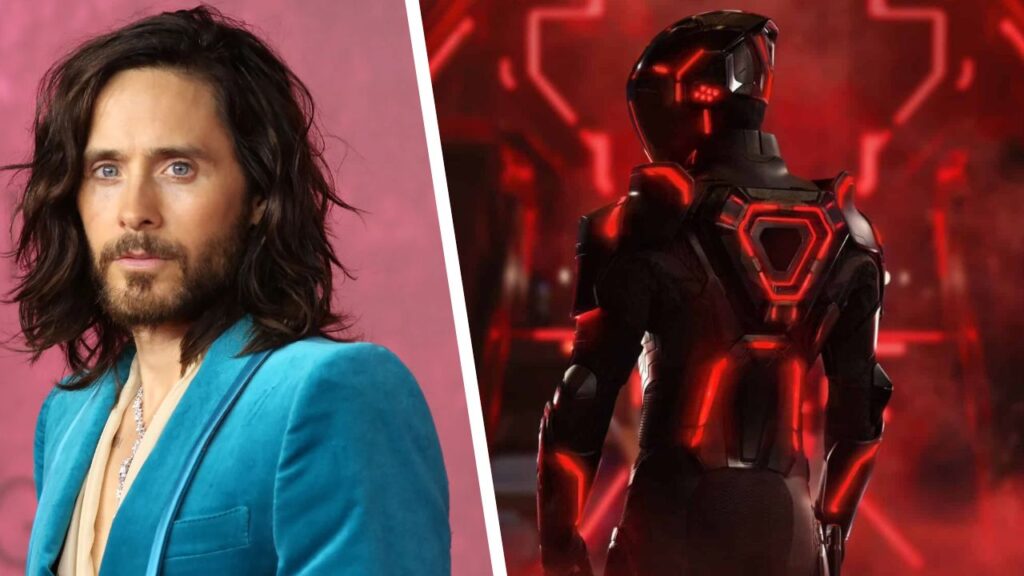
Tron: Ares’ Box Office Failure Marks a Turning Point in Jared Leto’s Career
Tron: Ares' box office flop stuns Hollywood. Learn why Jared Leto's passion project failed, its $33 million debut, and how it changed his career forever.
The November 2025 release of Disney’s long-awaited sequel, Tron: Ares, fizzled at the box office after a gross that trade observers called a disaster and an “IP-killing event”. The Joachim Rønning directed film made a lackluster domestic debut of $33.2 million to $33.5 million, well below its estimated opening gross by $10 million or more. The opening fell just shy of $60 million worldwide, ranging from $60.2 million to $60.5 million.
Ares not hitting the $100m mark in its opening weekend against its sizable budget made for an early and likely impossible-to-recover-from financial loss for Disney. With the failure, Report said that it is very likely that Disney will “retire the franchise from the big screen” for the foreseeable future, signaling to investors a continued reluctance to finance risky.
Jared Leto’s Star Power Comes Under Fire Once Again
The box office doom of Tron: Ares, according to MovieWeb, once again raised and intensified doubts about Jared Leto’s bankability as a star who could anchor a major studio tentpole. The seeds for this industry skepticism were planted three years earlier with the collapse of Sony’s Morbius (2022).
This recurring pattern of financial failure has consolidated a trade consensus that sees Leto as an actor who can’t reliably bring in box office for similar big Intellectual Property (IP) tentpole projects. Industry reports have indicated that “the big paydays Leto received for Ares might well be over,” as studios are increasingly shying away from the actor as a dependable male star draw.
Controversies During the Tron: Ares Press Cycle
In today’s Hollywood, star viability is inexorably linked to public perception and promotability, more so for those who headline massive franchises for corporations like Disney. Leto also has considerable baggage, including several sexual misconduct allegations (which his representatives deny) that surfaced just prior to the Tron: Ares press cycle.
The allegations posed significant challenges for Disney’s marketing team, with industry executives wondering how the actor could “shoulder the pressure of selling two theatrical movies while dancing around the damning claims”. The controversies had an immediate effect on possible promotional opportunities, creating uncertainty as to whether prominent media outlets would allow him to participate in the usual press routines to help market a blockbuster, making him a major-risk.
Industry Frustration Over Leto’s On-Set Behavior
Industry peers is also pointed out his self-serving spectacle and unprofessional distraction after his extreme behavior on set including mailing eccentric gifts to Suicide Squad co-stars or walking around on crutches for Morbius. The perceived expense of working with the actor’s process wasn’t anymore worth the result. This professional reputation of being a “pain in the ass” who wastes time, combined with his inability to open wide films makes him a uniquely risky bet for studios that want to run-efficient production and clean PR.
According to People, The flop of Tron: Ares is far more than a box office number, it’s the shattering of an actor’s sincere passion against the cold, hard financial calculations of contemporary Hollywood. For years, Jared Leto was spearheading the movie, leveraging his celebrity and producer credit, dating back to 2017, to bring Disney’s long-dormant sci-fi franchise out of development purgatory. His commitment was authentic; he was a fan of the original film and its tech, and playing the digital warrior Ares was a very personal goal for him.
A Strategic Rebrand: From Digital Warrior to Skeletor
The broad consensus in the business is that Leto’s way out is would be to turn on a dime and not be the lead vehicle for a big-budget franchise movie. The most obvious sign of that strategic recalibration: his next role is as Skeletor in Amazon MGM’s Masters of the Universe.
Reports say, This casting is generally regarded as a potential career booster for the actor. Adopting the role of the main villain, Leto once again places the financial weight solely on the IP and the hero, enabling him to focus on crafting a memorable performance. The campy villainous role of Skeletor is a dream role for Leto, and one that lends itself perfectly to his style of transformative acting where he utilises heavy makeup and theatricality (see House of Gucci). How well this transition works will depend on his ability to strike the right balance of “menace and camp,” and keep critics away from dismissing the performance as too silly, a perception that has dogged both his Paolo Gucci and Joker performances.
Conclusion
Leto and his team’s main professional challenge is to manage the promotional risk. Any future promotions around the film will have to strategically separate the actor from the success of the project, downplaying those risky stunts or conversations about method acting that come from set, and instead just talk about the character and the spectacle of the film. The twin flop of Morbius and Tron: Ares have cemented that Jared Leto is simply no longer considered bankable enough to weather the scrutiny and controversy that comes with carrying a mega-budget franchise.
Alpana
Articles Published :
93
Alpana is Fandomfans Senior Editor across all genres of entertainment. She evolved in the media industry since a very long time, she manages the content strategy and editing of all the blogs. Her focus on story development, review analysis, and research is well-equipped that ensures every article meets the standards of accuracy and depth.
Andrew Stanton’s ‘In the Blink of an Eye’ Might Be the Most Important Sci-Fi Film of the Decade
At Sundance 2026, Andrew Stanton’s In the Blink of an Eye debuts with a bold multi-timeline sci-fi tale examining human emotion in the past, present and future.
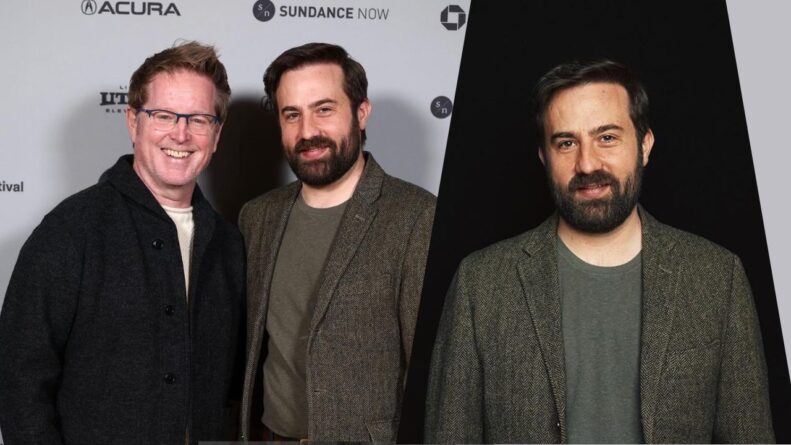
If you have been keeping up with the Sundance Film Festival 2026, you may have found yourself wondering what Andrew Stanton is doing these days. The Whiz behind Wall-E has at long last arrived back on live-action soil and he is doing so with uncertainty, not caution. His new film In the Blink of an Eye is not only a return to form it is a high concept, mindbending thrill ride.
In the Blink of an Eye at a Glance
Feature
Details
Movie Title
In the Blink of an Eye
Director
Andrew Stanton
Writer
Colby Day
Genre
Science Fiction / Drama
Narrative Style
Triptych (3 interconnected stories)
Time Periods
45,000 BC (Neanderthals), Present Day, and Far Future
Core Theme
Human connection across time, evolution, and technology
Story Approach
Visual storytelling & behavior over heavy dialogue
Structure
Non-linear and multi-timeline
Editing Style
Using “Emotional Sync Points” to link different eras
Premiere
Sundance Film Festival 2026
Vibe
Thought-provoking, Sci-Fi With Emotional Depth
Standout Factor
Skips the “Hero’s Journey” to focus on shared human feelings
Andrew Stanton’s Bold Return to Live-Action Sci-Fi
So, what’s the deal? That’s not your average “aliens destroy the White House” science-fiction movie. It’s a triptych — which is just a fancy way of saying that it tells three separate stories that are all interconnected.
A Typical Alien Story Told Across Millennia
It is a narrative that leaps randomly back and forth over the course of thousands of years, from ancient Neanderthals to the current day, and then to the future.
It’s ambitious, it’s a little experimental, and it’s trying to suss out what really makes us “human” from era to era.
A Triptych Narrative That Spans From Neanderthals to the Future
Visual Storytelling Over Dialogue
Andrew Stanton had long been working on big shows such as Stranger Things, 3 Body Problem, and he spent that time ‘hand-picking’ his dream team. He’s also leaning heavily on his animation roots.
Andrew Stanton’s biggest takeaway is the importance of imagination. He thinks the presence of a character — an expression, a movement, or maybe a choice can say more than dialogue ever could. The end product is a movie meant to make you feel first, leading emotion with images rather than explaining everything in words.
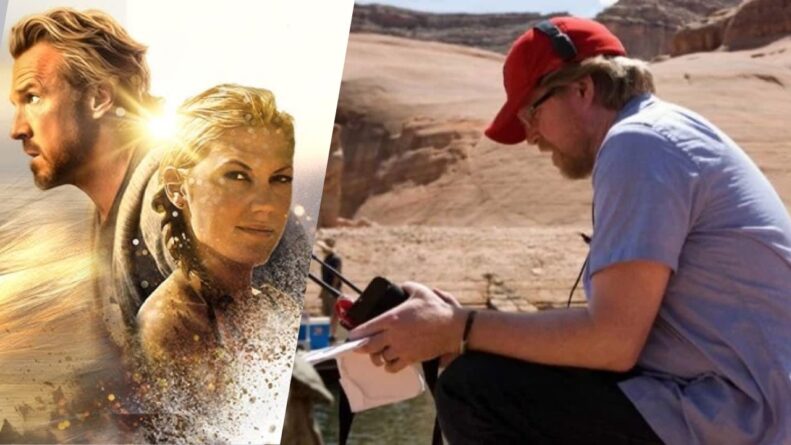
Image Credit: Fandomfans
Rejecting the Hero’s Journey for Something Riskier and Richer
The author, Colby Day, confessed he was a little tired of the typical movie structure we get applied to everything. Rather than tracking a single protagonist on a familiar trajectory, he wanted to “blow up the world” and change the rules. He was inspired by films such as Cloud Atlas — those “big swings” that might be a little messy but way more interesting than a “safe” blockbuster.
Image Credit: Fandomfans
How Editing Three Timelines Finds One Shared Human Emotion
Just think about what it would be like to edit three separate films into one. The editor Mollie Goldstein said they had to find “sync points.” They’re moments when a character in 45,000 BC is experiencing exactly what someone in the future is. It’s the emotional glue that holds the whole thing together.
Why Emotional Connection Is Replacing Spectacle in Sci-Fi
Connectedness is the new spectacle: The age of hollow, effects-laden action-movies is waning. In the Blink of an Eye caters to a burgeoning demand for narratives with emotional connections — demonstrating that no matter how far technology evolves or centuries elapse, what really resonates is how intimately we are linked to one another.
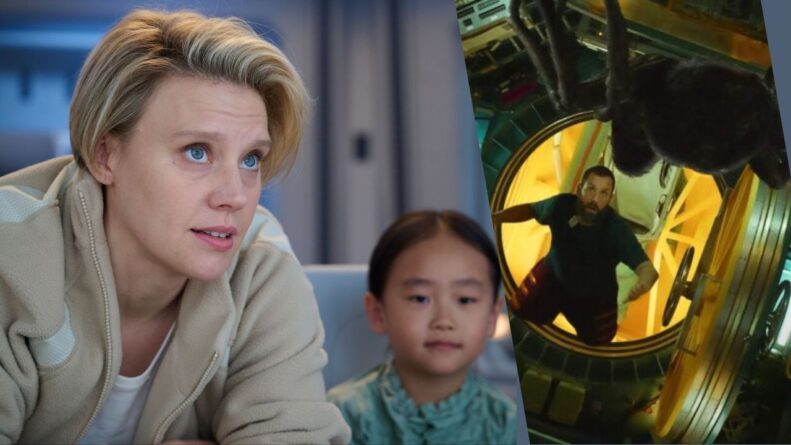
Image Credit: Fandomfans
The Comeback of Big, Risky Ideas in Modern Filmmaking
The Comeback of the “Big Idea”: For a time, it seemed like movies were made by committee. This feels like a personal project and a risk. If this works, studios will once again trust directors with strange, “unfilmable” scripts.
What the Film Says About Being Human
Universal Struggles: By featuring Neanderthals, the film makes us aware that even as our phones evolve, our hearts don’t. We’re all still coming to grips with the same primal fears and loves that people had thousands of years ago.
Darkly In The Blink of an Eye is a quiet rebellion against all the sci-fi that has played it safe for far too long. Rather than pursuing bigger explosions and louder stakes, it looks inward – across centuries, across species, across futures – to consider what actually endures.
When the film connects Neanderthals, modern humans and future societies through shared feelings, it tells us our survival is not dependent on wiping out the other; rather it magnifies our humanity. If this movie sticks the landing like it promises, it won’t just be a standout at Sundance — it may indicate a turn toward even braver, more emotionally intelligent sci-fi, where connection matters more than spectacle.
Dive into the world of entertainment with Fandomfans to get deeper details from directors, stars, and industry insiders.
Mariyam
Articles Published :
50
Mariyam Khan is Fandomfans Content Writer and providing reports and reviews on Movie Celebrities, and Superheroes particularly Marvel & DC. She is covering across multiple genres from more than 4+ years, experience in delivering the timely updates.