Home > Movies > ‘Star Trek: Starfleet Academy’ Rebuilds Hope as Episode..
‘Star Trek: Starfleet Academy’ Rebuilds Hope as Episode 6 is Turning Point
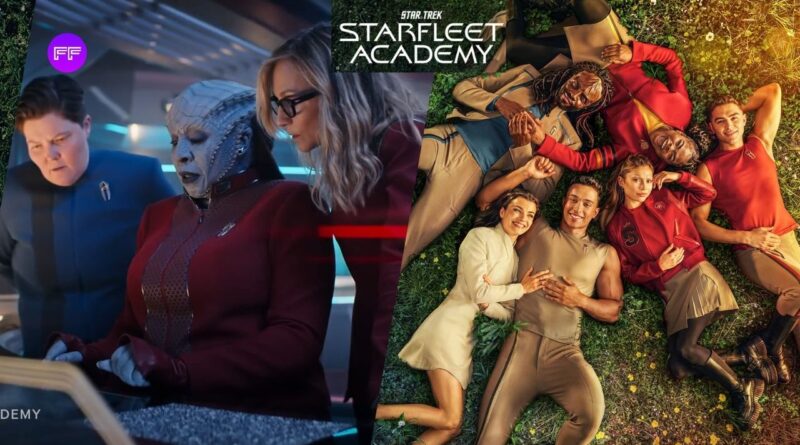
Star Trek: Starfleet Academy Episode 6 is a turning point, as cadets confronthard truths, moral sacrifices, and even the end of hope in a shattered galaxy.
When Star Trek: Starfleet Academy premiered on January 15, 2026, we got a whole new show as it gave the entire franchise a soul transplant. Following the launch of Star Trek: Discovery leading us into a 32nd century devastated by “The Burn,” the galaxies felt distant and broken. Academy arrives as the desperately “Architecture of Optimism,” you could call it, because it’s about a generation that doesn’t simply study history — they have to rebuild it.
At the midway point (Episode 6, “Come, Let’s Away”), the series has established itself as an intriguing, if divisive, “teaching hospital” among the stars.
Learning the Cost of Idealism in a Broken Galaxy
Showrunners Alex Kurtzman and Noga Landau took a sharp left turn away from Trek tradition. Typically we are chasing the best of the best.” In the Academy, taking place on the USS Athena in the year 3195, the school is not simply a campus in San Francisco, as it is a mobile unit where the classroom itself is the front line.
It is this paradigm that enables the series to address the cost of idealism. These cadets aren’t legacy hires, they’re survivors of a galaxy that stopped trusting. Seeing them fall on their faces — emotionally and professionally — helps their triumphs later on feel earned, not scripted.
Casting That Elevates the Entire Series
The series derives real dramatic heft from its powerhouse cast, and Holly Hunter’s Chancellor Nahla Ake is a defining force that lifts the whole show. She’s not a hard-nosed commander; she is a “reformed” officer who at one point walked out of Starfleet in protest. Her “steel magnolia” energy is a perfect foil to the raw, explosive energy of the cadets.
Opposite her is Paul Giamatti as Nus Braka. Giamatti never becomes the stereotypical “cackling space pirate” character, instead portraying Braka as a bitter victim of the Federation’s past mistakes. He’s a “Small Man” with a big grudge, a reminder that a single individual with a scheme can be as lethal as a Borg Cube.
The Bridge to the Past
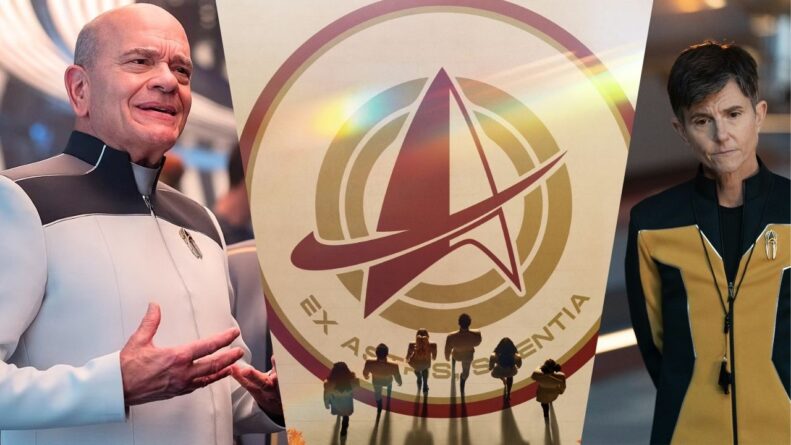
With the addition of Robert Picardo (The Doctor) and Tig Notaro (Jett Reno), you do have the vital connective tissue to Trek’s history.
The Doctor is the “voice of history,” having evolved from a 24th-century medical instrument to an ethics mentor.
Jett Reno is still the final reality check with the dry wit needed to put all the high stakes drama in perspective.
Character Arcs — A New Class of Starfleet Heroes
Caleb Mir (Sandro Rosta) is a reluctant leader. His vulnerability offers a welcome breath of fresh air among all the “swaggering captains”.
Tarima Sadal (Zoë Steiner): A Betazoid whose abilities are more of a curse than a gift. Her arc culminated in utter bleakness in Episode 6 when she had to take her empathy out as a lethal weapon.
Jay-Den Kraag (Karim Diané): A Klingon who shuns the “warrior” stereotype. In the 32nd century, Klingon is a diasporic identity, and Jay-Den gains his strength from arguing rather than from the bat’leth.
SAM (Kerrice Brooks): A photonic cadet engaging with the “Pinocchio” trope in terms of faith, resulting in a stunning (and divisive) homage to Benjamin Sisko.
Mid-Season Transition: From Classroom Drama to Survival Horror
The first six episodes made a brilliant transition from “academic orientation” to “survival horror.””
Many singled out Episode 5, “Series Acclimation Mil,” as a love letter to Deep Space Nine. The use of archival audio of Avery Brooks (with the blessing of the Sisko estate) was a gamble that paid off by anchoring the high-tech 32nd century in the spiritual mystery of the Prophets.
Episode 6 Turning Point
But then there was Episode 6. The addition of The Furies—cannibalistic hybrids taken the “CW Trek” whines down several notches. It was a painful reminder that the “teaching hospital” is now a trauma center. Tarima when she rescues the crew by “liquefying” the enemies’ brains, the show is letting you know it’s no longer the age of innocence.
From “CW Trek” to Mature Sci-Fi Drama
Maybe for the first three episodes, but by Episode 6, Starfleet Academy has got it right. It’s a show about how fragile civilization is, and how much responsibility comes with being the “Class of the Rebirth.”
Aspect
Detail
Theme
Rebuilding the Federation through empathy.
MVP
Holly Hunter (Chancellor Ake).
Key Set
The Sato Atrium (Largest in Trek history).
The Big Bad
Nus Braka & The Furies.
The first half of a season has established a high standard. We’ve had “sorting hat” moments; now we’re seeing the scars. As they pursue Nus Braka into the latter half of the season, these cadets have moved beyond mere students—they’re the final hope of a Federation desperate to make its way back toward the light.
What Star Trek Starfleet Academy truly is not so much another story about the spacefaring life — it’s what hope looks like in a shattered galaxy. Star Trek: Discovery showed us the end of the world, Academy the slow, painful, everyday work of rebuilding. By moving the storyline focus away from iconic captains to fallible cadets, from glory missions to moral consequence, the series recalibrates optimism as something acquired rather than bequeathed.
Dive deeper into the world of entertainment with Fandomfans to get updates from your favorite movies.
Mariyam
Articles Published :
77
Mariyam Khan is Fandomfans Content Writer and providing reports and reviews on Movie Celebrities, and Superheroes particularly Marvel & DC. She is covering across multiple genres from more than 4+ years, experience in delivering the timely updates.
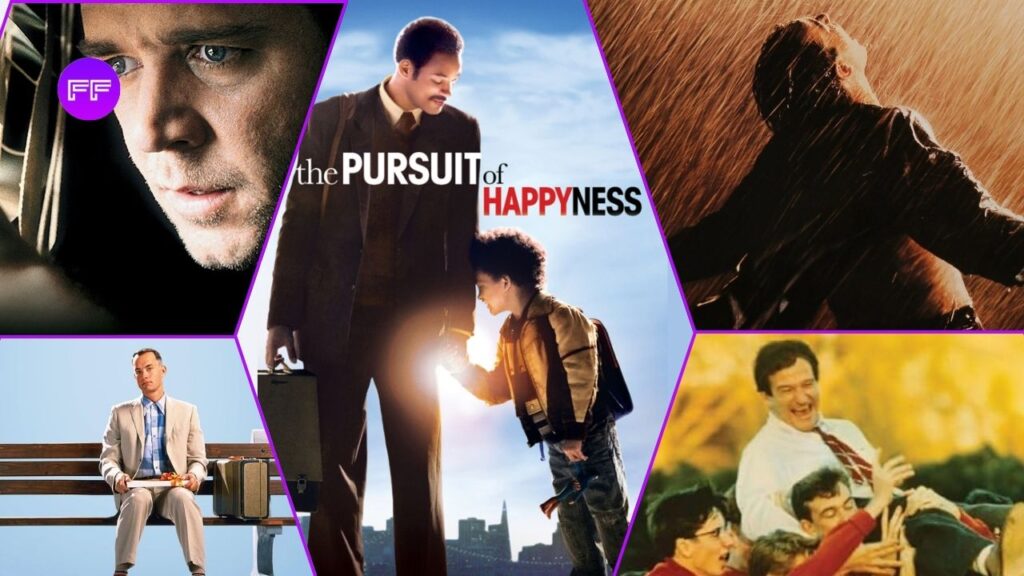
The 10 Must-Watch Movies That Will Fundamentally Change How You View Life
Discover 10 movies that motivate you to never stop trying, loving and praying. Watch them and you’ll see your path from a new, uplifting angle. Learn more..!
Written by:EmmaLast Updated: January 24, 2026, 7:58 am
Published: February 23, 2025, 11:56 am
Comments
Share:
Movies have the ability to inspire and can change your life. They take us to other places and make us question our beliefs. Films allow us to perceive the multi-dimensionality of the human life.
These 10 iconic films that will alter your perception of life. These are not just entertaining movies but also educating and giving you lesson to life with some good take away.
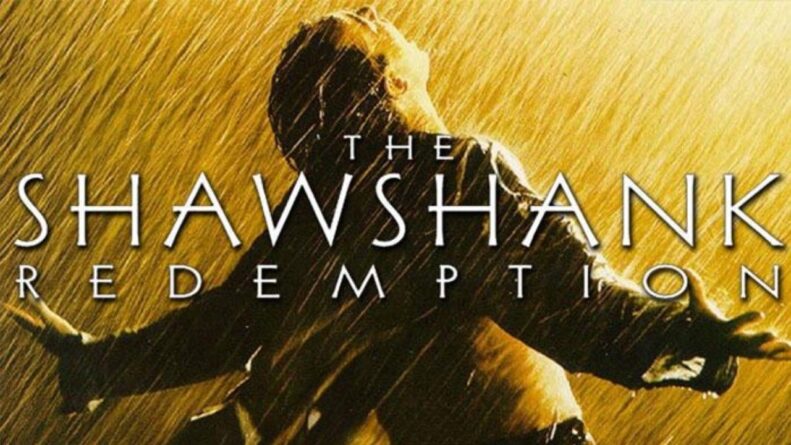
1. The Shawshank Redemption (1994)
The Shawshank Redemptionis regarded as one of the best films of all time. It tracks the story of Andy Dufresne, a banker who is falsely accused of his wife’s murder. Andy also remains hopeful and dignified in the brutal environment of Shawshank prison.
Image Credit: Tribune Style
The message is “The power of perseverance and hope.” Its iconic phrase, “Get busy living or get busy dying,” resonates with the audience.It motivates people to confront life’s obstacles directly and not to give up, whatever the difficulties.
2. Forrest Gump (1994)
Forrest Gump is the story of a retarded man who ends up influencing the course of history twice. His straightforward, poignant perspective on life teaches us about love, friendship and the surprises life has in store.
Image Credit: TV Insider
Forrest’s memorable line, “Life is like a box of chocolates – you never know what you’re going to get,” encourages us to greet life’s mysteries with an open mind and take pleasure in surprises. The film invites us to walk through life, one step at a time.
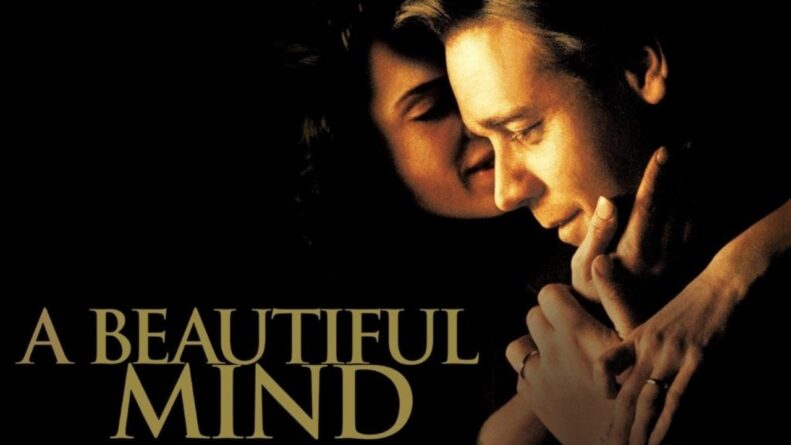
3. A Beautiful Mind
A Beautiful Mind is the true story of the great mathematician John Nash. The movie portrays his battle with schizophrenia. It chronicles his path to coming to terms with his illness and gaining insight. The film stresses the one thing people need for love to stick: a little help from the people around them.
Image Credit: themarckoguy
It underscores the fact that it’s these relationships that help us overcome ourselves. The film is a call for people to put mental health stigma behind them. The movie teaches a lot more than just relationships and love, it teaches us to learn the value of the richness of every person’s narrative.
4. The Pursuit of Happyness (2006)
The title gives the meaning of life to a single father named Chris Gardner to chase a dream of a happy little family. He struggles to keep his son out of poverty while working as a salesman in a brokerage firm.
Image Credit: Eyra
Will Smith delivers a powerful, uplifting portrayal of Gardner. The film conveys that you achieve success by working hard and not giving up.
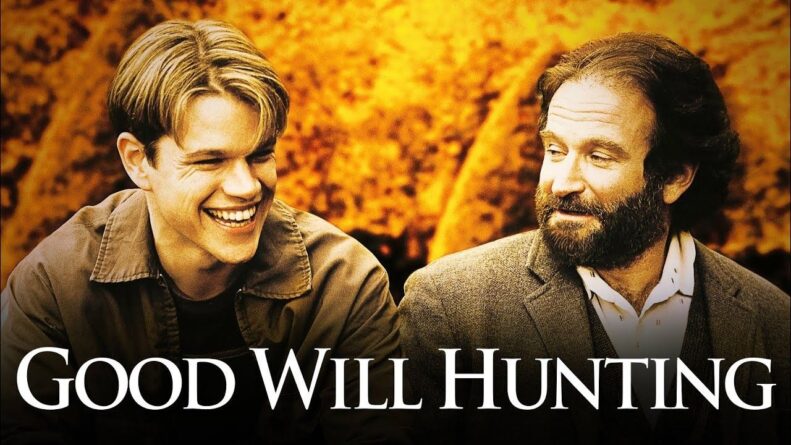
5. Good Will Hunting (1997)
Good Will Hunting is the story of a young janitor at MIT who has a gift for mathematics but is emotionally stifled by past trauma. He also receives assistance from a counselor, portrayed by Robin Williams.
Image Credit: MiraMax
With therapy, Will learns to confront his demons and achieve his potential. The film illustrates the power of mentorship, self-discovery and emotional healing. It’s an excellent watch if you’re someone who struggles with your identity or just your stuff.
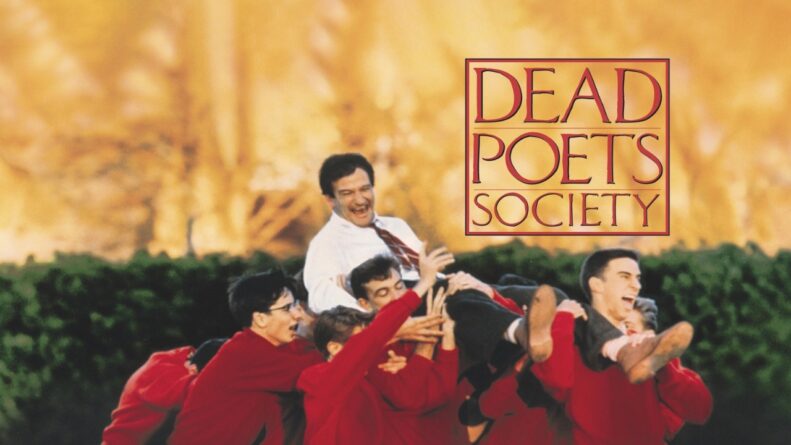
In “Dead Poets Society”, an English teacher inspires his students to live by “carpe diem,” instilling in them the need to make the most of every day and follow their dreams. He emphasizes the use of poetry for personal expression and individuality, encouraging them to confront adversity and find peace and meaning through creative work.
Image Credit: Prime Video
Robin Williams’ character: Life is too short. He encourages the audience to live passionately and truly, to defy societal norms and conformity.
7. Life Is Beautiful (1997)
Life Is Beautiful is an italian motion picture that recounts the experiences of the Jewish Guido Orefice during World War II. He relies on humor and nothing more than imagination to shield his child in a concentration camp. The film demonstrates that even in the darkest times love shines through.
Image Credit: Ashley Manning
It imparts courage, optimism, and the strength that comes from thinking positively. This tale is profoundly moving and it teaches us the value of love and hope no matter how difficult the circumstances.
8. Everything Everywhere All At Once (2022)
The new film Everything Everywhere All At Once examines issues of identity, family and existentialism. It is multiverse storytelling.
Image Credit: Book My Show
It’s a film that urges us to reconsider some of our decisions and connections. It’s a method of how to get through life’s storm. The distinctive narrative format redefines conventional storylines. It makes you think about where you fit in a big, growing universe.”
9. Slumdog Millionaire (2008)
SlumdogMillionaire is the story of Jamal Malik, an underprivileged young man from the slums of India’s bustling financial capital, Mumbai. He’s on a game show competing for his future. As he plays, he flashes back to moments in his past that brought him here.
Image Credit: The Hollywood Reporter
Themes of destiny, love and survival are prevalent throughout the film. It gives hope to those who are going through difficult time to hold on to their dreams.
10. Pan’s Labyrinth (2006)
Pan’s Labyrinth takes place in the aftermath of the Spanish Civil War. It’s about a young girl called Ofelia, who comes across a mythical labyrinth. The tale combines fantasy and brutal reality.
Image Credit: IMDB
It teaches them how to appreciate the world, how to value life, and how to understand the beauty of a cruel world. The movie celebrates imagination as a refuge from pain. It compels one to confront harsh realities while feeling solace and upliftment via the medium of creativity.
Conclusion
These amazing movies are not only entertaining and enjoyable, but they make us stop and think about our lives! They offer profound life lessons for personal growth. If you are struggling or just want to see things differently, these are the movies for you. They’re a better way to know yourself and a better way for you to see the world.
Life becomes truly difficult, and these movies remind us we are not isolated. They motivate us to cling to hope, be strong, and open our hearts to beauty and imagination. So, grab your popcorn, sit back and prepare yourself for an unforgettable ride. These movies change you in ways you can’t even conceive.
Fandomfansis giving every entertainment news as fast as the speed of Flash, keep following to get latest updates.
Emma
Articles Published :
36
Emma Miller is an entertainment enthusiast who is focusing on crafting storytelling blogs across all genres. Her special focus is build up around superheroes, thrillers, & historical dramas and movies. Her experience of delivering sharp review analysis and interview podcasts is helping fans to get transparency about their favorite cinema.
Dwayne “The Rock” Johnson is without a doubt high up on the list of the most bankable stars in Hollywood. The Rock has one of the most successful and diverse film careers in recent memory, going from an explosive breakout in action blockbusters to unexpected turns in comedy and family films. Here’s the definitive guide to the Top 32+ movies in which he demonstrates his stunning range as an actor and performer, whether you’ve been a fan for years or are just discovering his catalogue.
The Early Days: Foundation for Stardom
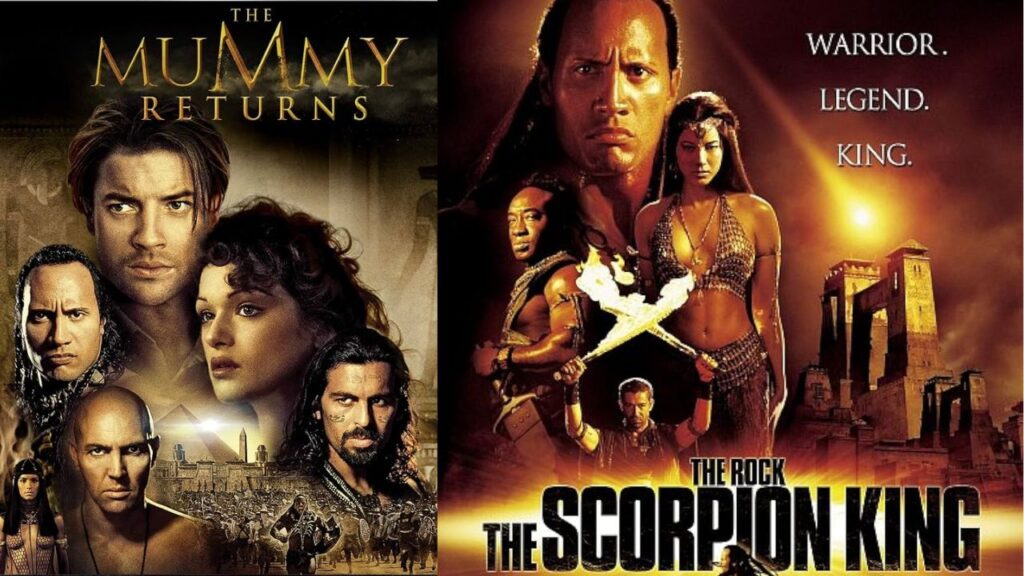
Dwayne Johnson was not a household name when he first got his start in Hollywood. Though his first feature film part was in 1997, in The Mummy Returns (2001)as the Scorpion King, a brief but impactful role that introduced him to mainstream audiences. That moment was pivotal, and then he had his first leading role a mere one year later in The Scorpion King (2002), which solidified him as an action superstar.
The Rock, meanwhile, solidified his status with The Rundown (2003), which remains one of his finest action-comedies. Co-starring with Christopher Walken and an early blend of comedy/action, the film gave Johnson a chance to display his charisma and potential as a leading man. As one of Johnson’s earliest films, The Rundown is a risky gamble, but it really pays off, as he portrays Beck, a taciturn bounty hunter who is sent to apprehend his boss’s son, who has been hunting for treasure in Central America.
Building an Action Empire (2004-2010)
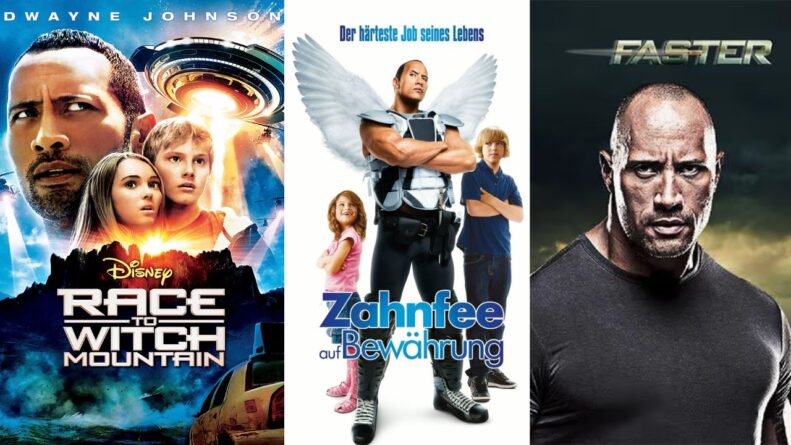
As Johnson found his niche in Hollywood, he was offered an array of different roles.Walking Tall (2004) was the respectable action film of the bunch, and Doom (2005) was the most ambitious albeit least successful adaption of a video game craft so far. The same year saw Johnson donning his comedic flair in Be Cool (2005).
Image Credit: Fandomfans
A guy who never limited himself to one genre, Johnson caught people off guard with Gridiron Gang (2006), a dramatic sports film in which he is a rehabilitation counselor employed by a juvenile detention center. This showcased his range as an actor and demonstrated that he could do more than just act in pure action movies. Family audiences started to become aware of him with The Game Plan (2007), while Reno 911!: Miami (2007) proved that he was a tour de force in comedic support roles.
Get Smart (2008) put him opposite Steve Carell in a secret agent-comedy schtick that favored action over humor. He added voice acting to his credits inPlanet 51 (2009) when he provided the voice for astronaut Chuck Baker and Race to Witch Mountain (2009) once again took him to the family movie field. The decade concluded withTooth Fairy (2010), a quirky kids movie that had Johnson actually turning into a tooth fairy. The film was savage but showed a performer ready to make wildly unconventional gambles. The same year, he made a return to his action roots with the more hard-edged thriller, Faster (2010), as a vengeful man.
The Box Office Explosion (2011-2015)
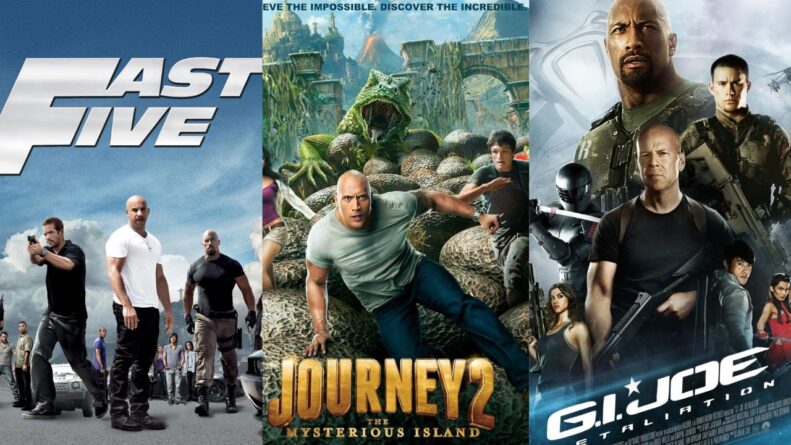
All that changed when Johnson entered the Fast Five (2011) stable as brutal enforcer Luke Hobbs. That’s the turning point that made The Rock a megastar. His chemistry with Vin Diesel and the rest of the cast and crew, as well as the sheer physical comedy and action prowess he brings, revitalized the franchise.
Image Credit: Fandomfans
After this breakthrough, Johnson was more selective about his parts. Journey 2: The Mysterious Island (2012) saw him get into family adventure material, taking on one of the genres with more long term potential. Fast & Furious 6 (2013) continued his momentum in the franchise, and Pain & Gain (2013) afforded him an opportunity to demonstrate his dramatic abilities in a true crime action film with Mark Wahlberg and Anthony Mackie.
Snitch and G.I. Joe: Retaliation were also out in the busy 2013 year. Empire State (2013)gave him the opportunity to extend his menacing presence as an NYPD officer with a vendetta. Hercules (2014) was another turn towards mythological adventure based storytelling, with Johnson playing the Greek demigod as he faces his mythic twelve labors. San Andreas (2015) turned out to be a turning point, demonstrating Johnson could lead a big disaster movie and become a worldwide mega-star who could open films on his own merits.
Furious 7 (2015) cemented his position as the franchise’s biggest earner, grossing over $1.5 billion and containing some of the series’ most memorable action scenes.
The Blockbuster Releases of Dwayne Johnson in 2016-2019
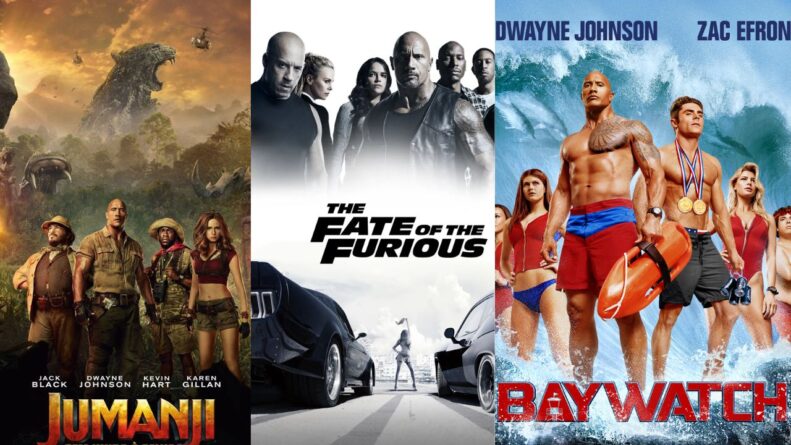
Johnson became one of the highest-grossing box office draws beginning in 2016. He teamed up again with Kevin Hart for the 2016 film Central Intelligence, and their comedic chemistry endured. Johnson made a multi-layered, vulnerable comedic and physical performance in Jumanji: Welcome to the Jungle (2017)a magnificent reboot of the franchise.
image credit: Fandomfans
Also that year was The Fate of the Furious, yet another Fast & Furious installment that brought in more than $1.2 billion globally. Baywatch (2017) was a more frivolous affair, although it was almost universally panned by critics – but audiences turned out to see Johnson in that red lifeguard suit.
Skyscraper (2018) is vulnerable — Johnson playing a lame one-legged FBI agent who has to risk everything to save his family in a burning skyscraper. Rampage (2018) saw him furthering his action dominance with taking on mutants alongside a super-sized ape.
Jumanji: The Next Level (2019) brought back the enchanted game world, plucking players into even more chaotic, wilder adventures, with Johnson offering comedic narration as he pretended to be Danny DeVito as he took over his game avatar. Hobbs & Shaw (2019)gives the fans what they want—Johnson and Jason Statham finally getting their own spin-off, and finally teaming up, giving them a chance to demonstrate their comedy timing as well as their action chops.
Recent Work and Diverse Ventures (2021-2025)
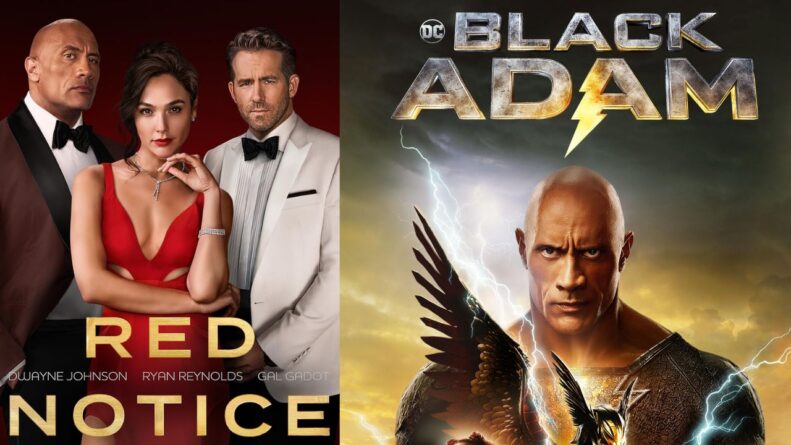
The Rock has also undergone the voice over and producing process. He was in the heist comedy Red Notice (2021), alongside Ryan Reynolds and Gal Gadot. In the Disney adventure Jungle Cruise (2021), Johnson and Emily Blunt are joined by Dwayne Johnson as Frank Wolff, a steamboat captain who agrees to unwillingly escort Dr. Lily Houghton down a perilous river in search of secrets.
Fighting with My Family (2019), about a wrestler’s rise to prominence, showcased his knack for serious supporting roles. He was afforded the chance to lend his voice to Krypto the Super-Dog in DC League of Super-Pets (2022), showcasing his talent to captivate spectators in animated movies. He received a Teen Choice Award for his role as the charming and lovable demigod Maui in the 2016 film Moana.
image credit: Fandomfans
(2022) was his debut foray into DC as the Egyptian mythological anti-hero, unleashing a formidable Kahlid who ascends as the ancient Egyptian magic avatar. This high-profile superhero venture, which was ambitious, had a budget of $250 million and grossed $393 million globally, demonstrating his capacity to lead big studio tentpoles.
What Makes The Rock Different?
A pattern is evident in all these 32+ movies. Johnson’s desire to do comedy and still be believable as an action hero makes him unique among action stars. He’s at ease being vulnerable — be it as a one-legged FBI agent or a demigod struggling with self-doubt. His work ethic and down to earth charm make him have on screen chemistry with all his co-stars and he has done just as well in family films, drama and blockbuster ensemble films.
From doubters questioning his talent as an actor to one of Hollywood’s highest paid stars, Dwayne Johnson’s filmography is a master class on how to have a sustainable career in the business. Whether you’re looking for action excitement, comedy laughs, family fun, or some real dramatic moments, his body of work has a little something for everyone. And that all makes going through his top 32 movies not only entertaining — it’s actually instructive on how to make a Hollywood career with a little authenticity and versatility.
Conclusion
Dwayne Johnson’s bankability and versatility is on full display across these top 32+ movies, proving why he’s one of Hollywood’s most powerful stars. Action packed, heart warm family film, comedy wise The Rock pumps charisma, commitment and authenticity in every role he plays. Not only is his filmography entertaining — it’s an education in how to craft a career that lasts and spans genres in the film industry.
Fandomfansis a platform where you can get your favorite celebrity blockbuster movies, journey details, early life in detail.
Alpana
Articles Published :
163
Alpana is Fandomfans Senior Editor across all genres of entertainment. She evolved in the media industry since a very long time, she manages the content strategy and editing of all the blogs. Her focus on story development, review analysis, and research is well-equipped that ensures every article meets the standards of accuracy and depth.