Blue Moon (2025): Richard Linklater’s Poignant Masterpiece on Art, Loss & the Cruelty of Time
Explore Blue Moon (2025), Linklater's poignant film on art, loss, and time, featuring Ethan Hawke's career-defining portrayal of Lorenz Hart.
Richard Linklater is known for his temporal distortions, which he often varies over the course of decades, as in the Before trilogy or Boyhood. But in his 2025 magnum opus, Blue Moon, he does something radically different. He condenses the crushing burden of an entire career going down the tubes into a single confining night in the bowels of Sardi’s restaurant.
This movie is not simply a biopic, it’s a chamber piece on the brutal architecture of artistic mourning. It is March 31, 1943, and with these words the film memorializes the end of the Jazz Age, which was immediately supplanted by the “golden age” of the musical theater.
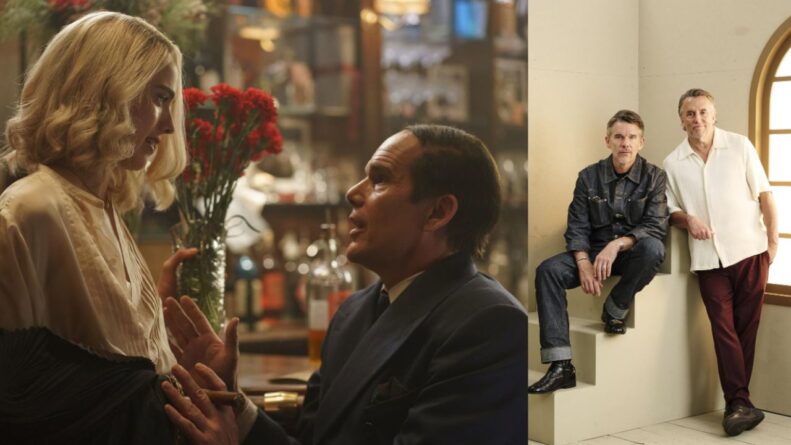
The setup is ruinously straightforward. Lorenz “Larry” Hart (an electric Ethan Hawke), the brilliant, jaded lyricist half of the legendary Rodgers and Hart team, is holding up the bar at Sardi’s.
Just across the street, his one-time soul mate and partner, Richard Rodgers, is debuting Oklahoma! with another partner, Oscar Hammerstein II. Hart must wait in the limbo of the restaurant, the muted applause he can hear is the sound of him being made redundant.
Linklater has said the film “Deals with a trauma that is, in a way, two-fold.”
This is not just a business split, it’s an artistic divorce between two men who defined an era together. Rodgers, the practical puppet master, had to change in order to live, to detach himself from Hart’s chaotic alcoholism and revue-style wit to something more formal and honest. Hart, the poetic soul of the roaring twenties, was just abandoned.
Read More 👉 Martin Gero and Amazon MGM Studios is looking for a New Cast for The Military Sci-Fi Series
The brilliance of Blue Moon is that it knows how to wait. According to The Guardian, Linklater and Hawke had been thinking about this film for more than ten years. Linklater famously told Hawke years ago,
“I’ll wait 10 years,”
Knowing the actor had to age into the role. To play the battered, gnome-like figure of the 47-year-old Hart, a guy worn down by drink and depression, he had to lose his youthful boyishness.
That prolonged timeline gives the film a deep, lived-in sadness. We see Hart desperately go through the motions of his old self — flirting, quipping, drinking trying to drown out the scary fact that the society he helped shape has no use for him anymore. He derides the “corny” nostalgia of Oklahoma! and cannot understand why the audience’s preference has moved away from his urbane sophistication to simple country sweetness.
“We all think we’re gonna run the table forever but tastes can change,” Linklater says in the production notes.
That is the film’s haunting thesis. Blue Moon is a monument to the “loser” of historical change. It’s a beautiful, sad recognition that sometimes even the most brilliant cultural architects find themselves trapped in the past, watching the future being built just down the street without them.
Blue Moon isn’t merely a movie — it’s an elegy. Linklater creates a haunting reflection on change, mourning and the slow brutality of time. The film, anchored by Ethan Hawke’s brilliant performance, reminds us that even the most brilliant creative minds can quickly become relics. It’s a masterwork of stillness, sorrow and storytelling: a paean to those who made the past even as they watched the future speed by.
Our daily coverage brings you the key takeaways, storytelling and pop-culture shifts from cinema. The Fandomfan’s mission is to assist you understand films not just as entertainment, but as cultural events that influence in the world of what we think.
AI star Tilly Norwood, created by Eline Van der Velden’s Xicoia studio, is drawing major Hollywood talent agencies—reshaping the future of acting.
Meet Tilly Norwood – Hollywood’s First “Fake Real” Star introduced by Dutch comedian-producer Eline van der Velden through her AI studio Xicoia. According to Variety, Norwood “has drawn the interest of several talent agents” after being debuted at industry-targeted Zurich Film Festival summit. Van der Velden informed the Zurich Summit panel that studios – early doubters of AI actors in early 2025 – are now “moving quietly ahead with AI projects,” and that she anticipates an imminent announcement of which agency will have Norwood as their client. And lo and behold, some talent agents are already swooping around her.
Her debut? An all-AI comedy sketch called AI Commissioner — from script to performance, it was all generated. Eline even went on to state that she wishes Tilly to become “the next Scarlett Johansson or Natalie Portman.” Daring, isn’t it?
News of Norwood’s agency buzz triggered swift backlash from working actors. Hollywood stars publicly criticised on social media, asking how a computer-generated “actress” would fill the role of actual actors. The Wrap covers –
Actress Melissa Barrera (In the Heights) took to Instagram: “Hope all actors repped by the agent that does this, drop their a$. How gross, read the room.”
Others sarcastically predicted that contracting an AI “actress” would be a PR debacle at best, a catastrophe at worst. The Independent’s report included similar zingers by stars such as White Lotus’s Lukas Gage: “She was a nightmare to work with!!!!”.
Van der Velden compares AI to previous technologies such as animation or CGI – “a new brush, a new paintbrush” – that enhance storytelling without doing away with live performance. She underlines that “nothing – certainly not an AI character – can take away the craft or joy of human performance”.
Overall, some people think that it can jeopardize the real talent of real performance and their careers too but some believe that this is an experimental creative tool of Norwood.
Tilly Norwood’s appearance has fueled controversy for the classic acting roles in the future. Critics caution that if studios or agencies start dealing with AI characters as commodities, human actors may see fewer opportunities, stated by Deadline. The 2023 SAG-AFTRA agreements already contain firm safeguards (negotiated under union pressure) to avoid unapproved AI use of actors’ likenesses. Union officials have maintained that any application of a performer’s digital double needs to be affirmatively approved and paid for. On the agency front, some reps may consider an AI actor to be a publicity stunt worthy of consideration — industry speculation about an agency inking Tilly to garner press attention has been out there – but most agents are cautious.
According to Hollywood Reporter, agencies that try to sign Norwood could destroy confidence: “If your agent does this, drop their a$.” Practically speaking, even if Norwood or other AI talent land the occasional job (commercials, voiceovers, background), big stars will continue to be required for bankable leads, and productions will need to work with union rules.
In the short term, Norwood’s case has placed agencies on notice that AI is a “hot” issue – agents can softly scout for AI talent or ignore the trend, but they risk blowback either way.
The Hollywood studios seem cautiously interested in generative AI. At the Zurich panel, Van der Velden saw a change in studio mindset from skepticism (“this is nothing”) early in 2025 to interest (“we need to do something”) mid-year. Industry analysts point out that studios might view AI tools as means to reduce costs and speed content production (e.g., automating background extras, pre-visualization, or editing). Experts have indicated that AI may allow even smaller studios to “make high-end content at a fraction of the expense,” possibly expanding competition.
The Deadline reports that the web’s leading “digital influencer,” Lu do Magalhães, boasts more than 8 million fans despite being a complete computer simulation. This pairing demonstrates that although mainstream cinema audiences first refuse to accept blatant deepfakes, younger or more computer-literate audiences occasionally accept or indeed prefer artificial celebrities on the web.
As van der Velden contends, if Norwood can provide compelling performances, audiences may be more concerned about story than she is machine. But at least for now, many industry observers believe AI actresses like Tilly will remain curiosities rather than genuine replacements for popular live performers.
Tilly Norwood is only one example of AI’s growing footprint in entertainment. Industry analysts are forecasting that AI tools will become widespread in production pipelines (storyboarding, visual effects, language dubbing, etc.), though leadership in creativity will still be human-driven in the near term. Some believe AI will unleash a deluge of cheap content (offering regulation or curation), while others envision it as fueling indie innovation. What is certain is that Hollywood will incorporate AI increasingly – though cautiously.
As the case of Tilly Norwood shows, studios and tech companies might chase “AI actors” as an experiment, but mass acceptance will depend on how audiences respond and union negotiations. If Norwood is successful at finding employment and garnering eyeballs, it will inspire more AI productions; if she crashes or incites consumer hostility, the market will tap the brakes.
As Variety and others point out, the controversy surrounding Tilly Norwood illustrates broader issues of whether AI is merely “another tool” for directors or a force that might disrupt conventional acting work. The long-term direction will depend on the degree to which Hollywood harmonizes progress with art and labor considerations – and a chapter that continues to be written.
Jennifer Aniston's stunning transformation from Rachel to The Morning Show has fans amazed. Check out her fitness, fashion and fearless role selections to date.
Aniston played Rachel Green on ‘Friends’ for ten seasons from 1994 to 2004, a character whose mannerisms, hairstyle, and love interests defined what it meant to be a 20-something woman around the world. The actress could not be disentangled from the character, it’s hard for everyone to recognize Aniston in other characters. Rachel Green was everywhere, on lunch boxes, in syndication, and in the cultural lexicon.
Aniston noted that she —
“Couldn’t get over from the shadow of Rachel Green ever in my life”
describing the experience as “exhausting”. The character was a “poor little rich daddy’s girl”, a specific archetype that afforded little room for the darkness or grit required of dramatic acting. Aniston admitted to fighting with herself and her identity in the industry “forever,” constantly trying to prove
She was “more than that person”.
—Aniston said
Jennifer Aniston’s whole Friends run nearly never happened because she was at that time already committed to a CBS sitcom titled Muddling Through back in 1994. Because she was “only in second position” for Friends, NBC was worried that they might have to recast Rachel if the CBS show was a hit, and speculated about shooting multiple episodes, only for CBS to pick it up and they’d have to do reshoots.
Aniston got her big break when Muddling Through was cancelled, and that led to her being cast on Friends – which just goes to show how precarious a career in Hollywood can be, and how one cancellation can make way for the series that takes an actor global and defines their stardom.
Helmed by Miguel Arteta, the film stars Aniston as Justine Last, a dour employee at a mall shoe store who has a clandestine relationship with a younger coworker (Jake Gyllenhaal). The choice to accept the part was nerve-racking.
“Panic that set over me,” thinking, “Oh God, I don’t know if I can do this? Maybe they’re right”.
—Aniston recalls
The film was an independent production, lacking the safety net of a major studio marketing budget or a laugh track. It required Aniston to perform “without a net” in front of the world. The success of The Good Girl and the critical acclaim she received—provided the “relief” necessary to continue pursuing dramatic work. It was the proof of concept that she could exist outside the “purple walls” of the sitcom apartment.
If The Good Girl proved she could be sad, Horrible Bosses proved she could be predatory. The appeal lay in the “black comedy” element. Aniston argued that “Comedy is a necessity,” but she expressed a preference for the “craziness” of the Horrible Bosses universe over the gentler comedy of Friends.
“Maybe everybody else is seeing something I’m not seeing, which is you are only that girl in the New York apartment with the purple walls”.
This quote speaks to the psychological complexity of the curse—it wasn’t only that she believed producers wouldn’t hire her but she was afraid she wasn’t capable of doing the work.
Breaking the curse required exposure therapy. By performing in independent films like The Good Girl and Cake, where the safety nets of budget and ensemble were removed, Aniston forced the industry to recalibrate its perception of her utility.
Cake is the ultimate punishment to shatter the curse. In this film, Aniston portrays Claire Bennett, a woman struggling with crippling chronic pain and addiction. Aniston quit exercising and wearing makeup. She studied friends with chronic pain to get a sense of what the condition felt like physically.
She allowed the role to “hurt” her, noting that during physical scenes, she “didn’t prepare” in the traditional sense but rather let the physical discomfort generate a real reaction.
Read More 👉 Wake Up Dead Man Review: A Bold Mystery but Missing the Knives Out Spark
The morning show era (TMS), Executive produced and co-created by Reese Witherspoon is the shift from Aniston the Actress to Aniston the Mogul. The show is more than just an acting vehicle, it’s a platform for industry commentary and power play.
The partnership with Witherspoon’s Hello Sunshine production company created an environment of “understanding, compassion and consideration” that Aniston notes
“Doesn’t always exist amongst the dudes”.
Alex Levy is the culmination of Aniston’s post-Friends evolution. She is a morning news anchor, but she shares no DNA with Rachel Green. Alex is “complex, vulnerable, controlled, lonely, enraged, self-serving”.
In Season 4 (2025), Alex has transcended the anchor desk to become a corporate executive. She is no longer fighting for a contract; she is fighting for the soul of the network. Critics have praised Aniston’s performance in this era as
“It is the best of her performances and able to perform mature characters”
noting her ability to portray moral conflict without the melodrama that sometimes plagued her earlier dramatic attempts. The role gives Aniston a chance to examine issues of power, complicity and growing older in a way Friends never did.
By 2025, she’s at a place very few could have predicted back in 2004: she’s the boss. On The Morning Show, she plays a character who runs the network, much like in real life, where she’s a producer on the show. She swapped the “purple walls” of the Friends apartment for the glass walls of the UBN executive suite. Jennifer Aniston has now shown beyond a shadow of a doubt that she is, in fact, “more than that person.”
Find out celebrities, movies, and web series updates on Fandomfans which is delivering every entertainment buzz to you.