The Rookie Season 8 Episode 10 “His Name Was Martin” delivers zombie-style horror, Lucy Chen’s emotional trauma, and shocking twists in a bold mid-season climax.
The Rookie Season 8 Episode 10 titled as “His Name Was Martin” with the opening from grounded procedural to powerhouse series. Analyzing the “zombie” outbreak at Westview Hospital, the psychological trauma of Lucy Chen, and the increasingly bizarre espionage storylines, we can determine how the show keeps its hold on the 2026 media environment.
Having been written and directed by series creator Alexi Hawley alone among the Broadway related episodes, and overseen by a true old-school production team consisting of Mark Gordon, Nathan Fillion, Michelle Chapman, Jon Steinberg, Terence Paul Winter, and Rob Bowman, Rookie Season 8 takes the procedural format and stretches it to the absolute, maximalist edge.
The Evolution of a Procedural Giant
John Nolan’s character study as an oldest rookie in the LAPD is what started an incredible story. The Rookie Season 8 Episode 10, “His Name Was Martin” is a definitive signpost of this development. Through a mash-up of horror conventions, domestic melodrama and international espionage, showrunner Alexi Hawley has fashioned a “maximalist” TV experience that values viral engagement over realism.
The Rookie Season 8 Broadcast
This structural division shows The Rookie Season 8 Episode 10 “His Name Was Martin” as a peak mid-season climax episode shattering the status quo and launching the characters into “Aftermath,” series name of their trauma and mission overreach.
| Episode Number |
Episode Title |
Original Broadcast Date |
Primary Narrative Focus and Thematic Catalyst |
| Season 8, Ep. 1 |
Czech Mate |
6/January/2026 |
Season Premiere; introduction of new interpersonal dynamics. |
| Season 8, Ep. 2 |
Fast Andy |
13/January/2026 |
Standard procedural case focus. |
| Season 8, Ep. 3 |
The Red Place |
20/January/2026 |
Final Tuesday broadcast prior to the network scheduling pivot. |
| Season 8, Ep. 4 |
Cut and Run |
26/January/2026 |
First Monday night broadcast; integration of new audience flow. |
| Season 8, Ep. 5 |
The Network |
3/February/2026 |
Escalation of serialized criminal underworld arcs. |
| Season 8, Ep. 6 |
Burn 4 Love |
9/February/2026 |
Character-centric relationship developments. |
| Season 8, Ep. 7 |
Baja |
26February/2026 |
Action-oriented procedural; suspension of Officer Penn. |
| Season 8, Ep. 8 |
Grand Theft Aircraft |
23/February/2026 |
High-stakes logistical crime sequence. |
| Season 8, Ep. 9 |
Fun and Games |
2/March/2026 |
Revelation of Luna’s emotional affair; Harper’s demotion. |
| Season 8, Ep. 10 |
His Name Was Martin |
9/March/2026 |
Zombie outbreak; Lucy’s lethal force trauma; Pentagon espionage. |
| Season 8, Ep. 11 |
Aftermath |
16/March/2026 |
Lucy returns to duty; Liam Glasser case hindered. |
| Season 8, Ep. 12 |
Spy Games |
23/March/2026 |
Continuation of Bailey’s covert Pentagon plot. |
| Season 8, Ep. 13 |
The Thinker |
30/March/2026 |
Procedural escalation and end-of-season positioning. |
A-Plot Analysis: The Westview “Zombie” Ambush
The main story of ‘The Rookie Season 8 Episode 10’ His Name Was Martin is survival horror tinged on the edge of police procedural. Stuck in the deserted Westview Psychiatric Hospital, Officers Nolan, Harper and Penn are bombarded by men, women and children who have been driven by a new psychotropic drug to a feral psychosis.
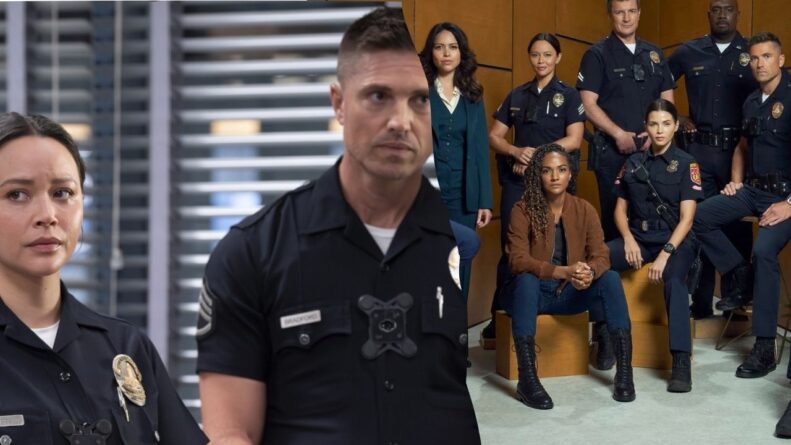
The ‘Zombie’ Loophole
The episode begins like any police procedural with a “routine welfare visit” to a deserted mental hospital. Instead, it swiftly deteriorates into nightmare territory when the police are overwhelmed by feral, violent assailants. To prevent the series from becoming full-on sci-fi, the writers went with a pharmacological explanation: the “zombies” are really people on a horrific new psychotropic drug. That means the series can experiment with supernatural scares while technically existing in a world that’s grounded in reality.
A Fresh Visual Style
It is not surprising that The Rookie Season 8 Episode 10 is a unique entry of the series in terms of tone and style. Gone is the polished sheen you’d normally expect from a network TV drama – the episode adopts a much rougher, found-footage aesthetic. It’s raw and immersive almost like something out of a video game or an episode of The Walking Dead.
The Shift in Perspective:
The series has a character, Dash, a civilian ride-along, geek who nerds out on the tech, that gives us a handheld, subjective camera perspective.
Social Commentary:
Dash’s role is even more intriguing given the amount of composure he maintains as he films it all. Even as the world falls apart, he’s still cataloguing it for “content.” It seems like a cheeky nod to our present-day practice, especially among Gen Z, of documenting everything for the world to see even when things might be getting a little heated, or hazardous.
Maximalist Action
The choreography departs from traditional arrests and crescendos into “brutal survival mode.”
Best Scene: John Nolan (Nathan Fillion) winds up in a “yucky” deserted hospital pool, getting into a raw, up-close-and-personal scrap with an infected adversary.
The Vibe: Complete with spooky tipsy clay props like deserted clown dolls and a 40-minute “twisted game of tag” on the wards, the installment goes full-blown “freak flag.”
The B-Plot: The Psychological Cost of Lethal Force
What starts with the first 30 minutes as a wild “zombie” action-movie-adaptation, the b-story pivots into a very different – and towards the end of the episode much darker and emotional – line. It’s about Lucy Chen and an experience that traumatises her and the audience quite a bit.

The Tragedy of “Martin”
The title of the episode is taken from the man that Lucy is forced to kill. Lucy is alone from the rest of them during a tense hospital raid, and attacked brutally in the dark. That’s not TV bullying, that’s a dark, cramped brawl to stay alive. Martin repeatedly slams her head against a metal grid, and Lucy, thinking that she might get killed by him, has no other option but to shoot him.
The gut-punch? Martin was an innocent victim. He wasn’t a gangster; he was a civilian caught up in the same drug underground that was creating the “zombie” plague. This makes a legal act of self-defense into a “moral injury”, a profound emotional wound that occurs when you do something that runs contrary to your very soul.
The “Trauma Trope” Controversy
Melissa O’Neil (Lucy) delivers an MVP level performance, particularly in the last scene where she arrives home battered and broken and has a complete emotional meltdown on her couch. Fans and critics didn’t let go empty, the debate unleash:
In 8 seasons, Lucy has been kidnapped, trapped underground in a box, and dispatched on dangerous undercover jobs. Reviews of reversing the trend: “Are the Blind Writers Over-Utilising ‘Lucy’s Trauma’?” Too Much?”
If ‘This Is Us’ doesn’t lighten up soon, it might not have a next season. It’s been noted that there’s a bit of a plot hole — Lucy has a degree in psychology. A lot of people thought she should have been the most prepared to handle a drug-induced breakdown and not be a victim of one.
The “Chenford” Strain
The Rookie Season 8 Episode 10 explores the distance between Lucy and Tim, and features a heartbreaking sequence which is dividing opinions among viewers. Now that Tim has chosen to honor Lucy’s wish for distance and not hassle her, the decision has divided opinions. Some audience members consider it a grown-up choice — a genuine attempt to honor her limits and provide her with the space she requested. Others, though, say that putting distance between them entirely can only exacerbate her feeling of isolation, particularly since she’s already suffering trauma.
That tug and pull of emotion is literally what’s driving the story in such a compelling way for audiences. It poses a tricky question: when do you really respect someone’s wishes, and when do you show up for them in case they might want support — even if they say they just want to be left alone?
In the Next Episode
This isn’t a “case closed” matter. Martin’s death turns out to be the beginning of a wider enigma, as the department discovers his secret history. It’s going to be a long road to recovery for Lucy, which will probably come to a head in the next installment, fittingly entitled “Aftermath.”
Secondary Arcs: Domestic Turmoil and Global Espionage
The density of the episode’s structure had several divisive subplots that generated a large amount of discussion within the online fandom.

The Grey Marriage Crisis
Wade Grey’s ultimatum to his wife, Luna, to leave your job or I’ll consider it an emotional affair has been termed as “toxic.” This storytelling decision would break up one of the show’s most stable and fan-favorite pairings for the purposes of contrived melodrama.
Bailey Nune and the Pentagon
Probably the most reviled element is the “shoehorning” in of Bailey Nune into a Pentagon spy ring. The idea of a local firefighter getting dispatched by a police lieutenant to do secret missions for the Department of Defense is a complete abandonment of procedural realism.
Read More:- This One Prequel You Must Read Before Watching Darth Maul’s New Star Wars Series
Conclusion
The Rookie Season 8 Episode 10 ‘His Name Was Martin’ is a microcosm of The Rookie’s survival mechanism in the era of streaming: bare-knuckled genre-mashing. And if you’re a fan of the “zombie” thrills or if you’re not a fan of the “espionage” leaps in logic, the episode accomplished its main aim, it generated a lot of talk, keeping the series fresh in the increasingly crowded marketplace.
Fandomfans is delivering the updates on movies, series, and celebrities to keep you entertain.