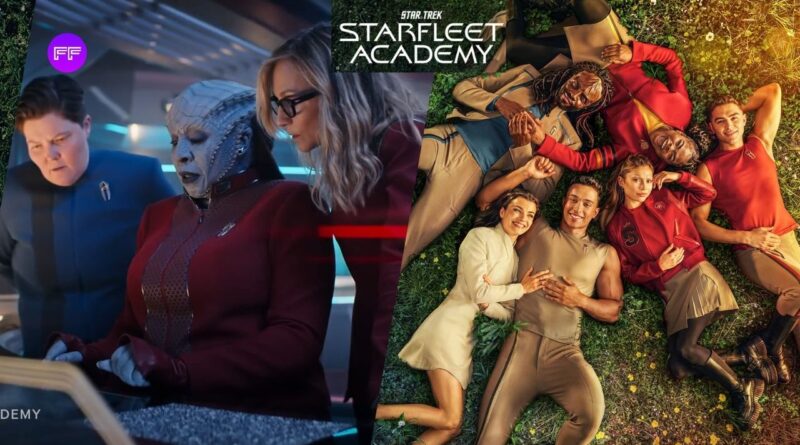
‘Star Trek: Starfleet Academy’ Rebuilds Hope as Episode 6 is Turning Point
Star Trek: Starfleet Academy Episode 6 is a turning point, as cadets confronthard truths, moral sacrifices, and even the end of hope in a shattered galaxy.
When Star Trek: Starfleet Academy premiered on January 15, 2026, we got a whole new show as it gave the entire franchise a soul transplant. Following the launch of Star Trek: Discovery leading us into a 32nd century devastated by “The Burn,” the galaxies felt distant and broken. Academy arrives as the desperately “Architecture of Optimism,” you could call it, because it’s about a generation that doesn’t simply study history — they have to rebuild it.
At the midway point (Episode 6, “Come, Let’s Away”), the series has established itself as an intriguing, if divisive, “teaching hospital” among the stars.
Showrunners Alex Kurtzman and Noga Landau took a sharp left turn away from Trek tradition. Typically we are chasing the best of the best.” In the Academy, taking place on the USS Athena in the year 3195, the school is not simply a campus in San Francisco, as it is a mobile unit where the classroom itself is the front line.
It is this paradigm that enables the series to address the cost of idealism. These cadets aren’t legacy hires, they’re survivors of a galaxy that stopped trusting. Seeing them fall on their faces — emotionally and professionally — helps their triumphs later on feel earned, not scripted.
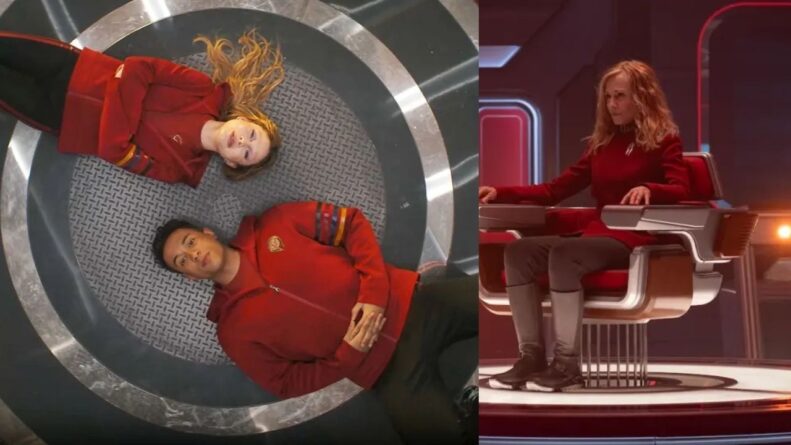
The series derives real dramatic heft from its powerhouse cast, and Holly Hunter’s Chancellor Nahla Ake is a defining force that lifts the whole show. She’s not a hard-nosed commander; she is a “reformed” officer who at one point walked out of Starfleet in protest. Her “steel magnolia” energy is a perfect foil to the raw, explosive energy of the cadets.
Opposite her is Paul Giamatti as Nus Braka. Giamatti never becomes the stereotypical “cackling space pirate” character, instead portraying Braka as a bitter victim of the Federation’s past mistakes. He’s a “Small Man” with a big grudge, a reminder that a single individual with a scheme can be as lethal as a Borg Cube.
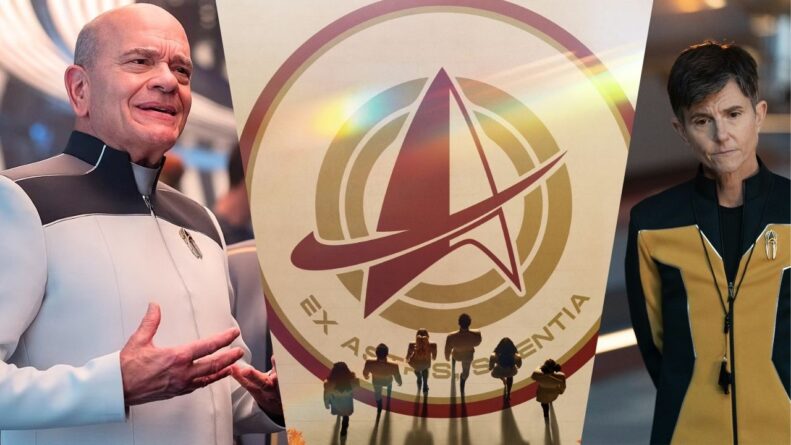
With the addition of Robert Picardo (The Doctor) and Tig Notaro (Jett Reno), you do have the vital connective tissue to Trek’s history.
The Doctor is the “voice of history,” having evolved from a 24th-century medical instrument to an ethics mentor.
Jett Reno is still the final reality check with the dry wit needed to put all the high stakes drama in perspective.
Caleb Mir (Sandro Rosta) is a reluctant leader. His vulnerability offers a welcome breath of fresh air among all the “swaggering captains”.
Tarima Sadal (Zoë Steiner): A Betazoid whose abilities are more of a curse than a gift. Her arc culminated in utter bleakness in Episode 6 when she had to take her empathy out as a lethal weapon.
Jay-Den Kraag (Karim Diané): A Klingon who shuns the “warrior” stereotype. In the 32nd century, Klingon is a diasporic identity, and Jay-Den gains his strength from arguing rather than from the bat’leth.
SAM (Kerrice Brooks): A photonic cadet engaging with the “Pinocchio” trope in terms of faith, resulting in a stunning (and divisive) homage to Benjamin Sisko.
The first six episodes made a brilliant transition from “academic orientation” to “survival horror.””
Many singled out Episode 5, “Series Acclimation Mil,” as a love letter to Deep Space Nine. The use of archival audio of Avery Brooks (with the blessing of the Sisko estate) was a gamble that paid off by anchoring the high-tech 32nd century in the spiritual mystery of the Prophets.
But then there was Episode 6. The addition of The Furies—cannibalistic hybrids taken the “CW Trek” whines down several notches. It was a painful reminder that the “teaching hospital” is now a trauma center. Tarima when she rescues the crew by “liquefying” the enemies’ brains, the show is letting you know it’s no longer the age of innocence.
Maybe for the first three episodes, but by Episode 6, Starfleet Academy has got it right. It’s a show about how fragile civilization is, and how much responsibility comes with being the “Class of the Rebirth.”
| Aspect | Detail |
| Theme | Rebuilding the Federation through empathy. |
| MVP | Holly Hunter (Chancellor Ake). |
| Key Set | The Sato Atrium (Largest in Trek history). |
| The Big Bad | Nus Braka & The Furies. |
The first half of a season has established a high standard. We’ve had “sorting hat” moments; now we’re seeing the scars. As they pursue Nus Braka into the latter half of the season, these cadets have moved beyond mere students—they’re the final hope of a Federation desperate to make its way back toward the light.
Read More 👉 Star Wars Character Kylo Ren’s Iconic Line That Changed the Skywalker Legacy Forever
What Star Trek Starfleet Academy truly is not so much another story about the spacefaring life — it’s what hope looks like in a shattered galaxy. Star Trek: Discovery showed us the end of the world, Academy the slow, painful, everyday work of rebuilding. By moving the storyline focus away from iconic captains to fallible cadets, from glory missions to moral consequence, the series recalibrates optimism as something acquired rather than bequeathed.
Dive deeper into the world of entertainment with Fandomfans to get updates from your favorite movies.

Discover the best horror movies 2025, from award-nominated thrillers to scares, prestige cinema and storytelling indie nightmares.
For decades now, horror has existed a bit on the margins of awards season — the darling of the audience but the red-headed stepchild of the institutions. But 2025 completely twists that narrative on its head. The horror genre has been conspicuously absent from Golden Globe nominations in recent years, but a blood-soaked drama here, classic monsters there, and some nerve-shredding indie scares for good measure proves that horror is now officially in the prestige spotlight. From Ryan Coogler’s bold Sinners to Guillermo del Toro’s soulful Frankenstein, this year offers ample proof that fear, when honed through vision and thoughtfulness, can hold its own with the most lauded cinematic storytelling.
The 2026 Golden Globes nominations was recently released, and the lead is not one of the usual biopics or oscarbaits. It’s blood, guts, and monsters. With major nods for Ryan Coogler’s Sinners and Guillermo del Toro’s Frankenstein, Screenrant has just spoken the quiet part out loud: 2025 is definitely the Year of Horror.
The jaw-dropper was not just that horror movies got nominated—it’s where they got nominated. Over the years, if a horror film managed to creep its way up the awards chat, it would usually be shafted to the technical side of things, or weirdly, “Musical or Comedy” (remember Get Out?).
But this year, two of the six slots for the Best Motion Picture – Drama are bona fide horror films.
First, we have “Sinners“. It was always going to be an event when Ryan Coogler re-teamed with Michael B. Jordan, but I don’t think anyone was ready for this level of acclaim. A period vampire thriller set in the Jim Crow South? It seemed risky on paper, but the execution was perfect.
With seven nominations, Sinners is both leading the pack and the only one with the majority of the votes. It combines high-brow historical drama with old-school, monster-movie terror in a way we haven’t seen since maybe Interview with the Vampire, but with more bite (pun intended).
Then there’s “Frankenstein.” Guillermo del Toro has long been our advocate when it comes to monsters, but his version of the Mary Shelley staple for Netflix feels like his magnum opus. Taking five nominations, it shows that classic monsters never go out of style – they just need a master’s touch.
Oscar Isaac (as the Doctor) and Jacob Elordi (as the Monster) being in the acting conversations at all is a sign that voters are finally looking beyond the prosthetics and seeing the soul beneath.
It’s not just the gargantuan applicants to the studio system getting the love. The indie community, who’d been holding the horror torch aloft for years, eventually was given its seat at the table.
Zach Cregger’s “Weapons”—his follow-up to Barbarian that’s highly anticipated—squeaked in a nomination for Amy Madigan as Supporting Actress. If you’ve watched the film, you know exactly why. What she did as Aunt Gladys was nightmare fuel, and she went right into the “Horror Hall of Fame.” To have a performance that is frighteningly recognized by a major voting body is a huge win for all of us who make the case that scaring an audience is just as hard a task as making them cry.
This round of accolades feels like a direct sequel to the proving ground of 2024. Remember when Demi Moore took home the Globe for The Substance? That felt like a fluke, we thought — “lifetime achievement” type deal for a body horror shocker. But in retrospect it was the crack in the dam. That victory sent a message to the industry that “weird” and “gross” could also be “prestige.”
The Last of Us Season 2 expands on the show’s haunting world, turning its focus from survival to the emotional toll of violence and revenge. With higher stakes, darker themes, and increasingly active threats, the season examines how love, loss, and trauma transform its characters in a vicious post-pandemic world.
Bella Ramsey’s nomination is a testament that the series still packs a punch emotionally even as the clickers grow more terrifying.
Then there’s Season 2 of “Wednesday” and “Monster: The Ed Gein Story,” both of which earned nominations for Jenna Ortega and Charlie Hunnam. It’s a media environment that implies dark audiences want darkness, and dark creators are catering to their tastes in high end packaging.
Wednesday Season 2 broadens the strange and disturbing world of Nevermore Academy. It throws Wednesday Addams into more lethal riddles and more challenging personal battles. The danger mounts with scarier scares, more warped laughs, and ever changing bonds. The program maintains its gothic, grim allure.
Read More 👉 Spider-Man: Brand New Day Explained – How Marvel Reset Peter Parker’s Life
We no longer need to call it “elevated” to be allowed to enjoy it. Sinners is simply an excellent film. Frankenstein is a tragedy and a masterpiece. Weapons are a roller coaster of anxiety. They aren’t “good for horror movies”—they’re just really good films, full stop.
The stigma against what some call “left-of-center” storytelling is dissipating. A generation of filmmakers raised on Carpenter, Craven and Romero are now making movies with A-list budgets and A-list stars. And obviously, the electorate wants to get on board for the ride.
What really makes 2025 feel like we’re standing at the cliff edge of a new era isn’t just the nominations themselves—it’s the mindset behind them. Best Horror Movies 2025 is no longer being praised simply for being horror but it’s being celebrated as powerful cinema. Studio-backed blockbusters, audacious independents and genre-heavy television racing to dominate in major categories: the implication is clear, horror has grown up, and the awards bodies are perhaps ready to acknowledge that. The monsters were always meaningful— we just needed the industry to stop looking away.
Fandomfans is focusing on delivering real insights and a list of A-list movies with full details.
At Sundance 2026, Andrew Stanton’s In the Blink of an Eye debuts with a bold multi-timeline sci-fi tale examining human emotion in the past, present and future.
If you have been keeping up with the Sundance Film Festival 2026, you may have found yourself wondering what Andrew Stanton is doing these days. The Whiz behind Wall-E has at long last arrived back on live-action soil and he is doing so with uncertainty, not caution. His new film In the Blink of an Eye is not only a return to form it is a high concept, mindbending thrill ride.
| Feature | Details |
| Movie Title | In the Blink of an Eye |
| Director | Andrew Stanton |
| Writer | Colby Day |
| Genre | Science Fiction / Drama |
| Narrative Style | Triptych (3 interconnected stories) |
| Time Periods | 45,000 BC (Neanderthals), Present Day, and Far Future |
| Core Theme | Human connection across time, evolution, and technology |
| Story Approach | Visual storytelling & behavior over heavy dialogue |
| Structure | Non-linear and multi-timeline |
| Editing Style | Using “Emotional Sync Points” to link different eras |
| Premiere | Sundance Film Festival 2026 |
| Vibe | Thought-provoking, Sci-Fi With Emotional Depth |
| Standout Factor | Skips the “Hero’s Journey” to focus on shared human feelings |
So, what’s the deal? That’s not your average “aliens destroy the White House” science-fiction movie. It’s a triptych — which is just a fancy way of saying that it tells three separate stories that are all interconnected.
It is a narrative that leaps randomly back and forth over the course of thousands of years, from ancient Neanderthals to the current day, and then to the future.
It’s ambitious, it’s a little experimental, and it’s trying to suss out what really makes us “human” from era to era.
Andrew Stanton had long been working on big shows such as Stranger Things, 3 Body Problem, and he spent that time ‘hand-picking’ his dream team. He’s also leaning heavily on his animation roots.
Andrew Stanton’s biggest takeaway is the importance of imagination. He thinks the presence of a character — an expression, a movement, or maybe a choice can say more than dialogue ever could. The end product is a movie meant to make you feel first, leading emotion with images rather than explaining everything in words.
The author, Colby Day, confessed he was a little tired of the typical movie structure we get applied to everything. Rather than tracking a single protagonist on a familiar trajectory, he wanted to “blow up the world” and change the rules. He was inspired by films such as Cloud Atlas — those “big swings” that might be a little messy but way more interesting than a “safe” blockbuster.
Just think about what it would be like to edit three separate films into one. The editor Mollie Goldstein said they had to find “sync points.” They’re moments when a character in 45,000 BC is experiencing exactly what someone in the future is. It’s the emotional glue that holds the whole thing together.
Connectedness is the new spectacle: The age of hollow, effects-laden action-movies is waning. In the Blink of an Eye caters to a burgeoning demand for narratives with emotional connections — demonstrating that no matter how far technology evolves or centuries elapse, what really resonates is how intimately we are linked to one another.
The Comeback of the “Big Idea”: For a time, it seemed like movies were made by committee. This feels like a personal project and a risk. If this works, studios will once again trust directors with strange, “unfilmable” scripts.
Universal Struggles: By featuring Neanderthals, the film makes us aware that even as our phones evolve, our hearts don’t. We’re all still coming to grips with the same primal fears and loves that people had thousands of years ago.
Raed More:- Best Medical Drama Series Like ‘The Pitt’ to Binge Watch in 2026
Darkly In The Blink of an Eye is a quiet rebellion against all the sci-fi that has played it safe for far too long. Rather than pursuing bigger explosions and louder stakes, it looks inward – across centuries, across species, across futures – to consider what actually endures.
When the film connects Neanderthals, modern humans and future societies through shared feelings, it tells us our survival is not dependent on wiping out the other; rather it magnifies our humanity. If this movie sticks the landing like it promises, it won’t just be a standout at Sundance — it may indicate a turn toward even braver, more emotionally intelligent sci-fi, where connection matters more than spectacle.
Dive into the world of entertainment with Fandomfans to get deeper details from directors, stars, and industry insiders.