Dunk and Eggs Deliver the Perfect Ending in The Morrow
Dunk and Eggs are high in The Morrow’s conclusion of A Knight of the Seven Kingdoms, resulting in a sentimental closing note focused on honor and selection.
Published: February 25, 2026, 7:13 am
Dunk and Eggs are high in The Morrow’s conclusion of A Knight of the Seven Kingdoms, resulting in a sentimental closing note focused on honor and selection.
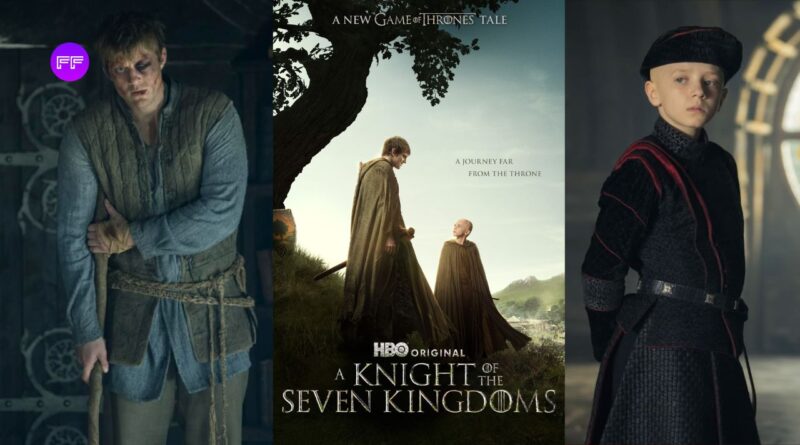
Halfway through A Knight of the Seven Kingdoms Episode 6, “The Morrow,” Dunk and Eggs is sitting opposite Prince Maekar Targaryen, and he declares with the sort of quiet conviction that can only come from having your understanding of the world dismantled and put back together across six weeks of television: “I think I’m done with princes.”
Five words. That’s all it takes. But in those five words you hear everything — the weight of Baelor’s death, the disillusionment with noble systems that warp children into monsters, and the blind, near-lunatic resolve of Dunk and Eggs to do what’s right even when the world rewards you for doing wrong.
The Guardians says, we’ve come to expect certain things from prestige fantasy television. The second to last episode turns up the spectacle—the battles, the killings, the “holy shit” moments. The series finale, while completing story arcs, sets up next season’s conflicts. There is usually a cliffhanger. There’s almost always a feeling of building momentum leading us to bigger, louder, more costly storytelling.
“The Morrow” does none of that. Which is exactly why it works.
The episode is basically 31 minutes of people talking. That’s it. No swords are drawn (save for the knife Egg considers using against his sleeping brother, which we’ll get to). No armies clash. The most violent thing that occurs is emotional. And yet, the viewer was drawn forward, utterly captivated, in a way as they had been in the earliest seasons of the original Game of Thrones, when dialogue resembled skirmishes and each character choice had the consequence of multiple kingdoms.
This is the show’s thesis, born out: being good isn’t what you are, it’s what you do. Repeatedly. Even when it costs you everything.
Peter Claffey’s Dunk facts for the season have been an exercise in making virtue compelling. It’s not easy to write a nice character that’s not boring. Our culture reveres the anti-hero, the morally complex operator, the person who commits bad acts for reasons that make sense to us. We’re trained to see all plain-spoken righteousness as either naïve or performative.
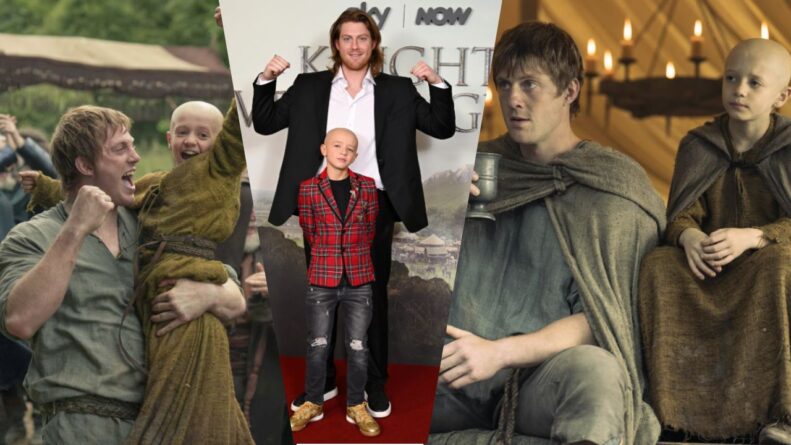
But Claffey treats Dunk’s morality as a conscious decision, rather than a baseline. Watch his face when Lyonel Baratheon offers him a life at Storm’s End — hunting, sailing, friendship, the sort of simple male bonding that would be the happy ending in any other story. You can see Dunk genuinely considering it. He wants it. Who wouldn’t? After a fortnight of sleeping in the mud and eating hard salt beef, the lure of comfort and companionship can’t be that strong.
But he says no. It’s not the offer he can’t afford, it’s just not what he wants to do. And he knows it.
This time it’s Maekar’s offer from Summerhall. When Maekar speaks of proper training and finishing what Arlan began you can see Claffey’s longing in his eyes. Dunk craves legitimacy. He wants to be the knight as he pretends to be. But when the price of this is Egg turning into just another Targaryen prince twisted to cruelty by the iron machinery of court life, he can’t bring himself to accept it.
The episode’s most powerful sequence is Dunk’s vision (memory? dream? hallucination?) of Ser Arlan of Pennytree. Their talk about the Pennytree tradition — hammering a copper penny into a tree when you leave, pulling it out when you come back, because “a good knight always finishes a story” — could be interpreted as symbolism too close to a cliche. But it doesn’t, because the show has earned its emotional moments over the course of six patient character episodes.
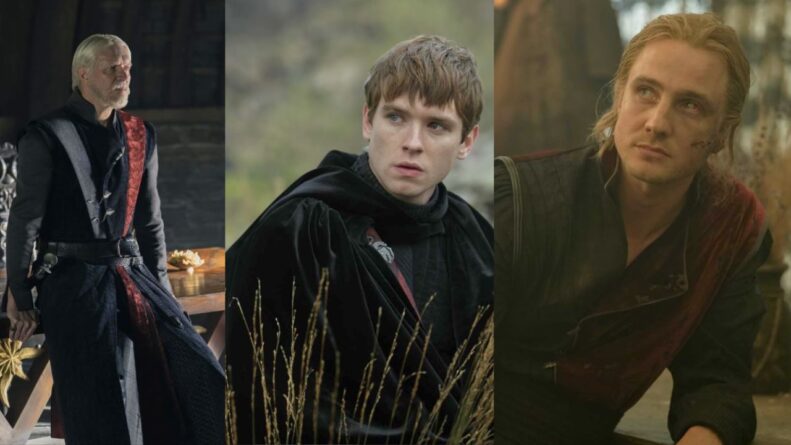
If Ser Arlan did in fact knight Dunk, then the source of Dunk’s legitimacy is a secret, private deathbed ceremony. But if Dunk has not been knighted after doing everything, then his authority is based solely on what he has done. The ceremony doesn’t matter.
Egg stood over his sleeping brother Aerion, knife in hand. It’s not righteous indignation but tragic temptation, which Dexter Sol Ansell plays. Watch his face when he looks in the mirror and sees his silver hair coming back. He said in Episode 4 that he hated his Targaryen traits. But here, behold his eyes. We see the violence and entitlement woven into that bloodline, reasserting itself.
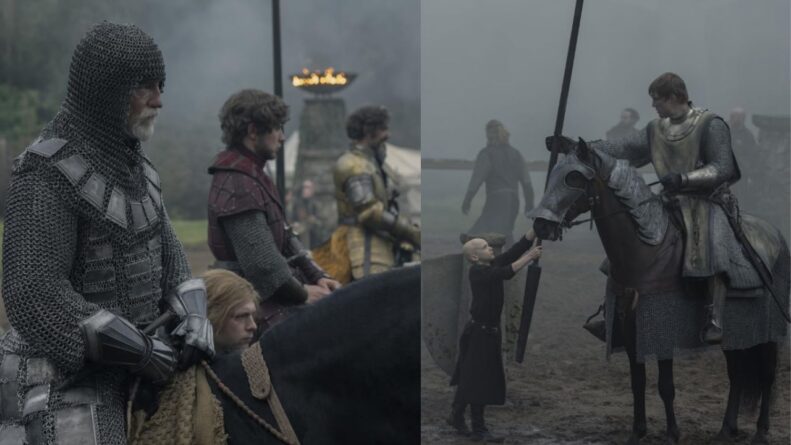
When Maekar catches his son—placing his hands gently on Egg’s shoulders rather than scolding him angrily—both Targaryens are crying. The work of Sam Spruell here is spectacular. He is aware of what could have been, too close for comfort, and what that means. He has good reason to believe Daeron was right: Aerion wasn’t born a monster. He was fashioned by the judicial machinery. And Egg has that as well, and always will, that same door hidden within himself, and what it takes to unlock that door.
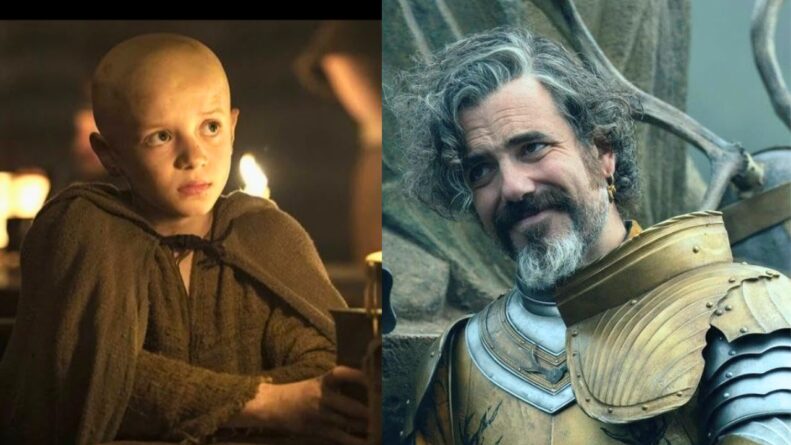
One of Maekar’s sons still lives who might not be broken by this throne. And when Dunk offers to take him to save him by ditches and hard salt beef and a life of no iron machinery, Maekar says no. He can’t picture life as dignified. He loves his son enough to weep with him over Aerion, but not enough to send him away.
And that’s the real tragedy of Dunk and Eggs “The Morrow.” Maekar wants to save his children and he has no idea how.
Egg has fibbed about having his father’s permission – a deviation from George R.R. Martin’s original novella in which Maekar actually gives his consent. Some fans will disagree, as in the book version, Maekar’s consent is a sign of growth, and repentance for killing Baelor, inadvertently. The show’s version undermines that character growth for a laugh and possible Season 2 drama as season gets 9.0/10 rating from IMDb.
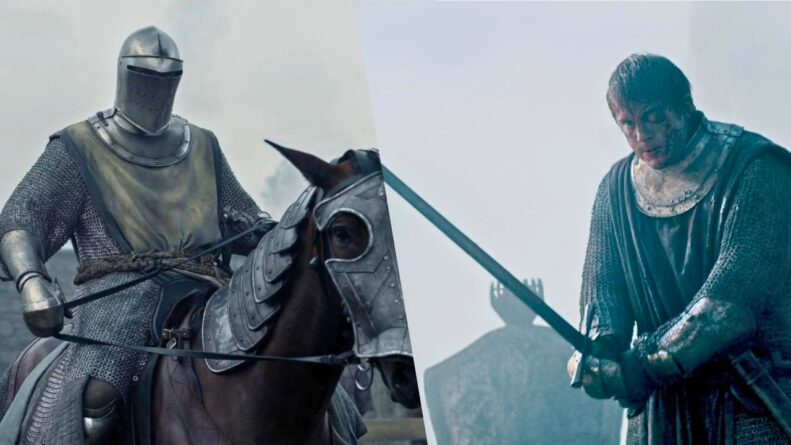
But even this choice is thematically defensible. The show is concerned with how difficult it is to select goodness. Egg (Pink Letter) lies and flees instead of accepting Maekar’s denial, losing his integrity. It robs Dunk of his assurance in Egg’s character when he comes upon the truth. It robs Maekar of his son. Doing what’s right is gonna cost something dearly for everyone.
The final shot where Arlan ghost riding off over a field of grass while Dunk and Eggs walk on down the road is grief made plain. Dunk is paying tribute to his mentor (the penny in the tree), applying his teachings (finish your story, keep your oaths), and moving beyond his need for Arlan’s approval. The question of being knighted is not relevant. It’s the road and the royal squire at his side that matters now.
Read More 👉 Absolute Universe DC Comics Bombshells from ComicsPRO That Will Reshape 2026
A Knight of the Seven Kingdoms Season 2 will explore George R.R. Martin’s second “Dunk and Eggs” novella, “The Mystery Knight.” Co-creator and showrunner Ira Parker spilled details on that direction in an interview with Variety. Also, Parker said one of the original titles for the series was nixed by Martin, but he didn’t reveal the reasoning or what the title was.
Season 2 can’t come fast enough but there was so much potential in that last shot of two figures on horseback riding off into the unknown, everything up in the air but their commitment to each other and to becoming better people. The show has demonstrated that tiny storytelling is viable in this universe, that you don’t need dragons and sprawling ensemble casts and constant escalation to justify your existence.
A Knight of the Seven Kingdoms has given the Game of Thrones universe new life in a way that seems almost miraculous. Dunk and Eggs makes us fall back in love with this world, not for the spectacle, but for the people. It’s because of the conviction that in a world that is structured to treasure self-interest and to punish kindness, the most radical thing that you can do is simply be good.
As Ser Arlan would say: A good knight always finishes a story. Dunk and Eggs are finishing this one and starting another. We just have to wait until then.
Dive into the world of dragons and dungeon politics with Fandomfans, our goal is to focus on recent updates and reviews from latest movies, series, characters, and interviews.

Fallout Season 2 Episode 2 breakdown explores Shady Sands’ destruction, Mojave power shifts, Brotherhood secrets, and Caesar’s Legion’s rise.
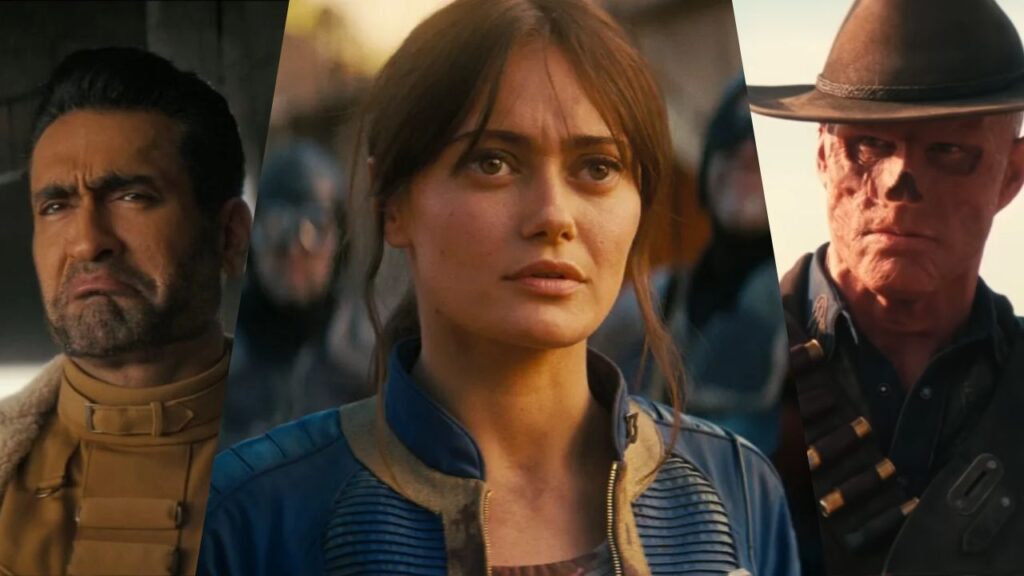
Transitioning into the Mojave for Fallout Season 2 is not just a change of scenery—it’s jumping headfirst into the high-tension, factionalized mayhem fans longed for. Episode 2, “The Golden Rule,” serves as a savage link between the naive ideals of the Vaults and the brutal, imperialistic surface world. With Episode 3, “The Profligate,” the story is drawing into a tangle involving cold fusion, aged resentments, and the frightening specter of Caesar’s Legion.
The cold open of “The Golden Rule” is a historiographical assault to the senses. The show’s loss becomes personal when it gives us Shady Sands in 2283 — not as a wreck, but as an established society with water filtration.
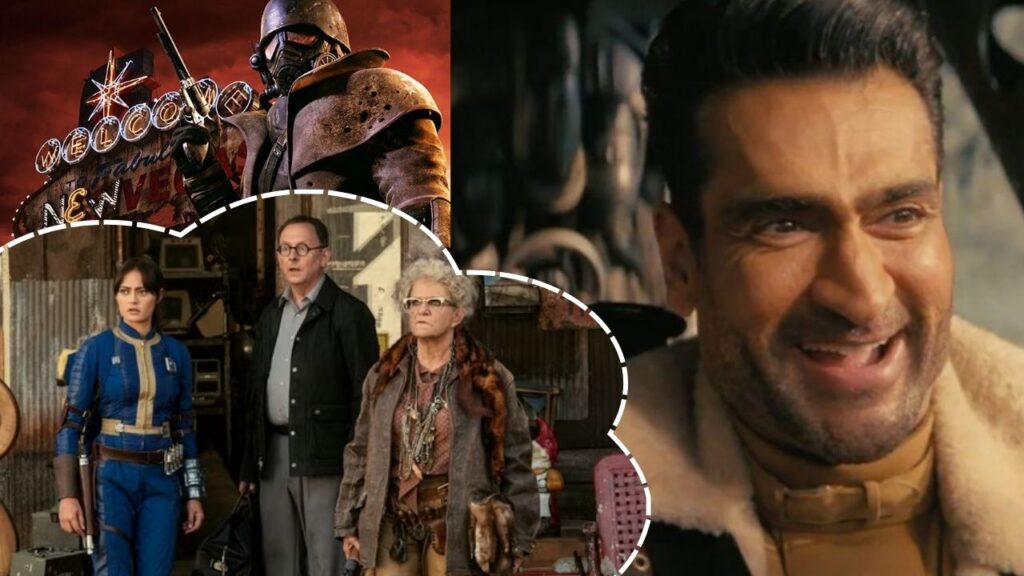
The fact that a mind-controlled trader carried the nuclear payload adds a layer of “Management Class” horror. It sure as hell wasn’t a war; it was an eviction. Hank MacLean, the “wholesome” father reading The Wind in the Willows to his children and committing mass murder via his Pip-Boy, is the quintessential Vault-Tec sociopath. To them, they aren’t people, they’re “assets” and “obstacles.”
While the NCR is in shambles, the Brotherhood of Steel is rising. Moving their headquarters to a buried Area 51 is a coup of ”technological archaeology.” The effect of cold fusion is a game changer.
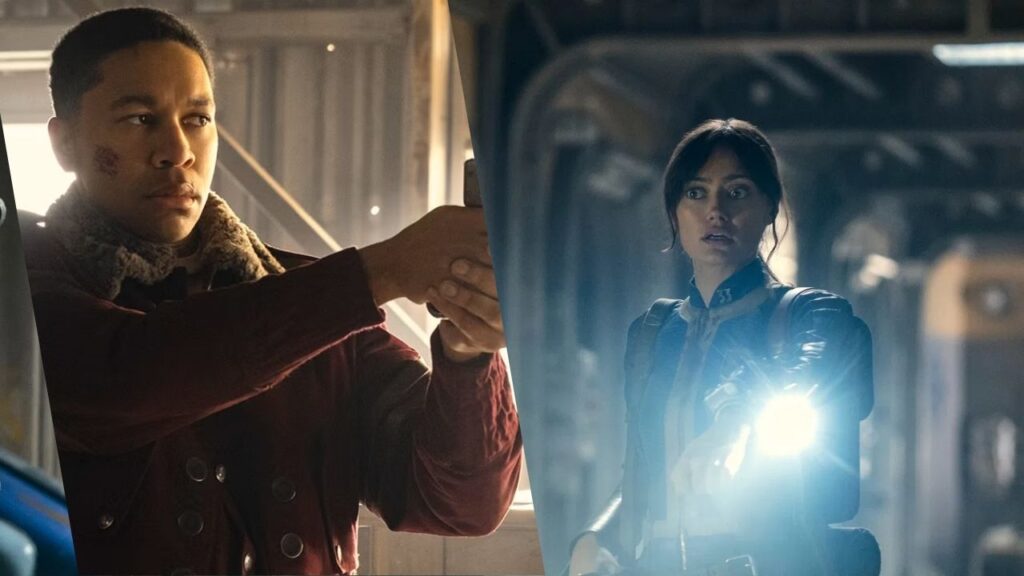
This make for a “Power Armor Surplus”, but as Maximus we see, more power means more rot from within. His Knight promotion removed his idealism and made him a man who stabs his own brothers in the back to keep his standing.
Lucy MacLean remains the emotional core of the series, but “The Golden Rule” pushes her to her limits. Her choice to spend her last Stimpak on a stranger and not the Ghoul is pure Lucy – following her Vault born “Golden Rule.”
| Character | Philosophy | Outcome |
| Lucy | Deontological (The Golden Rule) | Captured by the Legion |
| The Ghoul | Pragmatic/Cynical | Wounded and abandoned |
| The Tunic Woman | Utilitarian/Legion Proxy | Successfully lures Lucy into a trap |
This “kindness” brings her straight to Caesar’s Legion. For Lucy, the Mojave is teaching her that playing the “Good Samaritan” too many times just makes you easier prey.
Read More 👉 Robin Hood Season 1: Every Major Twist That Changed Sherwood Forever
The wordage of “the Profligate” is a slur the group Caesar’s Legion uses when referring to those they consider barbaric or uncivilized in the old-world sense.
1. The Arrival of Macaulay Culkin It is rumored that Culkin will be portraying a ”crazy genius.” Is he Arcade Gannon, the depressed medic? Or Fantastic, the fellow with a “theoretical degree in physics”? My money is on a new character—Brutus—a top Legion scientist who will be able to help the Legion understand the cold fusion tech the Brotherhood has obtained using Lucy’s Vault-Tec knowledge.
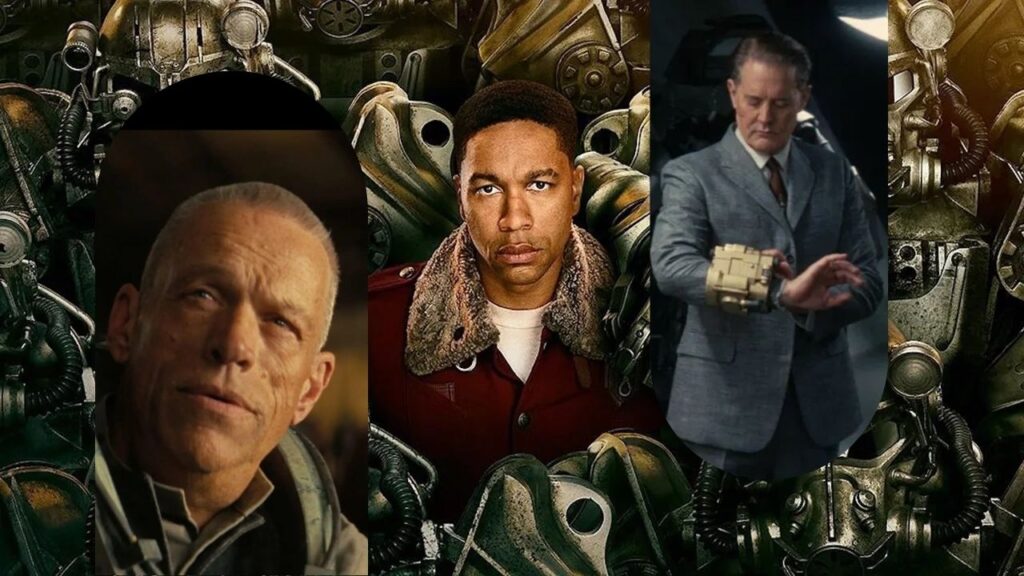
2. The Robert House Paradox It is very likely that we will be seeing Justin Theroux as Robert House in Episode 3 “modern” first . House is going to make sure that the Brotherhood doesn’t get to hang on to cold fusion whether he’s a digital ghost or a mummified corpse. It makes his Securitron army pointless, and House never plays second fiddle.
3. The Synth Theory The entry of Paladin Xander Harkness from the Commonwealth (Boston) is a huge red flag. Since “Harkness” is a reference to a synth in Fallout 3, we could be seeing the beginning stages of an Institute infiltration.
As the series makes its way to the neon lights of New Vegas, the “Golden Rule” is being usurped by a much simpler motto: survive at any cost.
Read More 👉 Stranger Things Spin-Off Expanding the Horror With New Cast & Story
With “The Golden Rule,” Fallout Season 2 is telling you straight away that the Mojave isn’t a place thinking that you live in some sort of Vault-bred innocence. The annihilation of Shady Sands recasts wasteland politics as corporate malice rather than friendly fire, and the Brotherhood’s infiltration of Area 51 signals a frightening empowerment driven by cold fusion. Lucy’s rigid sense of right and wrong—previously her biggest asset becomes a hindrance, resulting in her capture by Caesar’s Legion and showing that compassion, in this world, is really just another resource that can be drained.
Ahead of Episode 3, “The Profligate,” all factions are converging on the same prize: the future in a box view: scavenged technology. Whether it’s the Legion’s perversion of the ideology out of domination, Robert House refusing to be outmaneuvered, or the faint suggestion of synth infiltration, the series is turning away from its idealism to focus on brutal survival. The tone is blunt and clear—New Vegas doesn’t reward virtue, it rewards adaptability, and those still playing by the old rules are already halfway to extinction.
Fandomfans is providing details from movies and shows that you love to watch, stay connected for more updates.
Explore Run Away on Netflix cast and characters from Harlan Coben’s thriller. Full breakdown of Simon, Paige, Ingrid and supporting roles.
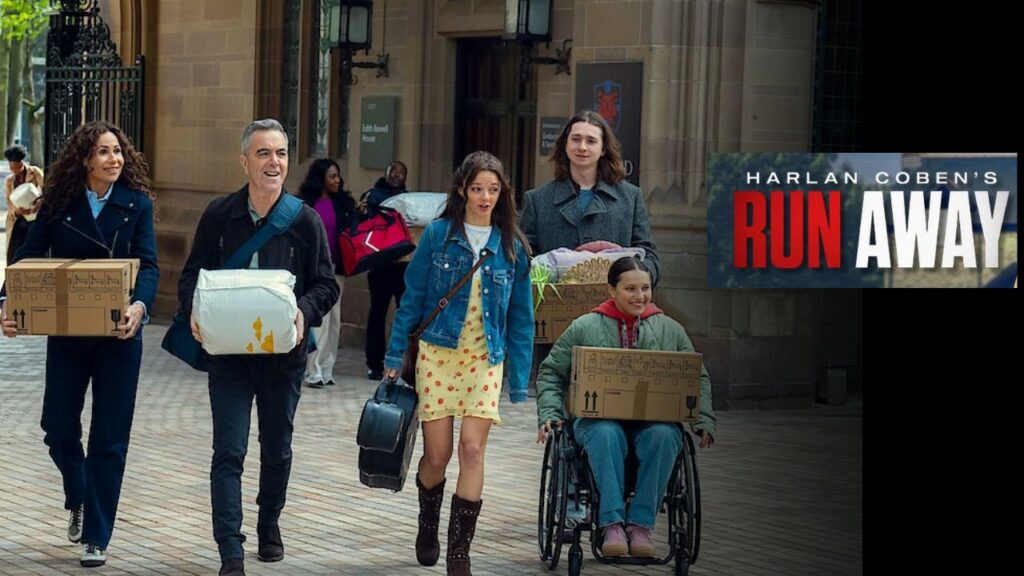
Harlan Coben is back with a new thriller series on Netflix, and this time he’s leading you into the secret, distorted world of Run Away. ‘Run Away’ is adapted from the 2019 novel of the specified name, with a stellar cast bringing its complex characters to life. Limited to one season of eight episodes, the series has held the attention of viewers by way of compelling storytelling and performances. If you’ve already watched the show or are about to watch the show, the cast and their characters will definitely make an impact.
James Nesbitt is at the forefront as Simon Greene, whose life appears perfect until his oldest daughter Paige disappears. Nesbitt, who has played winning roles in other Coben adaptations like Missing You and Stay Close, lends a remarkable depth to a desperate father. Coben also commented on Nesbitt’s versatility, saying:
“There’s a naturalness to him that comes with an ease and warmth, so that you find yourself rooting for Simon — even when you know he’s making all the wrong choices.”
Minnie Driver is Ingrid Greene, Simon’s wife, who keeps the family stable as her husband descends in peril. Driver (The Serpent Queen, the iconic Good Will Hunting) brings emotional heft to the home front chaos at the core of this thriller.
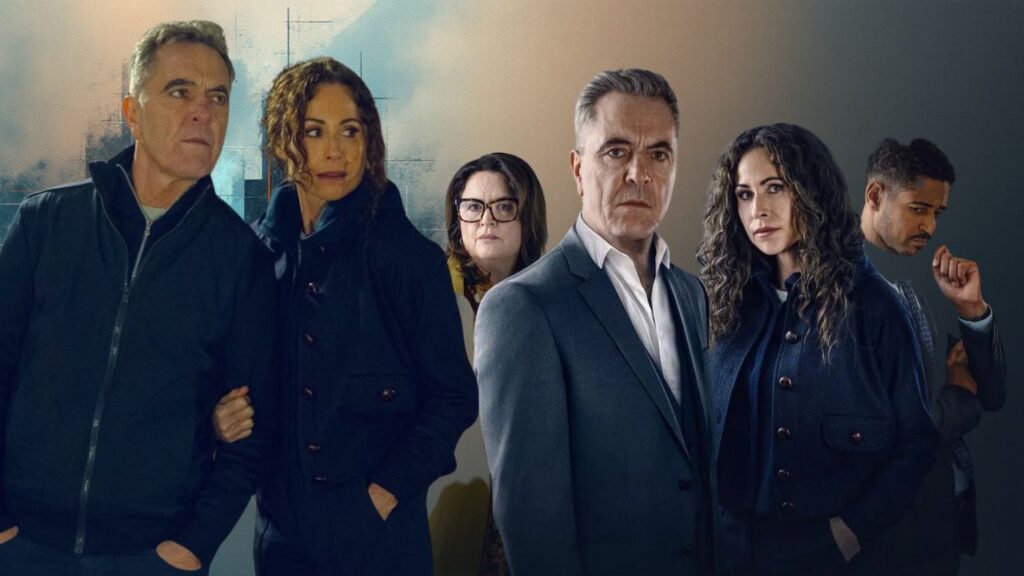
Ellie de Lange is the daughter who had runaway, now a character with addiction issues and secrets, Paige Greene. Coben personally chose de Lange from a multitude of audition tapes, and lauded her strength and vulnerability as an actress – a fine balance key to Paige’s character arc.
Read More:- ‘The Hunting Party’ Returns for Season 2 With Melissa Roxburgh
Ruth Jones stars as Elena Ravenscroft, an ex-cop-turned-private-eye. Her new case, a missing person, intersects with Simon’s own desperate mission and sends them both hurtling into a labyrinth of mystery and intrigue.
Alfred Enoch (Dean Thomas in Harry Potter) stars as Detective Isaac Fagbenle, who is looking into the murder of a drug dealer, Aaron Corval. When a viral video puts Simon at the center of the crime, Isaac’s pursuit gains momentum—especially as secrets from his past threaten to compromise the case.
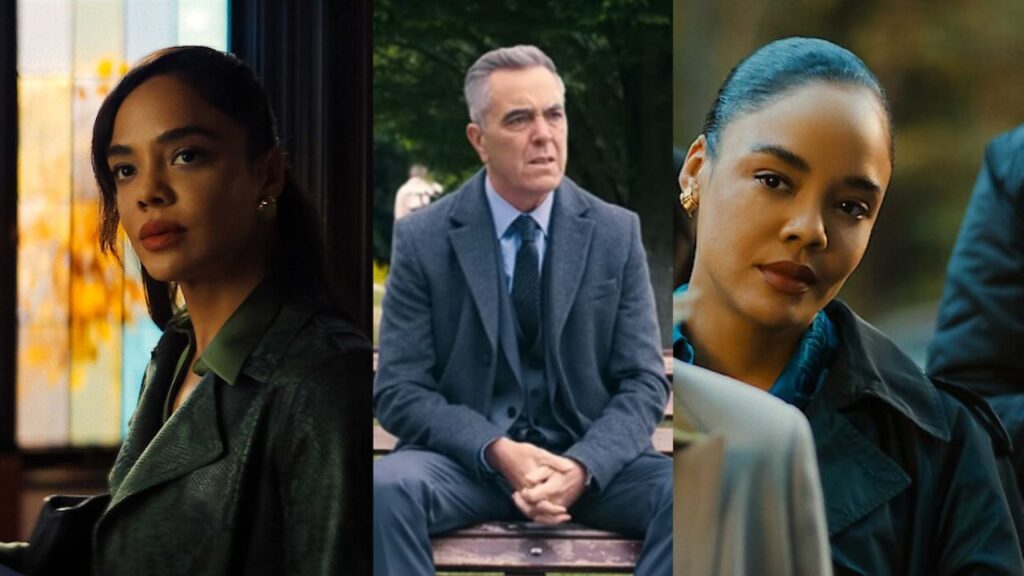
Lucian Msamati (Conclave, Gangs of London) is Cornelius Faber, a former soldier now residing in the Marinduque Estate. Cornelius ends up becoming Simon’s friend and confidante, but the unpredictable nature of the former makes for some nervous moments. Msamati describes the character as “a storm waiting to happen.”
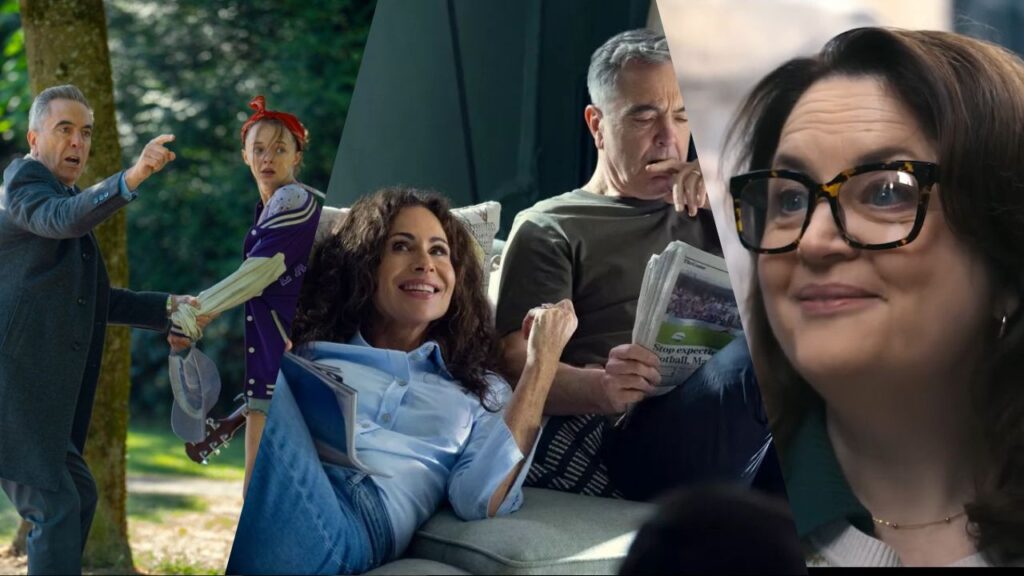
The show manages to bring genuinely unsettling characters to life, thanks to Jon Pointing as Ash and Maeve Courtier-Lilley as Dee Dee — two assassins who were raised in foster care and now run around the country wreaking havoc together. Coben characterizes them as
Like a couple plucked from True Romance or Bonnie and Clyde, they’re clearly off the rails — but the way they make their getaway is completely spellbinding.”
The ensemble is further bolstered by Tracy-Ann Oberman as Simon’s barrister Jessica Kinberg, Annette Badland as Lou, and Amy Gledhill as Detective Ruby Todd. Each character in this elaborate web of secrets and lies is needed to bring the story together in ‘Run Away’ on Netflix.
Run Away, the latest from Netflix based on the novels of Harlan Coben, shows us once again why he’s the king. With this all-star cast riveting performances, viewers are taken on an unforgettable journey into darkness and despair. The series is now available to stream on Netflix, which is ready to you keep you busy on your next binge-fest.
Dive deeper into the details of movies and series with Fandomfans. Keep connected to get the latest updates.