Home > Movies > You Shouldn’t Miss To Rewatch ‘Kill Bill’ Because..
You Shouldn’t Miss To Rewatch ‘Kill Bill’ Because of These Legendary Moments
Rewatch 'Kill Bill' to rediscover the iconic fights, hidden details and cinematic homages that shaped Tarantino's masterpiece. Explore the moments. Learn more!
Among the records of 21st-century film, very few works can claim the unparalleled position held by Kill Bill Vol. Ostensibly a revenge thriller, the film functions less as a story and more as a spirited look back at film history: a “curated museum” whose high art and exploitation cinema boundaries dissolve.
Seeing a film like Kill Bill is to see a dervish at work—homing in on a “roaring rampage of revenge” to examine how genre works, the aesthetics of violence, and the lasting power of the screen image. If volume 1 is a blistering tribute to Eastern cinema (wuxia, samurai chanbara, and anime), volume 2 makes a sudden shift to the West, adopting the dry tempos of the Spaghetti Western.
This article unpacks the minuscule details — from cereal brands to philosophical monologues which elevate Kill Bill from a film to a masterpiece.
The Genesis: From “Q & U” to the Silver Screen
Image Credit: IMDb
Tarantino and Thurman conceived “The Bride” in casual conversations while life mimicked art in the six years it took to write. When Thurman got pregnant before shooting, Tarantino delayed production instead of recasting, saying,
“If Josef Von Sternberg is planning to make Morocco and Marlene Dietrich gets pregnant, he waits for Dietrich!”
It indicates the character Bride is not just a simple role but a specifically designed around Thurman’s physicality.
Casting Counterfactuals
The movie might have been very different. The part of Bill was first written for Warren Beatty, as a suave, Bond-villain kind of guy. When David Carradine was cast, the character shifted to a tough martial arts icon, drawing on Carradine’s background as the lead of Kung Fu, which originally aired in the early 1970s.
Character
Actor Cast
Original Choice
Impact of Change
Bill
David Carradine
Warren Beatty / Bruce Willis
Shifted Bill from a suave suit to a rugged, flute-playing martial arts legend.
O-Ren
Lucy Liu
Generic Japanese Actress
Rewritten as Chinese-Japanese-American to accommodate Liu, adding racial tension to her Yakuza rise.
Budd
Michael Madsen
Robert Patrick
Madsen’s weary persona perfectly suited the “loser” brother living in a trailer.
Johnny Mo
Gordon Liu
Michael Madsen
Gordon Liu (he is a Shaw Brothers legend) was given the opportunity to take on two roles (Johnny Mo and Pai Mei), connecting the two volumes.
Revenge is a Dish Best Served Cold
Bloodied, terrified, and immobilized, The Bride has a stark black-and-white close-up of her face. This decision to film the slaughter aftermath in black and white has several reasons. While this is mostly justified as an homage to 70s TV censorship of kung fu movies, it is also an aesthetic choice. It creates a detachment, and the violence is transformed into nightmarish and abstract rather than realistic.
Image Credit: IMDb
The needle drop of Nancy Sinatra’s “Bang Bang (My Baby Shot Me Down)” is among the most iconic musical cues in cinema history. The song is also used as a literal narration:
“Bang bang, he shot me down… bang bang, that awful sound.”
The sad tremolo guitar establishes a mood of tragic inexorability. Instead of a regular action flick beginning with high-octane stunts, Kill Bill begins with failure and grief, laying out the emotional deficit The Bride needs to replenish with vengeance.
The Bride is creating her own future nemesis
The battle concludes at the death of Vernita Boreas, observed by her four-year-old daughter, Nikki. The Bride’s line here is an important one:
“It was not intentional and for that I am sorry. But you can take my word for it, your momma had it comin.”
Then she provides the child with a future means for vendetta: “When you get a little older, if you still feel raw about it, I’ll be waiting”.This is at least an acknowledgement that revenge is cyclical.
The “sniper shot,” as O-Ren kills a politician, is a highlight in visual storytelling. The space, the quiet, the abrupt violence all serve to define O-Ren as an emotionally cold, remote character. The return to live action O-Ren’s single tear, bridges the stylized animated trauma and the real life villain The Bride will take on.
The Brides Blue Leaves Disguise
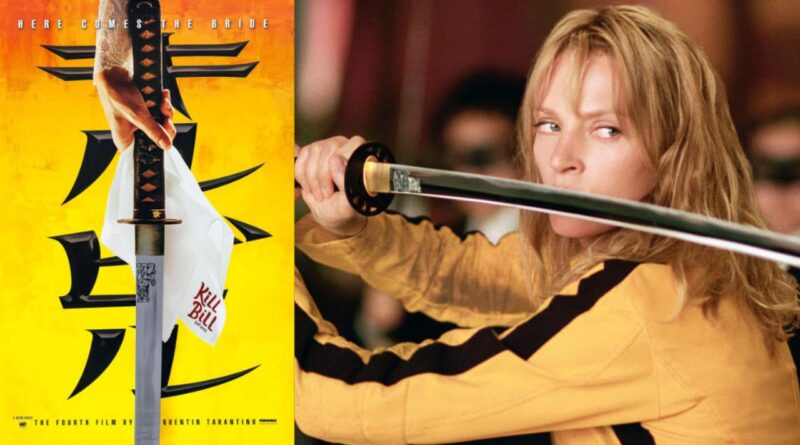
The Bride’s yellow tracksuit with black stripes is the film’s most obvious visual nod, an homage to Bruce Lee’s outfit in Game of Death (1978). This wardrobe choice places The Bride among the martial arts greats. But she is armed with a katana, so that visually she blends the Chinese kung fu tradition with the Japanese samurai tradition.
Gogo Yubari and the Meteor Hammer
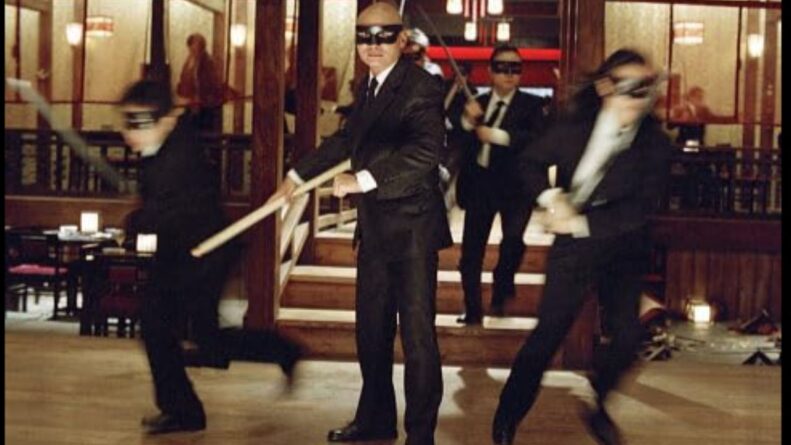
The battle with Gogo Yubari (Chiaki Kuriyama) alters the “schoolgirl” cliché. Gogo is a cruel murderer who uses a ”meteor hammer” (a form of the flying guillotine weapon).
Image Credit: IMDb
The sound here is fastidious; When Gogo, is defeated and lands on a table, the crash has the sound of bowling pins being knocked over quietly layered in – a sonic joke to the violent absurdity.
Lady Snowblood is the spiritual mother of Kill Bill
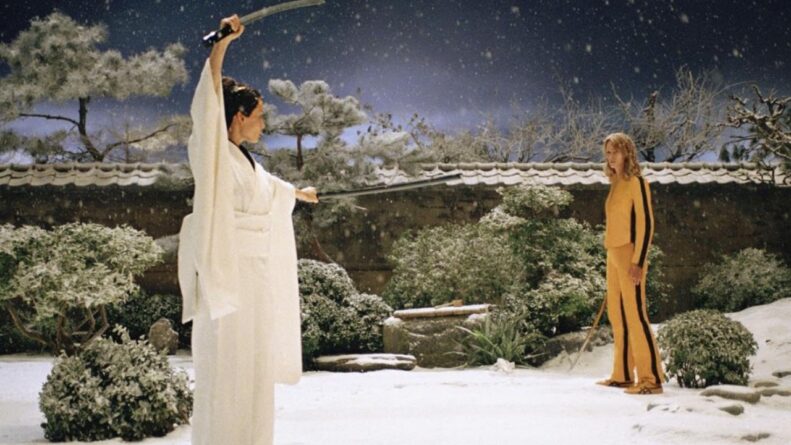
The fight ends with a moment of grisly precision — The Bride cuts off the top of O-Ren’s head. Inversion of a usual decapitation. It exposes O-Ren’s brain, making her vulnerable both literally and figuratively.
“I sincerely apologize for my haste in judgment and for trivializing the circumstances in not knowing the full case.”
Are O-Ren’s final words and a return to the samurai code of honor. It elevates the action from a simple kill to a shared moment of warrior respect.
The death of Budd at the hands of Elle Driver is ironic
Elle brings a Black Mamba snake, The Bride’s codename in Kill Bill vol to kill him. The scene in which she reads trivia about the snake from a notepad
“The amount of venom… can be gargantuan”
Is a moment of dark humor. Elle makes the link between the reptile and the woman, essentially informing Budd that “The Bride” has already killed him, even if she wasn’t physically there.
The Cruel Tutelage of Pai Mei
Gordon Liu, who portrayed Johnny Mo in Volume 1, reprises his role as Pai Mei. This double casting is an homage to Liu’s stature as a martial arts legend, Screenrant mentioned. The lesson is on the “Three-Inch Punch,” a variant of Bruce Lee’s “One-Inch Punch.”
Image Credit: IMDb
This method is the narrative key to The Bride’s escape from the casket. In having so much of the film be taken up with the repeating of this movement. The bloody knuckles and fatigue of The Bride — Tarantino “earns” the improbable act of punching through a coffin lid two-thirds of the way through.
Conclusion
Kill Bill is a celebration of how cinema can consume itself and regenerate. It’s the film about two lovers of movies telling the story with the language of movies. The “legendary moments” discussed here, reveal a level of precision and attention that makes the movie more than just a pastiche.
Watching Kill Bill again is like reading a text that is constantly opening up. It is also a tale of identity, The Bride’s view that identity is mutable (she moves from killer to mother). It is a tale about the “forest” of revenge — A place that has been known to disorient travelers.
Alpana
Articles Published :
156
Alpana is Fandomfans Senior Editor across all genres of entertainment. She evolved in the media industry since a very long time, she manages the content strategy and editing of all the blogs. Her focus on story development, review analysis, and research is well-equipped that ensures every article meets the standards of accuracy and depth.
KPop Demon Hunters animated film is now a top trending on Netflix, listed in the most-watched movies of all time is a big achievement. This turning event of film after becoming a top five in English-language film noted at Cartoonbrewsurprised everyone including the film industry and worldwide audience.
From Quiet Release to Viral Sensation
Interestingly, the film did not really receive much audience on the day it released – 20 June 2025, but now it has become viral. According to data reported by TheWrap, KPop Demon Hunters got 158.8 million views in 90 days on Netflix. The number is huge from the viewers that led this film to list on the number four in most popular films. It slightly passed the big action movies like The Adam Project and Leave the World Behind.
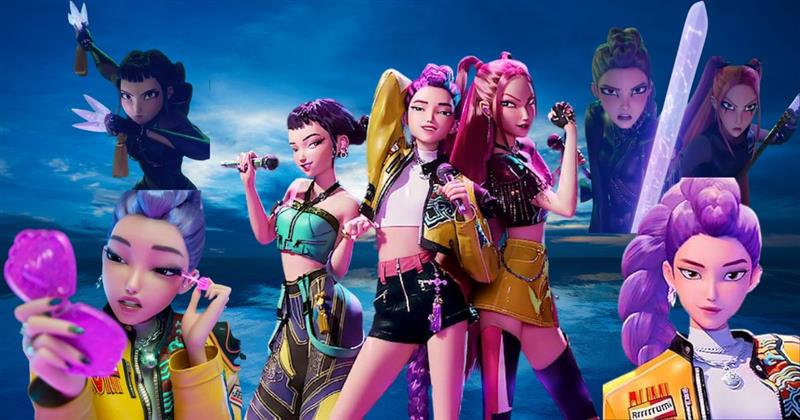
KPop Girl Group HUNTR/X with their Musical Numbers. Credit: Netflix
Consistent Growth in Viewership
Many other Netflix Originals which got massive surge in their first week of air but KPop Demon Hunters has become a consistent on the top films due to its week-over-week growth. The viewership pattern is making a remarkable success for the Sony Pictures Animation & Netflix. As noted by ScreenRant, the number of viewers started to increase from 20M to 25M views in its fifth week on the service that gives it a unique pattern of climbing up the all-time charts.
The film centers on a fictional K-Pop girl group, HUNTR/X, who are also skilled demon hunters. The mix of vibrant action, amazing storytelling, and incredible music are catching the hearts of the audience. According to TheWrap, The soundtrack took an important part in its groundbreaking success, the original song ‘Golden’ got at 1st rank on the Billboard Global Charts.
The film is getting great reviews not only from the audiences but critics also gave 97% rating on Rotten Tomatoes. KPop Demon Hunters seems to further become a No.1 on Netflix from the fourth position because the 90-day tracking period is still left to leave behind Red Notice (230.9 million views), Carry On (172.1 million), and Don’t Look Up (171.4 million). Publications like ScreenRantbelieve it could beat these movies and become the most-watched movie ever on Netflix.
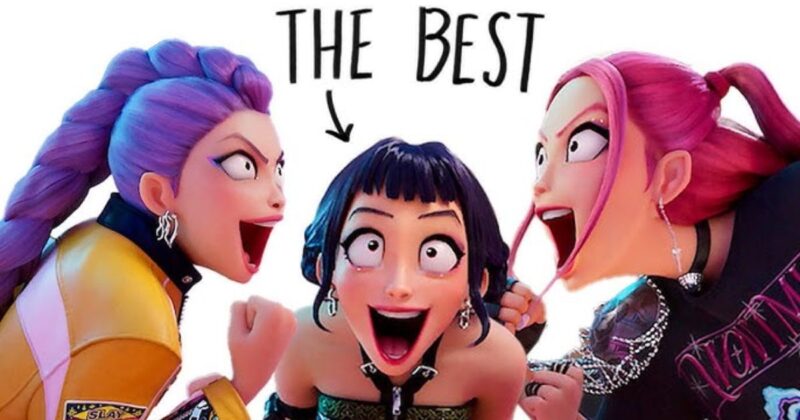
Best Demon Hunters from the KPop Demon Hunter Film, Credit: Youtube
The huge success of the film has led them to make the sequel and spin-off series. This is already happening and reports say that Netflix is considering to remake this in a live-action version. The success of the film has just started, fans are already demanding for its sequels. The story serves a powerful combination of compelling storytelling, fresh concept, and musical numbers.
The KPop Demon Hunters Shocks Netflix Viewers by Breaking Into Top 5 Most-Watched Movies, the number of viewers gave a massive success that led to its remake and spin-offs. The fanbase is increasing day-by-day along with the critics’ reviews. You can watch this animated film on Netflix.
Emma
Articles Published :
36
Emma Miller is an entertainment enthusiast who is focusing on crafting storytelling blogs across all genres. Her special focus is build up around superheroes, thrillers, & historical dramas and movies. Her experience of delivering sharp review analysis and interview podcasts is helping fans to get transparency about their favorite cinema.
Dwayne “The Rock” Johnson is without a doubt high up on the list of the most bankable stars in Hollywood. The Rock has one of the most successful and diverse film careers in recent memory, going from an explosive breakout in action blockbusters to unexpected turns in comedy and family films. Here’s the definitive guide to the Top 32+ movies in which he demonstrates his stunning range as an actor and performer, whether you’ve been a fan for years or are just discovering his catalogue.
The Early Days: Foundation for Stardom
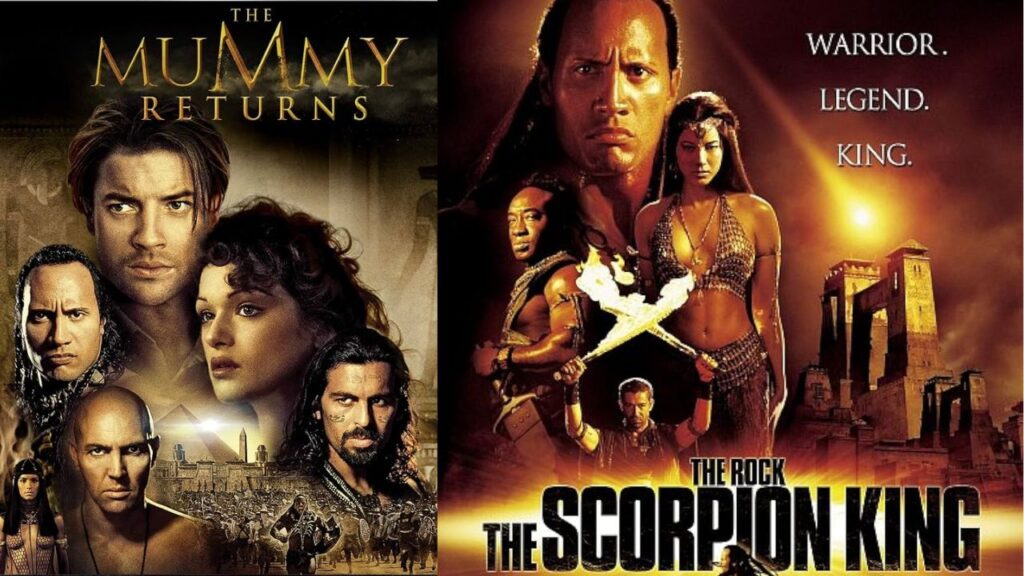
Dwayne Johnson was not a household name when he first got his start in Hollywood. Though his first feature film part was in 1997, in The Mummy Returns (2001)as the Scorpion King, a brief but impactful role that introduced him to mainstream audiences. That moment was pivotal, and then he had his first leading role a mere one year later in The Scorpion King (2002), which solidified him as an action superstar.
The Rock, meanwhile, solidified his status with The Rundown (2003), which remains one of his finest action-comedies. Co-starring with Christopher Walken and an early blend of comedy/action, the film gave Johnson a chance to display his charisma and potential as a leading man. As one of Johnson’s earliest films, The Rundown is a risky gamble, but it really pays off, as he portrays Beck, a taciturn bounty hunter who is sent to apprehend his boss’s son, who has been hunting for treasure in Central America.
Building an Action Empire (2004-2010)
As Johnson found his niche in Hollywood, he was offered an array of different roles.Walking Tall (2004) was the respectable action film of the bunch, and Doom (2005) was the most ambitious albeit least successful adaption of a video game craft so far. The same year saw Johnson donning his comedic flair in Be Cool (2005).
Image Credit: Fandomfans
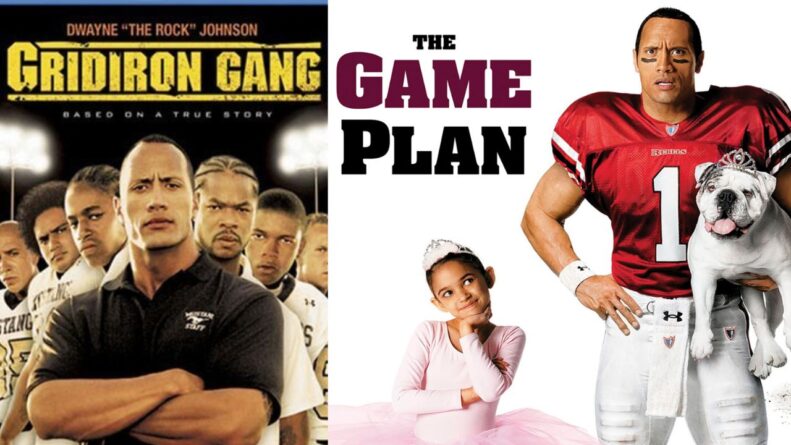
A guy who never limited himself to one genre, Johnson caught people off guard with Gridiron Gang (2006), a dramatic sports film in which he is a rehabilitation counselor employed by a juvenile detention center. This showcased his range as an actor and demonstrated that he could do more than just act in pure action movies. Family audiences started to become aware of him with The Game Plan (2007), while Reno 911!: Miami (2007) proved that he was a tour de force in comedic support roles.
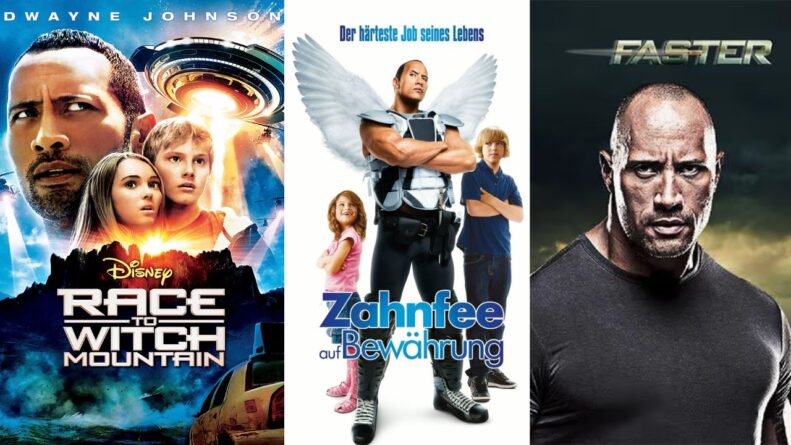
Get Smart (2008) put him opposite Steve Carell in a secret agent-comedy schtick that favored action over humor. He added voice acting to his credits inPlanet 51 (2009) when he provided the voice for astronaut Chuck Baker and Race to Witch Mountain (2009) once again took him to the family movie field. The decade concluded withTooth Fairy (2010), a quirky kids movie that had Johnson actually turning into a tooth fairy. The film was savage but showed a performer ready to make wildly unconventional gambles. The same year, he made a return to his action roots with the more hard-edged thriller, Faster (2010), as a vengeful man.
The Box Office Explosion (2011-2015)
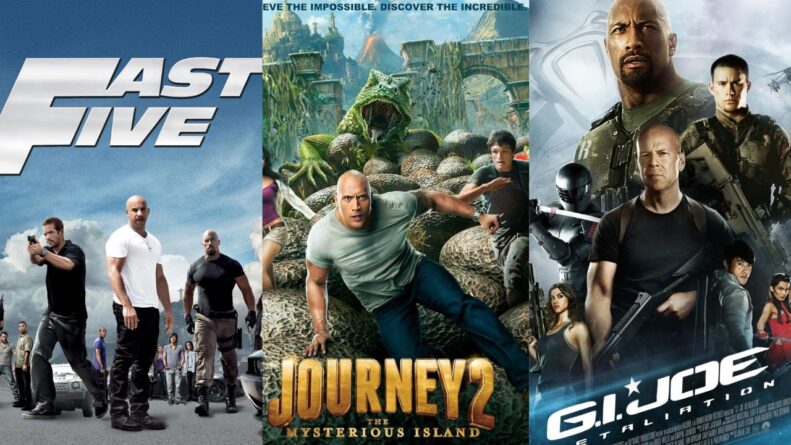
All that changed when Johnson entered the Fast Five (2011) stable as brutal enforcer Luke Hobbs. That’s the turning point that made The Rock a megastar. His chemistry with Vin Diesel and the rest of the cast and crew, as well as the sheer physical comedy and action prowess he brings, revitalized the franchise.
Image Credit: Fandomfans
After this breakthrough, Johnson was more selective about his parts. Journey 2: The Mysterious Island (2012) saw him get into family adventure material, taking on one of the genres with more long term potential. Fast & Furious 6 (2013) continued his momentum in the franchise, and Pain & Gain (2013) afforded him an opportunity to demonstrate his dramatic abilities in a true crime action film with Mark Wahlberg and Anthony Mackie.
Snitch and G.I. Joe: Retaliation were also out in the busy 2013 year. Empire State (2013)gave him the opportunity to extend his menacing presence as an NYPD officer with a vendetta. Hercules (2014) was another turn towards mythological adventure based storytelling, with Johnson playing the Greek demigod as he faces his mythic twelve labors. San Andreas (2015) turned out to be a turning point, demonstrating Johnson could lead a big disaster movie and become a worldwide mega-star who could open films on his own merits.
Furious 7 (2015) cemented his position as the franchise’s biggest earner, grossing over $1.5 billion and containing some of the series’ most memorable action scenes.
The Blockbuster Releases of Dwayne Johnson in 2016-2019
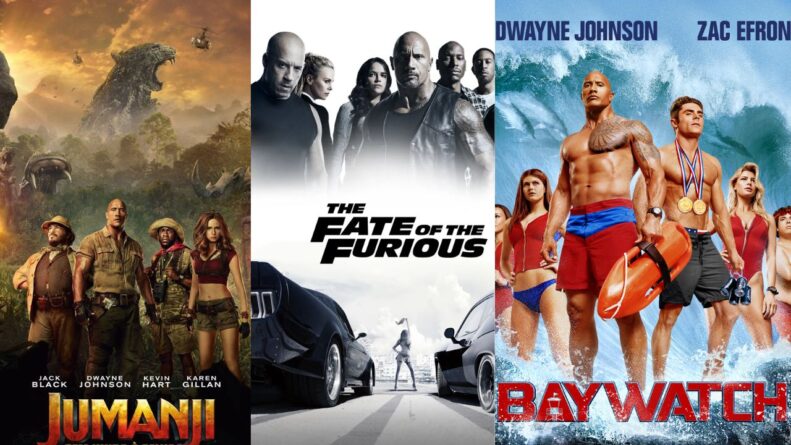
Johnson became one of the highest-grossing box office draws beginning in 2016. He teamed up again with Kevin Hart for the 2016 film Central Intelligence, and their comedic chemistry endured. Johnson made a multi-layered, vulnerable comedic and physical performance in Jumanji: Welcome to the Jungle (2017)a magnificent reboot of the franchise.
image credit: Fandomfans
Also that year was The Fate of the Furious, yet another Fast & Furious installment that brought in more than $1.2 billion globally. Baywatch (2017) was a more frivolous affair, although it was almost universally panned by critics – but audiences turned out to see Johnson in that red lifeguard suit.
Skyscraper (2018) is vulnerable — Johnson playing a lame one-legged FBI agent who has to risk everything to save his family in a burning skyscraper. Rampage (2018) saw him furthering his action dominance with taking on mutants alongside a super-sized ape.
Jumanji: The Next Level (2019) brought back the enchanted game world, plucking players into even more chaotic, wilder adventures, with Johnson offering comedic narration as he pretended to be Danny DeVito as he took over his game avatar. Hobbs & Shaw (2019)gives the fans what they want—Johnson and Jason Statham finally getting their own spin-off, and finally teaming up, giving them a chance to demonstrate their comedy timing as well as their action chops.
Recent Work and Diverse Ventures (2021-2025)
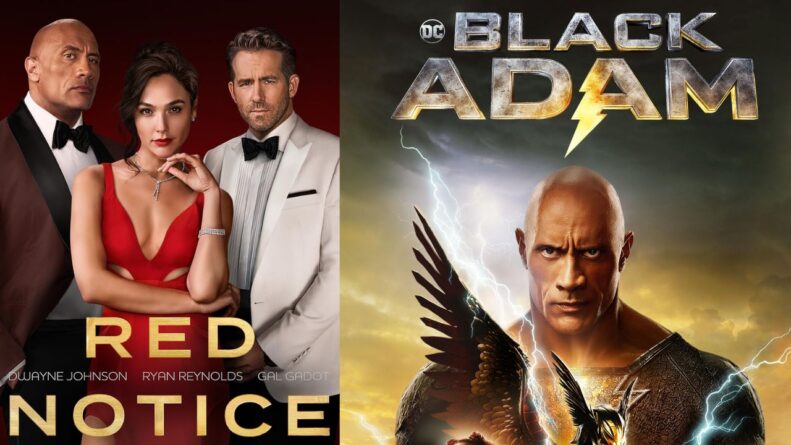
The Rock has also undergone the voice over and producing process. He was in the heist comedy Red Notice (2021), alongside Ryan Reynolds and Gal Gadot. In the Disney adventure Jungle Cruise (2021), Johnson and Emily Blunt are joined by Dwayne Johnson as Frank Wolff, a steamboat captain who agrees to unwillingly escort Dr. Lily Houghton down a perilous river in search of secrets.
Fighting with My Family (2019), about a wrestler’s rise to prominence, showcased his knack for serious supporting roles. He was afforded the chance to lend his voice to Krypto the Super-Dog in DC League of Super-Pets (2022), showcasing his talent to captivate spectators in animated movies. He received a Teen Choice Award for his role as the charming and lovable demigod Maui in the 2016 film Moana.
image credit: Fandomfans
(2022) was his debut foray into DC as the Egyptian mythological anti-hero, unleashing a formidable Kahlid who ascends as the ancient Egyptian magic avatar. This high-profile superhero venture, which was ambitious, had a budget of $250 million and grossed $393 million globally, demonstrating his capacity to lead big studio tentpoles.
What Makes The Rock Different?
A pattern is evident in all these 32+ movies. Johnson’s desire to do comedy and still be believable as an action hero makes him unique among action stars. He’s at ease being vulnerable — be it as a one-legged FBI agent or a demigod struggling with self-doubt. His work ethic and down to earth charm make him have on screen chemistry with all his co-stars and he has done just as well in family films, drama and blockbuster ensemble films.
From doubters questioning his talent as an actor to one of Hollywood’s highest paid stars, Dwayne Johnson’s filmography is a master class on how to have a sustainable career in the business. Whether you’re looking for action excitement, comedy laughs, family fun, or some real dramatic moments, his body of work has a little something for everyone. And that all makes going through his top 32 movies not only entertaining — it’s actually instructive on how to make a Hollywood career with a little authenticity and versatility.
Conclusion
Dwayne Johnson’s bankability and versatility is on full display across these top 32+ movies, proving why he’s one of Hollywood’s most powerful stars. Action packed, heart warm family film, comedy wise The Rock pumps charisma, commitment and authenticity in every role he plays. Not only is his filmography entertaining — it’s an education in how to craft a career that lasts and spans genres in the film industry.
Fandomfansis a platform where you can get your favorite celebrity blockbuster movies, journey details, early life in detail.
Alpana
Articles Published :
156
Alpana is Fandomfans Senior Editor across all genres of entertainment. She evolved in the media industry since a very long time, she manages the content strategy and editing of all the blogs. Her focus on story development, review analysis, and research is well-equipped that ensures every article meets the standards of accuracy and depth.