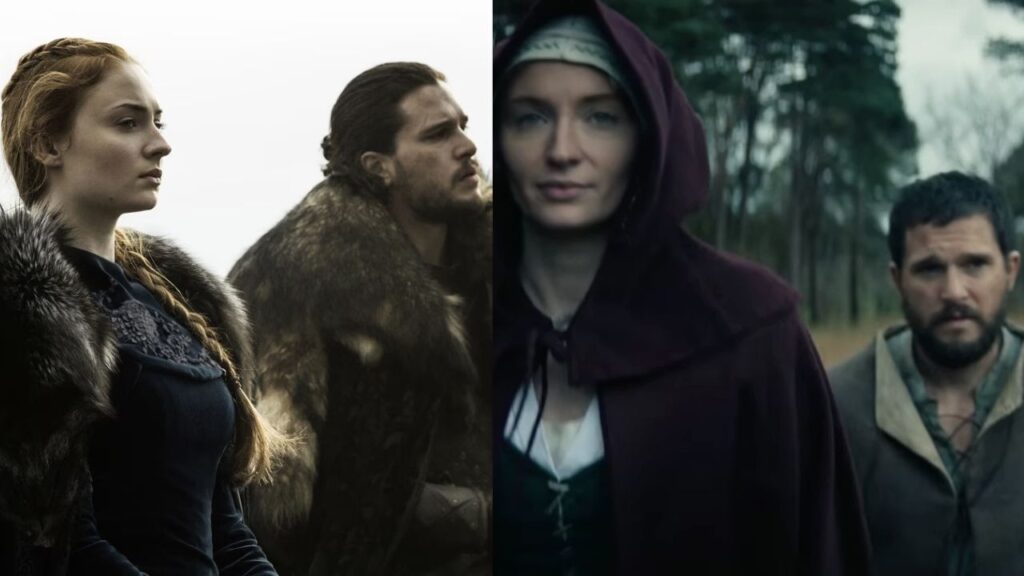
The Dreadful Movie in 2026 has witnessed a resurgence of the Gothic mode, with one of its leading exponents emerging as a project that promises to be as unsettling as it is historic. The Dreadful isn’t your typical horror flick; it’s an elegant meeting point between period drama and supernatural terror. Drawing on the immense cultural capital of its legendary leads, the film plunges into the murkier realms of human survival and moral complexity.
For fans of prestige television, the movie marks a pointed and bold next step for Sophie Turner and Kit Harington. Departing from the sprawling, high-fantasy politics of Westeros, they have swapped iron thrones for the claustrophobic, psychologically crushing domain of “misty forests and crushing dread.” This is a tale in which the mood is as leaden as the secrets its players harbour.
The Vision: From Japanese Masterpieces to English Soil
The metaphysical core of The Dreadful is based upon a wish to orient the themes of classic international cinema in the savage reality of English history. Writer-director Natasha Kermani is inspired by Kaneto Shindō ’s 1964 Japanese cult classic, Onibaba. In the process, she has created a storytelling model around a small, isolated community with its members’ interrelations just as deadly as the supernatural elements hiding in the forest.
This is in keeping with the “folk horror” motif, where the land becomes a sort of other foe. The film, meanwhile, is a groundbreaking achievement for independent horror, combining the art house virtues of auteur-directed filmmaking with the marketing muscle of Lionsgate. With Sophie Turner in the lead role and also producer, there is a definite sense of creative ownership that should keep the “emotional heart” of the film beating from start to finish.
Release Date & Availability
The Dreadful release is positioned to take advantage of the early 2026 market. The Dreadful release date is perfect to capitalize on the late-winter audience that enjoys moody thrillers, and wide-release is scheduled for February 20, 2026.
Territory
Release Date
Primary Platform
Format
United States
20/February/2026
Theaters & Digital
Wide / Day-and-Date
United Kingdom
20/February/2026
Theatrical
Wide (True Brit)
India
Q1 2026
Lionsgate Play
Streaming Premiere
Global Digital
20/February/2026
VOD / Amazon / Apple
Digital Purchase/Rent
A World of Roses and Regret: Genre, Theme & Setting
The Dreadful’s aesthetic is dominated by its 15th-century setting: the Wars of the Roses. This period of English history (1455–1487) was marked by violent civil war between two rival houses, the House of Lancaster and the House of York.
The Wars as a Thematic Catalyst
The Red Rose–White Rose rivalry is more than mere window dressing; it drives the characters to desperate acts. In a world where central authority has disintegrated, people such as Anne and Morwen are abandoning the edges of civilization.
Faction / Element
Historical Basis
Narrative Implication
House of Lancaster
Red Rose Symbolism
Associated with the “war” Anne’s husband attends.
House of York
White Rose Symbolism
Represents the broader political chaos.
Ostracized Living
Outskirts of Society
Heightens the vulnerability of the protagonists.
15th Century
Transition to Tudor Era
A time of deep superstition and radical change.
The Synthesis of Gothic and Folk Horror
From both sides of the conflict, the film adopts elevated perspectives. While the film is Gothic horror at its core—defined by crumbling homes and buried family secrets—it is also very much a work of folk horror. Director Natasha Kermani delves into fear, desire, and regret through a visceral medieval aesthetic. The “English countryside,” with its mud, rain, and cold nights, becomes a character in its own right. The supernatural elements are implied to arise from the land itself, and the “curse” may be read as a projection of the characters’ moral failings.
The Creative Powerhouse: Director & Crew
The Dreadful is, brilliantly, entirely in Natasha Kermani’s hands. Known for pushing genre boundaries in films such as Imitation Girl and Lucky, Kermani applies a layered “Three Keys” approach on set: forming a trusted team, drawing on her short-film experience, and turning to classical texts.
A Collaborative Framework
The production is a partnership between the independent studios Black Magic and Redwire Pictures. Sophie Turner’s role as a producer is particularly vital, signalling a shift toward more equitable power relations among lead performers.
Director / Writer: Natasha Kermani (the visionary behind the film’s transposition of Onibaba) Director of Photography: Julia Swain (capturing the film’s “mud and rain” aesthetic) Editor: Jeff Betancourt (shaping the film’s slow-burn suspense)
The Plot: When Men Walk Like Demons
The story of The Dreadful is a brutal account of survival. We follow Anne (Sophie Turner), who lives in isolation in the countryside with her overbearing mother-in-law, Morwen (Marcia Gay Harden), as she waits for a husband taken by the wars.
This stasis is shattered by the arrival of Jago (Kit Harington), a figure from Anne’s past. He brings news of death while reviving erotic tensions—both sexual and homicidal—that imperil the household. As Jago infiltrates their lives, a “mysterious knight” emerges: the materialization of a curse that feeds on their sin.
Cast & Characters: A Powerhouse Trio
The Dreadful movie cast is small, yet the film’s triumph lies in this tiny ensemble, which somehow carries immense psychological weight.
Sophie Turner as Anne: the film’s emotional heart. Turner portrays a woman whose strength is forged through solitude in a cruel world.
Kit Harington as Jago: a figure of ambiguity. Harington is equal parts puppy-eyed vulnerability and latent darkness.
Marcia Gay Harden as Morwen: the ruthless mother-in-law. She grounds the supernatural in a very real human desperation.
The reunion everyone is talking about
The on-screen reunion of Turner and Harington is the film’s biggest marketing hook. Having portrayed siblings for ten years, their evolution into lovers has been described by the actors as both “weird” and “igniting.” This discomforting tension feeds directly into the movie’s atmosphere of dread, allowing the audience to viscerally sense the boundary-crossing.
Production Prowess: Technical Details
Shot on location amidst the craggy hills of Cornwall, the production embodies environmental naturalism. Cinematographer Julia Swain employs a visual language reminiscent of The Green Knight, emphasizing misty and eerie hues.
The supernatural elements are deliberately restrained, designed to feel earned rather than “cheap.” The film has received an MPA-R rating for “violence, gory images, and sexual references,” a rating crucial to presenting a medieval nightmare without compromise.
The participation of Lionsgate guarantees extensive coverage, with True Brit Entertainment concentrating on the horror legacy of the UK.
What are the fans saying? The response on places like Reddit is electric. Although some are uneasy with the transition from “sibling-to-lover,” it has ignited a viral discussion that goes far beyond horror. Industry Insiders say the film is likely to become a cult hit, a consistent moneymaker that confirms that Natasha Kermani is a force to be reckoned with.
Conclusion
The Dreadful Movie isn’t just a horror movie – it’s a celebration of the Gothic tradition. It asks us to confront the demons that arise from our own histories — all the while cloaked in the lovely, horrifying mists of 15th-century England.
Fandomfans is a platform where you can find all the latest details from movies review, webseries review, and television shows that are worth watching.
Alpana
Articles Published :
156
Alpana is Fandomfans Senior Editor across all genres of entertainment. She evolved in the media industry since a very long time, she manages the content strategy and editing of all the blogs. Her focus on story development, review analysis, and research is well-equipped that ensures every article meets the standards of accuracy and depth.
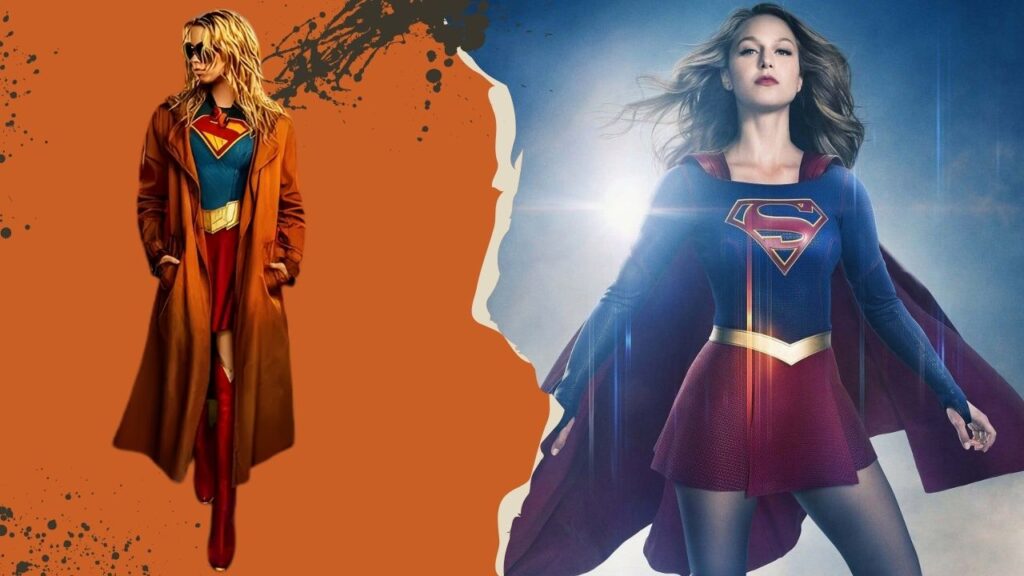
Supergirl’s outfit has never been just an outfit. Costume has been a constant source of identity issues for the character. And still, a debate continues to revolve on social platforms. From Melissa Benoist’s sunny Arrowverse take on the character to Milly Alcock’s gritty DCU debut, Supergirl’s wardrobe has been telling stories long before she’s landed her first blow.
At the heart of the development of Supergirl’s look is not about fashion trends. It is what kind of hero the world needs her to be. And while Benoist’s suit was a symbol of unity and hope, Alcock’s costume is for survival, sorrow, and isolation. Those two creations embody very different approaches to storytelling.
The Arrowverse Supergirl: Dressing the Paragon of Hope
It seemed like there were dark leather suits and gritty realism everywhere when Supergirl premiered in 2015. Costume designer Colleen Atwood had to find a way to take Silver Age idealism and translate it into a contemporary, realistic look without making the character seem cold.
The solution was subtlety. Melissa Benoist’s costume was based more on texture than armor or detailing. The matte Euro-jersey material absorbed rather than reflected light, making the outfit appear soft, friendly and human. ThisSupergirl was supposed to be inspiring, not frightening. Strength was there, but never aggressive.
Image Credit: Fandomfans
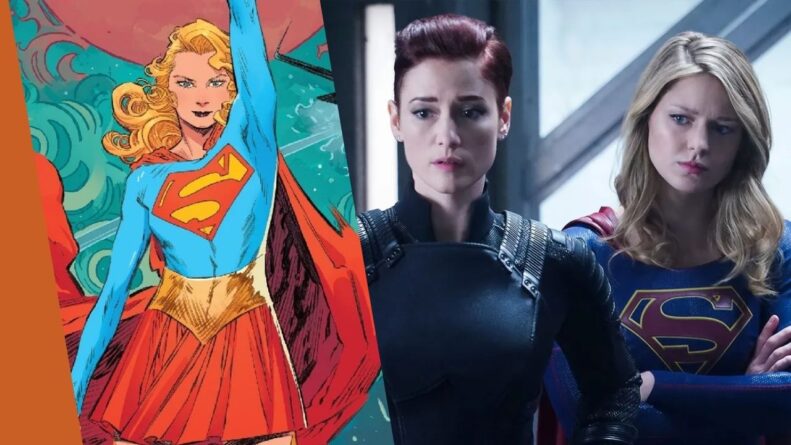
Arguably the most conscious decision was the omission of the notorious midriff costume that the character sported in the comics. The high neckline, long sleeves and thumb holes suggested function over fashion. Kara was portrayed as a hard-working, active hero — not a pinup. Even the thumb holes brought an “activewear” feel, making the suit more about function than fantasy.
The Skirt Debate
For the first four seasons, the red pleated skirt was a staple of Benoist’s Supergirl. In part, it paid tribute to the character’s comic legacy and suggested that femininity and strength could co-exist. She was able to save the city, but do so while being joyous and kind and emotionally open.
But the skirt was also contentious. Critics said that it infantilized the character, comparing it to a cheerleader uniform rather than armor for battle. Yet the show leaned into this tension. That skirt sent a message: Supergirl wasn’t required to ditch the traditionally feminine signifiers to be capable. Her sunny disposition wasn’t a vulnerability — it was her superpower.
Reality Steps In: The Pants Era
The biggest change was in , when the character started wearing full length pants instead of the skirt. Though it was presented as maturing character-development, the change was due more so to production needs. Shooting in Vancouver’s brutal weather, the original suit was an ordeal for Benoist.
Image Credit: Fandomfans
The new suit highlighted unity and protection. The elongated blue body, attached boots, and solid gold belt gave the outfit a more armored, technological look. It was sensible, but it also watered down the immediately recognizable outline Supergirl has. It was practical—but it also diluted the instantly recognizable Supergirl silhouette.
Benoist’s Supergirl remained, above all else, an icon. Her costume was sleek, luminous and aspirational, customized to comfort both viewers and the world she saved.
The DCU Supergirl: Armor for a Broken Survivor
Milly Alcock’s Supergirl finds itself in a vastly different world. Kara is no longer defined by being integrated or hopeful under James Gunn’s DCU. She’s defined by loss.
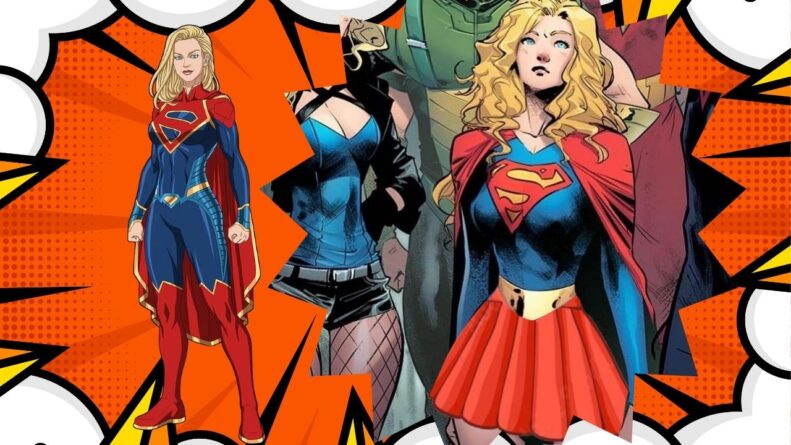
Born amongst the remnants of Krypton and seeing all she loved perish, this Supergirl is not a light—she is a survivor. Her costume reflects that reality. Taking inspiration from Supergirl: Woman of Tomorrow, the costume dispenses with sleek minimalism and introduces layered textures, metallic weaves and visual weight. This is not clothing. It is armor.
The largest visual change is the House of El symbol. The Kingdom Come diagonal slash that has traditionally been a sign of disenchantment is now part of Alcock’s crest. The elimination of yellow is vital. Yellow is warmth, sunlight and positive feeling. It’s gone to indicate mourning. She bears the name of the family, but not its innocence.
The Return of the Skirt—Reclaimed
In a surprising about-face, the DCU reintroduces the skirt. But this is not the CW’s smiling cowlick of cheer. It’s heavier, more structured, and worn with thigh-high boots. The skirt on this occasion is cultural, not cute — a claim that femininity doesn’t need justification.
Image Credit: Fandomfans
In contrast to the earlier debates, Alcock’s Supergirl is not depicted as trying to be “approachable” by putting on the skirt. She vents it because she doesn’t give a damn what people think about it. Her toughness is unquestionable.
Space Grunge and the Drifter Myth
Maybe the most revealing aspect of Alcock’s visual design is what she wears on top of the suit. The oversized trench, combat boots and sunglasses make her a cosmic drifter. This Supergirl hides herself from the world, cloaking trauma in layers.
The contrast is deliberate: under the tattered, dirty shell is the regalia of a bygone culture. It is visual storytelling at its most efficient.
Conclusion
The shift from Arrowverse to DCU is a game changer for the genre in and of itself. Supergirl isn’t just a beacon of hope anymore. She was evidence that hope could exist after ruin.
Melissa Benoist’s Arrowverse suit was a beacon of hope, warmth, and community, making Supergirl someone to look up to. Millie Alcock’s DCU design, however, is armor – forged through loss, survival, and emotional wounds. All of these identities give us a visual representation of Supergirl’s arc from a bright emblem of hope to a profoundly human survivor, reminding us that what a hero wears can tell the tale of who they are—and what they’ve been through.
Catch up on the DC universe costumes revolution with facts and accurate details theory behind the symbol with Fandomfans.
Alpana
Articles Published :
156
Alpana is Fandomfans Senior Editor across all genres of entertainment. She evolved in the media industry since a very long time, she manages the content strategy and editing of all the blogs. Her focus on story development, review analysis, and research is well-equipped that ensures every article meets the standards of accuracy and depth.
You Shouldn’t Miss To Rewatch ‘Kill Bill’ Because of These Legendary Moments
Rewatch 'Kill Bill' to rediscover the iconic fights, hidden details and cinematic homages that shaped Tarantino's masterpiece. Explore the moments. Learn more!
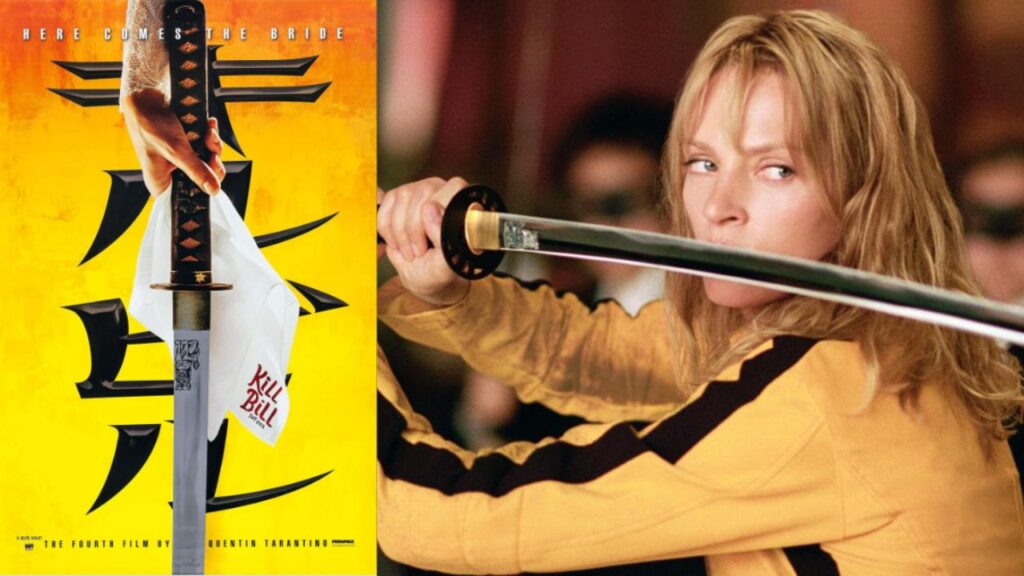
Among the records of 21st-century film, very few works can claim the unparalleled position held by Kill Bill Vol. Ostensibly a revenge thriller, the film functions less as a story and more as a spirited look back at film history: a “curated museum” whose high art and exploitation cinema boundaries dissolve.
Seeing a film like Kill Bill is to see a dervish at work—homing in on a “roaring rampage of revenge” to examine how genre works, the aesthetics of violence, and the lasting power of the screen image. If volume 1 is a blistering tribute to Eastern cinema (wuxia, samurai chanbara, and anime), volume 2 makes a sudden shift to the West, adopting the dry tempos of the Spaghetti Western.
This article unpacks the minuscule details — from cereal brands to philosophical monologues which elevate Kill Bill from a film to a masterpiece.
The Genesis: From “Q & U” to the Silver Screen
Image Credit: IMDb
Tarantino and Thurman conceived “The Bride” in casual conversations while life mimicked art in the six years it took to write. When Thurman got pregnant before shooting, Tarantino delayed production instead of recasting, saying,
“If Josef Von Sternberg is planning to make Morocco and Marlene Dietrich gets pregnant, he waits for Dietrich!”
It indicates the character Bride is not just a simple role but a specifically designed around Thurman’s physicality.
Casting Counterfactuals
The movie might have been very different. The part of Bill was first written for Warren Beatty, as a suave, Bond-villain kind of guy. When David Carradine was cast, the character shifted to a tough martial arts icon, drawing on Carradine’s background as the lead of Kung Fu, which originally aired in the early 1970s.
Character
Actor Cast
Original Choice
Impact of Change
Bill
David Carradine
Warren Beatty / Bruce Willis
Shifted Bill from a suave suit to a rugged, flute-playing martial arts legend.
O-Ren
Lucy Liu
Generic Japanese Actress
Rewritten as Chinese-Japanese-American to accommodate Liu, adding racial tension to her Yakuza rise.
Budd
Michael Madsen
Robert Patrick
Madsen’s weary persona perfectly suited the “loser” brother living in a trailer.
Johnny Mo
Gordon Liu
Michael Madsen
Gordon Liu (he is a Shaw Brothers legend) was given the opportunity to take on two roles (Johnny Mo and Pai Mei), connecting the two volumes.
Revenge is a Dish Best Served Cold
Bloodied, terrified, and immobilized, The Bride has a stark black-and-white close-up of her face. This decision to film the slaughter aftermath in black and white has several reasons. While this is mostly justified as an homage to 70s TV censorship of kung fu movies, it is also an aesthetic choice. It creates a detachment, and the violence is transformed into nightmarish and abstract rather than realistic.
Image Credit: IMDb
The needle drop of Nancy Sinatra’s “Bang Bang (My Baby Shot Me Down)” is among the most iconic musical cues in cinema history. The song is also used as a literal narration:
“Bang bang, he shot me down… bang bang, that awful sound.”
The sad tremolo guitar establishes a mood of tragic inexorability. Instead of a regular action flick beginning with high-octane stunts, Kill Bill begins with failure and grief, laying out the emotional deficit The Bride needs to replenish with vengeance.
The Bride is creating her own future nemesis
The battle concludes at the death of Vernita Boreas, observed by her four-year-old daughter, Nikki. The Bride’s line here is an important one:
“It was not intentional and for that I am sorry. But you can take my word for it, your momma had it comin.”
Then she provides the child with a future means for vendetta: “When you get a little older, if you still feel raw about it, I’ll be waiting”.This is at least an acknowledgement that revenge is cyclical.
The “sniper shot,” as O-Ren kills a politician, is a highlight in visual storytelling. The space, the quiet, the abrupt violence all serve to define O-Ren as an emotionally cold, remote character. The return to live action O-Ren’s single tear, bridges the stylized animated trauma and the real life villain The Bride will take on.
The Brides Blue Leaves Disguise
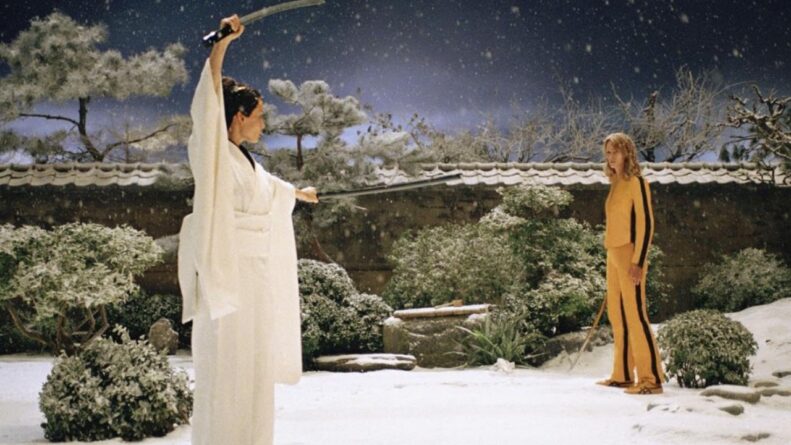
The Bride’s yellow tracksuit with black stripes is the film’s most obvious visual nod, an homage to Bruce Lee’s outfit in Game of Death (1978). This wardrobe choice places The Bride among the martial arts greats. But she is armed with a katana, so that visually she blends the Chinese kung fu tradition with the Japanese samurai tradition.
Gogo Yubari and the Meteor Hammer
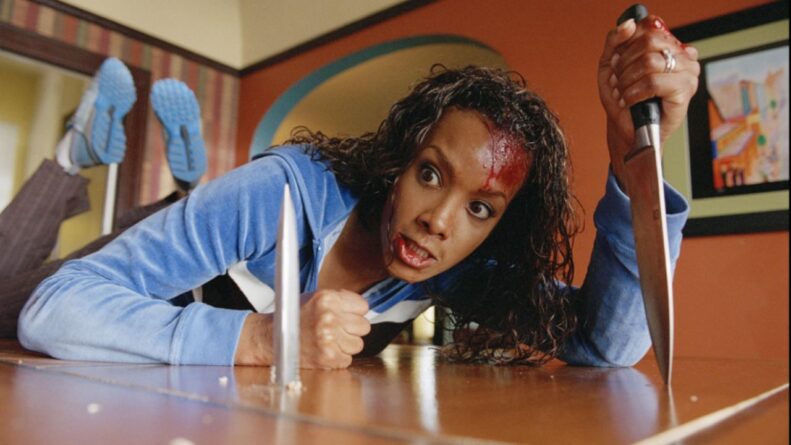
The battle with Gogo Yubari (Chiaki Kuriyama) alters the “schoolgirl” cliché. Gogo is a cruel murderer who uses a ”meteor hammer” (a form of the flying guillotine weapon).
Image Credit: IMDb
The sound here is fastidious; When Gogo, is defeated and lands on a table, the crash has the sound of bowling pins being knocked over quietly layered in – a sonic joke to the violent absurdity.
Lady Snowblood is the spiritual mother of Kill Bill
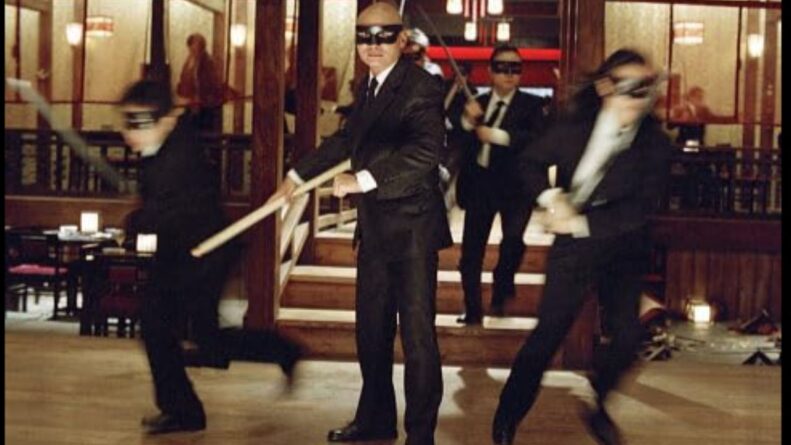
The fight ends with a moment of grisly precision — The Bride cuts off the top of O-Ren’s head. Inversion of a usual decapitation. It exposes O-Ren’s brain, making her vulnerable both literally and figuratively.
“I sincerely apologize for my haste in judgment and for trivializing the circumstances in not knowing the full case.”
Are O-Ren’s final words and a return to the samurai code of honor. It elevates the action from a simple kill to a shared moment of warrior respect.
The death of Budd at the hands of Elle Driver is ironic
Elle brings a Black Mamba snake, The Bride’s codename in Kill Bill vol to kill him. The scene in which she reads trivia about the snake from a notepad
“The amount of venom… can be gargantuan”
Is a moment of dark humor. Elle makes the link between the reptile and the woman, essentially informing Budd that “The Bride” has already killed him, even if she wasn’t physically there.
The Cruel Tutelage of Pai Mei
Gordon Liu, who portrayed Johnny Mo in Volume 1, reprises his role as Pai Mei. This double casting is an homage to Liu’s stature as a martial arts legend, Screenrant mentioned. The lesson is on the “Three-Inch Punch,” a variant of Bruce Lee’s “One-Inch Punch.”
Image Credit: IMDb
This method is the narrative key to The Bride’s escape from the casket. In having so much of the film be taken up with the repeating of this movement. The bloody knuckles and fatigue of The Bride — Tarantino “earns” the improbable act of punching through a coffin lid two-thirds of the way through.
Conclusion
Kill Bill is a celebration of how cinema can consume itself and regenerate. It’s the film about two lovers of movies telling the story with the language of movies. The “legendary moments” discussed here, reveal a level of precision and attention that makes the movie more than just a pastiche.
Watching Kill Bill again is like reading a text that is constantly opening up. It is also a tale of identity, The Bride’s view that identity is mutable (she moves from killer to mother). It is a tale about the “forest” of revenge — A place that has been known to disorient travelers.
Alpana
Articles Published :
156
Alpana is Fandomfans Senior Editor across all genres of entertainment. She evolved in the media industry since a very long time, she manages the content strategy and editing of all the blogs. Her focus on story development, review analysis, and research is well-equipped that ensures every article meets the standards of accuracy and depth.